Vaginal Discharge Color and What It Indicates
Discharge color combined with texture and smell reveals what's actually happening inside your body.

Vaginal discharge color tells you something specific about what's happening inside the reproductive tract. It comes from glands in the vagina and cervix, and its job is to clear out old cells, keep tissue moist, and fight off invading organisms. When something shifts internally, color and smell shift with it, and knowing where normal ends is what actually gets someone to the right treatment instead of the wrong box off a pharmacy shelf.
Start with the ecosystem itself. About 90% of the microorganisms in a healthy vagina are Lactobacillus species, and their job is to produce lactic acid and hold the pH between approximately 3.5 and 4.5. That acidity is active defense: most pathogens can't survive in it. Daily discharge volume runs between 1.6 and 4.8 grams, roughly a quarter to a full tablespoon, and going well outside that range without an obvious hormonal reason signals a need for a second look.
Douching is among the more disruptive things on the list, and it's worth naming directly rather than lumping in with a handful of equally-weighted culprits. Antibiotics, certain contraceptives, and other factors can also affect the vaginal environment, changing how discharge looks and smells even with zero pathogen involved. None of this guarantees an infection is coming. But color by itself never tells the whole story, and every person's baseline sits a little differently and moves throughout the cycle. The actual skill here is knowing your own pattern well enough to catch the moment it breaks from itself. It's knowing your own pattern well enough to catch the moment it breaks from itself.
Discharge changes across the menstrual cycle and life stages
Discharge follows a fairly predictable arc across a 28-day cycle, assuming that's the length someone is working with.
Days 1 through 5 bring red, bloody discharge as the uterine lining sheds: the period itself. From roughly day 6 through day 12, discharge tapers off, often turning cloudy, white, or pale yellow, sometimes sticky as an egg develops. Around days 13 to 15, near ovulation, it turns thin, slippery, and stretchy, the egg-white consistency that helps sperm travel through the cervix. That texture is mechanical: the fluid thins specifically to let sperm move through, and it's recognizable enough that cycle-tracking apps flag it as its own distinct phase. From day 16 through 28, discharge thickens, then lightens back toward white or slightly yellow, and the cycle resets.
Life stage changes the picture further. Before puberty, vaginal pH runs neutral to alkaline, and Lactobacillus appears only occasionally in the vagina rather than dominating the way it does afterward. Pregnancy tends to increase the volume of clear or white discharge, sometimes noticeably. Menopause pushes the opposite direction: declining estrogen thins the Lactobacillus population, pH climbs, dryness increases, and susceptibility to infection goes up right along with it. Hormonal birth control resets someone's baseline too, which matters if today's discharge is getting compared to a memory from before the pill, patch, or ring started.
None of this is the warning system. It's the background hum the warning system gets measured against, and everything that follows is a deviation from this normal noise, not a replacement for knowing it.
Clear and white discharge: when white becomes a warning
Clear or milky white discharge is the baseline of a healthy vagina. It's usually odorless or close to it, and texture ranges from watery to slightly sticky depending on where someone sits in the cycle. The egg-white variety around ovulation, thin, stretchy, nearly see-through, fits squarely into this category. It looks strange the first time anyone notices it, but it's a fertility signal, not a symptom.
White discharge turns into a different story once texture and smell change alongside it. Thick, lumpy, cottage-cheese consistency with little or no odor is the classic sign of a yeast infection (vulvovaginal candidiasis, clinically). Thin white or gray discharge with a distinct fishy smell points somewhere else entirely: bacterial vaginosis, not yeast, despite how often the two get treated as interchangeable. White discharge paired with intense itching, burning, or swelling rounds out the yeast symptom cluster.
Color alone never carries the full signal, and treating it like it does is how the wrong medication ends up in someone's cart. Grabbing an over-the-counter antifungal without a confirmed diagnosis can delay real treatment if the actual cause is BV or an STI, since neither responds to antifungal medication. Texture and smell have to get read alongside color, every time, or the guesswork just moves from the color chart to the pharmacy aisle.
Yellow discharge: reading the shade and accompanying symptoms
Light yellow discharge with no other symptoms is often completely normal. Diet changes, certain supplements, and discharge simply drying on underwear in the days after ovulation can all produce a faint yellow tint on their own, no infection required.
Yellow becomes something to watch when other symptoms show up alongside it, including a new or unpleasant odor, a brighter or greenish-yellow shade, a thick or frothy or pus-like texture, pelvic pain or fever or urinary symptoms, and bleeding between periods.
There's a reason to take yellow discharge seriously even without dramatic symptoms attached. Chlamydia usually causes no symptoms at all, with 50% to 70% of people who have it never noticing anything. When symptoms do show, yellow discharge is among the most common. Gonorrhea produces a similar yellow or greenish discharge, sometimes with visible pus. Trichomoniasis, in the roughly 30% of cases where it does cause symptoms, produces thin or frothy discharge ranging from white to yellow to greenish.
So the practical rule holds up simply enough: anyone sexually active who notices yellow discharge alongside any of the warning signs above should get tested. Waiting around assuming it's diet or hormones is the wrong bet more often than people think.
Green and gray discharge: the colors that consistently signal infection
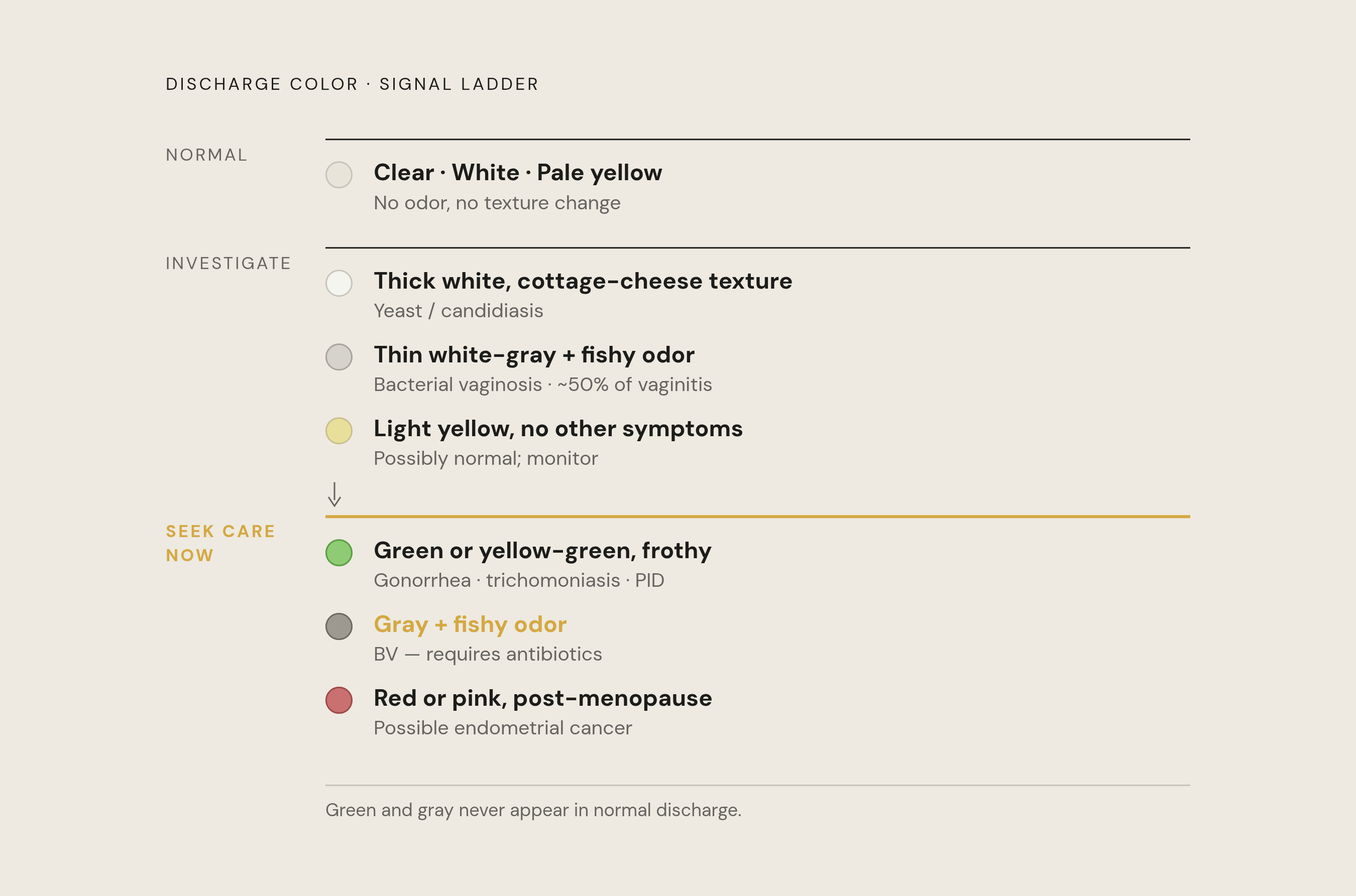
Green discharge doesn't happen at any healthy phase of the cycle. It isn't part of the normal background noise described above, which makes it one of the more reliable signals that something bacterial or sexually transmitted is underway.
Gonorrhea often produces yellow or greenish discharge, sometimes with a foul odor and visible pus. Left untreated, it can progress to pelvic inflammatory disease, and PID carries a real risk of infertility. PID itself can also cause green discharge directly, usually alongside pelvic pain, fever, and irregular periods, and that combination needs medical attention without delay. Chlamydia can cause yellow, white, or gray discharge, though only a smaller share of cases produce any symptoms. Frothy, greenish-yellow discharge should raise the possibility of trichomoniasis too, even though roughly 70% of people carrying it show no symptoms whatsoever. Any green discharge that comes with fever or pelvic pain counts as urgent, not something to wait out over a weekend.
Gray discharge is the hallmark of bacterial vaginosis, the single most common cause of abnormal discharge, responsible for roughly half of all vaginitis cases. The mechanism is the same disruption described earlier: Lactobacillus loses dominance, pH climbs above 4.5, and anaerobic organisms, including Gardnerella species, move in and take over. What results is typically thin discharge with a fishy odor, often more noticeable after sex, sometimes with mild itching or burning riding along. Between 50% and 70% of people with BV name the odor itself as the main complaint, rather than discharge volume or color.
Treatment is antibiotics, usually metronidazole or clindamycin. Single-dose regimens carry lower cure rates than longer courses, and recurrence stays a well-documented problem even after treatment works the first time. Neither green nor gray discharge clears up on its own. Waiting it out isn't a strategy so much as a delay with a cost attached to it.
Pink, red, and brown discharge: blood in different stages of oxidation
Blood changes color as it ages, and that fact explains almost this entire category on its own.
Brown discharge is old blood that's had time to oxidize, and the longer it sits before leaving the body, the darker it gets. That makes it common and generally harmless at the very start or end of a period, when flow slows down and blood has more time to darken before it exits. It can also be leftover blood from a prior cycle or a side effect of hormonal birth control. Brown discharge outside those contexts, particularly mid-cycle or after menopause, deserves a clinical look rather than a shrug.
Pink discharge is a small amount of fresh blood mixed into regular discharge. Common, low-concern causes include spotting just before a period starts, implantation bleeding in early pregnancy, minor irritation from sex, or a brief appearance right after ovulation. Persistent or unexplained pink discharge between periods is worth a call to a provider, even when it seems minor enough to shrug off.
Red discharge during the period needs no explanation. Between periods, it's a different animal: benign causes exist, including polyps, fibroids, or hormonal fluctuation, but more serious causes exist too, and color alone can't sort one from the other. Anyone postmenopausal who notices any red or pink discharge should call a doctor promptly, since it can be an early sign of endometrial cancer.
Timing is the real variable running through this whole category, more than the color itself. Where someone sits in the cycle, or which life stage they're in, changes what a given shade of red or brown actually means.
Why the three most common infections are frequently missed or mistreated
Bacterial vaginosis, yeast infections, and trichomoniasis together account for the overwhelming majority of abnormal discharge complaints, and all three get confused for each other constantly. That raises a fair question: why does something this common stay this hard to diagnose correctly, even for the person living inside the symptoms?
Yeast gets self-diagnosed more than anything else on this list, and it's also the one where self-diagnosis goes wrong the most. Up to 75% of women experience vulvovaginal candidiasis at least once, and the symptoms (thick white cottage-cheese discharge with itching and burning) sound distinctive enough on paper. But they overlap with BV and trichomoniasis just enough that plenty of people reach for the wrong treatment first. When the diagnosis lands correctly, treatment works well: CDC STI treatment guidelines note that short-course topical azoles or oral fluconazole cure 80% to 90% of cases.
BV is the bigger trap of the three, precisely because it gets treated like yeast so often. That mistake leaves the actual infection running while the wrong cream sits in someone's medicine cabinet doing nothing. BV accounts for roughly half of abnormal discharge cases and affects around 30% of women annually, with recurrence a frequent problem even after treatment succeeds the first time. Its gray color and fishy odor are distinctive once someone knows to look for them, and that's exactly the gap: most people don't know to look for them, because nobody told them gray and white aren't the same signal.
Trichomoniasis compounds the confusion further. Roughly 70% of infected people carry no symptoms. When symptoms do appear, frothy, colored, faintly unpleasant, they mimic BV or yeast closely enough that self-diagnosis becomes close to a coin flip.
Clinical data show this isn't just a home-treatment problem either. A study covering 429 women in northern Taiwan between March 2019 and June 2022 found that 55.2% of empirical antifungal and metronidazole prescriptions were either ineffective or unnecessary. That figure comes from inside clinical settings. Pair that with how often chlamydia and trichomoniasis cause zero symptoms, and discharge color becomes, in a real number of cases, the only visible clue that something has gone wrong.
The symptoms that should always prompt clinical contact, regardless of discharge color
Some symptoms outrank whatever color they show up with. Contact a provider if discharge comes with any of the following: itching, burning, or irritation in or around the vagina; a foul or fishy odor, especially if it's new; a frothy or cottage-cheese texture; pelvic or lower abdominal pain; fever or chills; pain during urination or sex; bleeding between periods or after sex.
Certain colors carry their own standing rule too, independent of anything else going on. Gray discharge always warrants a visit, since BV needs antibiotics to clear, not time. Green discharge does too, given how consistently it points to a bacterial or sexually transmitted cause. Red or pink discharge outside expected period timing deserves a call, and any bleeding at all after menopause should prompt one right away, not next week.
Recent sexual activity with a new or multiple partners, paired with yellow discharge, is reason enough to get tested on its own, even with zero pain, odor, or itching in the picture. Given how often chlamydia and trichomoniasis cause no symptoms at all, that discharge might be the only signal available.
Routine gynecologic care, the annual well-woman visit, catches a large share of these infections precisely because they cause no symptoms. Treat that visit as baseline maintenance rather than something reserved for when things already feel wrong. When something does need attention, providers move faster if given specific details: the start date of the color change, its timing relative to the cycle, any recent antibiotics or new medications, recent sexual activity, and whether odor, texture, or pain accompany it.
How diagnosis works and where telehealth fits in the care pathway
Formal diagnosis usually starts with a clinical history and pelvic exam, followed by a vaginal pH measurement and microscopic examination of a discharge sample. Lab testing for trichomoniasis and other STIs rounds it out, following the IUSTI/WHO 2023 guidelines. In resource-limited settings where lab diagnosis isn't available, providers often lean on syndromic case management instead: standardized algorithms that match symptom clusters to likely causes. Describing symptoms with precision matters for that reason. The algorithm is only as good as the description feeding it.
Access is a real barrier for plenty of people, not a minor inconvenience. BV alone affects around 30% of women every year, and many of them face real obstacles getting to in-person care, whether that's cost, distance, scheduling, or the plain discomfort of talking about it face to face. Telehealth addresses several of those barriers at once. Asynchronous, message-based consultation works well for most first-pass discharge concerns, provided there's no fever, severe pelvic pain, or other sign of acute infection that calls for a physical exam. A clinician reviewing the case remotely can triage it, order lab work, or prescribe treatment without an office visit ever entering the picture.
AI-assisted tools are showing up in this space too, generally used to support pattern recognition rather than replace clinical judgment. Any platform built responsibly pairs that kind of AI assessment with review from a licensed clinician before a treatment plan goes out the door. As a practical rule, telehealth makes sense as the first step for a new or changing discharge color without acute symptoms attached. In-person care becomes the right call the moment pelvic pain, fever, or the possibility of PID enters the picture, no exceptions.
Reading discharge accurately, color and texture and smell and timing together, means walking into that first conversation, in person or over telehealth, with enough precision to get the right test ordered on the first try. It's about walking into that first conversation, in person or over telehealth, with enough precision to get the right test ordered on the first try.