Telehealth Dermatology Platforms That Layer AI Triage Under Clinician Sign-Off
AI screens skin images while clinicians retain diagnostic authority and patient accountability.
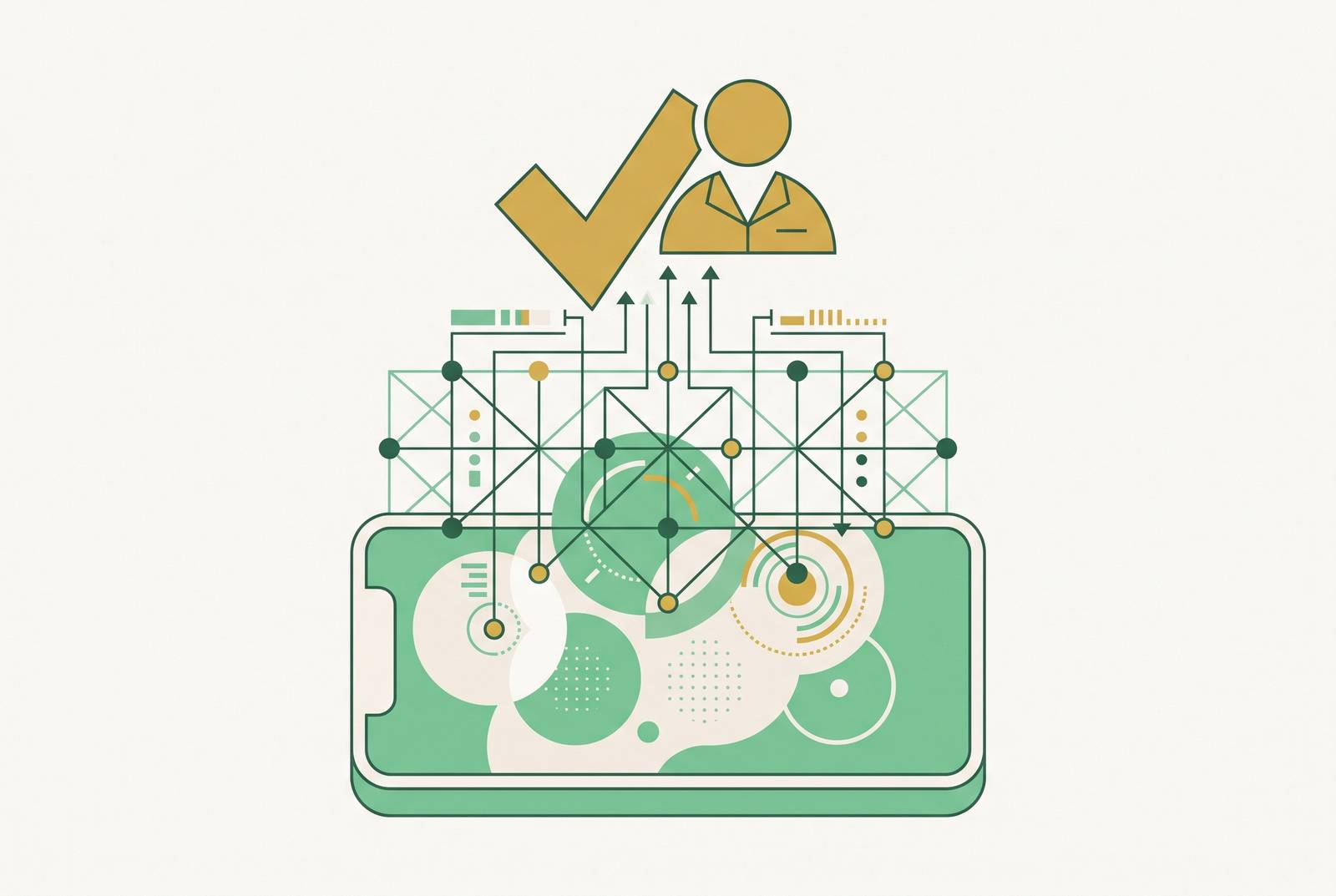
AI-assisted teledermatology with mandatory clinician sign-off means AI screens images and organizes findings, but a licensed clinician reviews them before a diagnosis or treatment plan reaches the patient. The key distinction is between AI helping decide who needs care and a clinician deciding what care to provide. Platforms that allow autonomous AI discharge follow a related model, but they do not provide individual clinician sign-off on every case.
Why telehealth dermatology has a specialist access problem that a single technology cannot fix
The EADV Congress 2026 study describes a sharp mismatch in UK dermatology access. Urgent suspected skin cancer referrals have more than doubled since 2009, while roughly one in four dermatologist roles remains unfilled. Only about 6% of those referrals prove to be true urgent skin cancers. Sorting the referrals is itself a substantial workload. Patients in underserved areas and those who need a specialist to review their case early suffer most when that sorting takes too long.
With telehealth without triage support, specialists still have to review the cases that come in, and AI cannot take the responsibility that a licensed clinician must bear for each patient’s diagnosis and treatment plan. Google DeepMind and Google Research’s paper, “Towards physician-centered oversight of conversational diagnostic AI,” frames these as safety-critical, regulated activities. The two-stage approach divides the work accordingly, using AI to organize demand while leaving clinical judgment with a licensed professional.
How the two-stage pipeline works — image intake, AI risk classification, then clinician review
The process starts with images and context. Patients send smartphone photographs and, when needed, dermoscopic images through a secure portal, along with answers to structured clinical questions. AI then classifies the images into risk categories, including low-risk or benign findings and high-risk findings. A reviewing clinician uses those findings to decide whether a case needs discharge, an in-person appointment, or surgical referral. Cases unsuitable for the AI-assisted pathway move to face-to-face care instead.
The DERM deployment illustrates this routing clearly. The study evaluated its use across two NHS hospital sites over 16 months and presented the findings at EADV Congress 2026. Clinicians reviewed the high-risk images that AI flagged, but low-risk cases could also leave the pathway through autonomous AI discharge with safety-netting advice. At the first site, that route handled 31% of urgent suspected cancer referrals. This is an important boundary in the example, because autonomous discharge is not mandatory individual clinician sign-off.
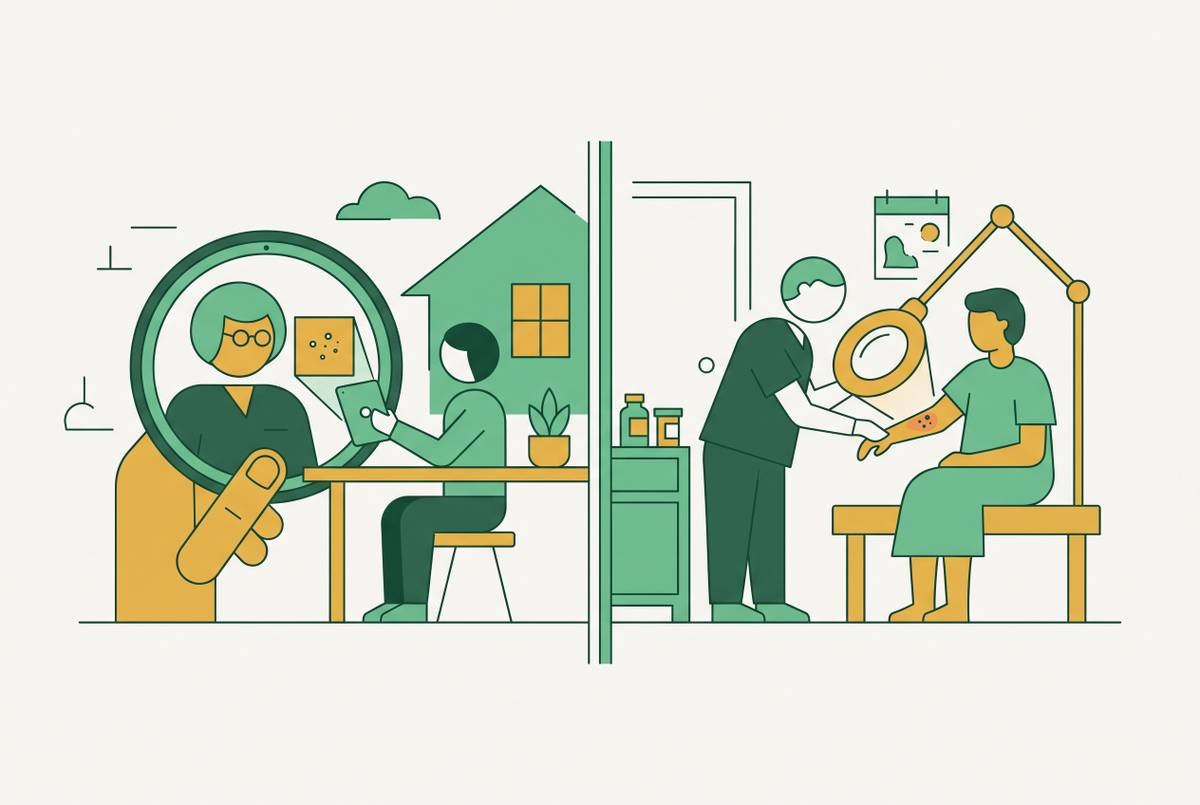
At Bridge Dermatology in the U.S., structured intake lets patients or referring clinicians send information and high-resolution images through a secure portal on desktop or mobile. Intake and review need not happen together. In an asynchronous service, dermatologists can review cases in groups without needing an appointment slot for each one. The g-AMIE paper formalizes a related design in which AI gathers information and prepares a structured case summary for later physician review. That framework helps explain the division of labor, although conversational intake and image classification are different tasks.
What the AI layer actually does — and what it cannot do
Image models classify visual patterns but cannot take clinical responsibility. Convolutional neural networks, vision transformers, and hybrid architectures have achieved dermatologist-level accuracy in classifying dermoscopic and clinical images. Combining images with patient metadata can improve risk stratification further. How well a system does on an image-classification task does not show that it can choose the right care on its own for every person who sends a photograph.
Useful output also makes the model’s reasoning inspectable. In documented deployments, the AI surfaces dermoscopic features relevant to its classification, giving clinicians a way to judge whether it has emphasized the right patterns. The layer can also flag cases outside its scope, including unsuitable lesion types, inadequate images, and Fitzpatrick skin types underrepresented in training data. Refusing to classify an unsuitable image is part of the design.
The DERM study identified six false-negative cases discharged through its autonomous pathway, including five basal cell carcinomas and one melanoma in situ. Postmarket surveillance, rather than the initial triage, found them. Those findings show that even with high sensitivity, oversight and safety-netting are still needed. They also limit what can be claimed for autonomous discharge, since a safety process that later catches an error is not the same as preventing it before discharge.
What the clinician layer actually does — and why it cannot be removed without changing what patients are receiving
Clinical review changes what the patient is receiving. The AI provides decision support, and the licensed clinician is responsible for each patient’s diagnosis, management plan, and what the patient is told. That clinician can override, narrow, or escalate the classification using patient history, prior visits, image adequacy, and judgment about an atypical presentation. Sign-off therefore has to mean more than agreement with a label. It is the point where a proposed interpretation becomes an accountable clinical decision.
The g-AMIE framework makes this distinction concrete through the material the physician reviews. AI generates a structured SOAP note and a proposed patient message, which the physician can approve, modify, or replace. The physician retains editorial control over what reaches the patient. Safety-netting belongs within that clinical responsibility, including instructions about what to watch for and when to return. The DERM protocol gave such advice for autonomous discharges, but advice based on a protocol does not show that a doctor reviewed each case before discharge.
Patients also distinguish between assistance and authority here. They favor AI as a triage or image-based differential tool, with a clinician delivering the answer. Having a clinician in this role gives patients what they prefer and adds judgment that the model cannot provide on its own. The two-stage design is not merely a workaround for imperfect AI, but a reflection of what clinical accountability requires.
Which conditions travel well through this pipeline and which do not
Acne and rosacea are especially well suited to this pathway. Clinical studies report the highest diagnostic concordance for these conditions across photo-acquisition methods, supporting their suitability for store-and-forward review. Common inflammatory conditions can be assessed by sight and can often be treated in much the same way from case to case. But suitability is not a promise that every photograph will suffice. The clinician still has to decide whether the information submitted supports care at a distance.
Pigmented-lesion assessment creates a different clinical boundary altogether. Suspected melanoma, actinic keratosis, and undiagnosed pigmented lesions are not appropriate for photo-only triage, because dermoscopy and biopsy remain essential. This does not contradict the use of AI within a suspected-cancer referral pathway that includes dermoscopic images and escalation. It distinguishes that pathway from an ordinary photograph-only consultation. Patients who may have a malignancy strongly prefer in-person visits, which fits with their need for further examination and tests.
Photo quality is one practical lever patients have. A study at the American University of Beirut involving 360 dermatology patients found lower diagnostic concordance with unassisted patient photographs than with photographs taken after brief standardized training. Resident-taken photographs achieved 87% diagnostic concordance. For patients using an image-based service, following its photo-acquisition guidance helps improve the material on which both AI classification and clinician review depend.
The skin-tone bias problem and what responsible platforms do about it
AI dermatology systems are less accurate on darker skin tones. That gap reflects underrepresentation in training datasets, with some major databases containing only a small fraction of images from Black or African American patients. It is not a minor calibration issue. Reduced performance outside specialist settings compounds the problem, since patients in underserved areas may encounter these tools without specialist backup nearby. A pathway intended to widen access can therefore distribute its risks unevenly.
Clinician review offers a partial safeguard. Showing the features behind a classification lets a reviewer examine whether the model is emphasizing clinically appropriate patterns or artifacts of its training data. Keeping cases outside the model’s supported scope out of the pathway adds protection if there is a clear route to face-to-face care. Neither measure makes an unrepresentative dataset representative. Responsible design has to acknowledge the limitation rather than present the presence of a doctor as proof that bias has disappeared.
Monitoring must continue after a system enters use. Dr. Lucy Thomas’s comment from the EADV study makes the requirement plain, saying that “deploying an AI system safely isn't a one-off exercise; you need to keep monitoring it, understand when things go wrong”. Postmarket surveillance is how services identify false negatives and performance drift. Transparency also means explaining the system’s scope and how it handles darker skin tones. Privacy and transparency gaps in model training remain unresolved concerns, so a general assurance about safety is not a substitute for those answers.
What capacity the two-stage architecture actually frees up — and for whom
Specialist time is the scarce resource this architecture reallocates. AI pre-sorting and documentation can cut the time clinicians spend gathering information and reviewing low-risk cases, giving them more time for patients who need specialist judgment. The DERM study reported saved clinician hours translating into thousands of additional face-to-face dermatology appointments, with a capacity gain of roughly two-thirds. Total clinician processing time per patient fell to approximately nine minutes.
Other findings help explain where that capacity came from. Biopsy rates were lower in the AI-assisted pathway than in standard face-to-face management, which suggests that fewer patients had procedures they did not need and that the work was more than just shifted elsewhere. Autonomous AI also reduced the proportion of patients requiring follow-up care. But those results came from a pathway that included autonomous discharge. They cannot be treated as a measured forecast for a service requiring a physician to review every case.
The beneficiaries include patients with confirmed or suspected malignancies and those with severe inflammatory skin disease who need earlier specialist access. Dr. Thomas described the value as the specialist capacity unlocked, with time saved reviewing low-risk lesions available for patients with skin cancer. The g-AMIE framework likewise found physician oversight of AI-assisted intake more time-efficient than standalone physician consultations. Clinicians spend more of their time reviewing organized information and making decisions, and less collecting it.
What patients should ask about AI-assisted teledermatology with mandatory clinician sign-off
For patients evaluating a platform, the first question is who reviews the AI findings and when that review happens. Does a licensed clinician approve the diagnosis and treatment plan before either reaches the patient, and before any prescription is sent? Or does the service call for review only when cases have high-risk classifications and allow autonomous low-risk discharge? These are different promises about the care provided. A clinician being “available” does not establish that review is mandatory, and structured intake alone does not establish who authorizes treatment.
What happens when an image is inadequate or the case falls outside the AI’s scope, and is there a defined off-ramp to face-to-face care? Does the reviewing clinician see the features driving the classification, and how does the platform handle darker skin tones? Patients can also ask whether the service monitors performance after deployment and has a process for detecting false negatives. An answer should explain what happens to a case, rather than merely promise that the technology is accurate.
Bridge’s secure, structured submission process illustrates one part of that pathway, but it does not by itself establish an every-case prescription-approval policy. The distinction is worth preserving when comparing any service. For everyday concerns suited to remote assessment, including acne, rosacea, and chronic inflammatory skin conditions, asynchronous AI-assisted care with licensed clinician review can offer faster access and a route to escalation. Assessing whether a platform’s division of labor leaves the patient with an accountable clinical decision and a clear next step is more useful than comparing how much AI platforms use.
Sources
- Autonomous AI Triage of Suspected Skin Cancers Alleviated Dermatology Demands in Real-World Study
- JMIR Dermatology - Patient Perceptions of Artificial Intelligence and Telemedicine in Dermatology: Narrative Review
- Towards physician-centered oversight of conversational diagnostic AI
- Patient perceptions of artificial intelligence integration in dermatology: a cross-sectional study of trust, comfort and equity across multiple care modalities