Scalp and Hair Loss Patterns by Underlying Cause
Pattern and timing reveal which hair loss cause is actually at work.
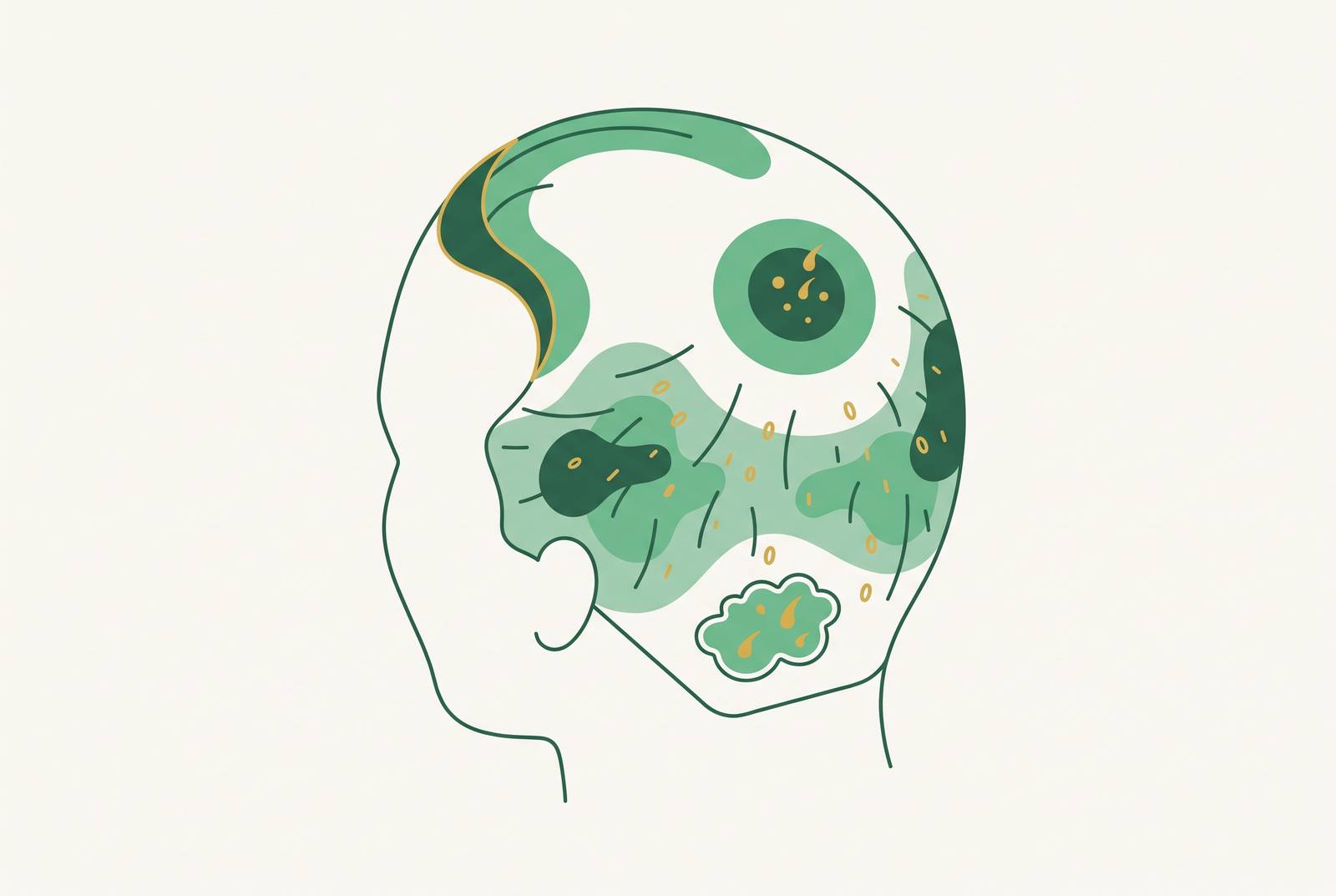
Losing 50 to 100 hairs a day is normal. With roughly 100,000 follicles on a healthy scalp, that kind of turnover barely registers, because new hairs cycle in as old ones shed out. The real question isn't whether hair is coming out, but where it's thinning, in what shape, and over what stretch of time. Those three details, taken together, point toward a cause the way a fingerprint points toward a suspect. And the biggest mistake people make is treating "hair loss" as one problem instead of five, because the wrong read leads to months wasted on the wrong fix.
Doctors sort hair loss into two broad buckets first: scarring and non-scarring. Non-scarring means the follicle is still alive under the skin, just not producing hair the way it used to, and regrowth stays possible. Androgenetic alopecia, alopecia areata, and telogen effluvium all fall into this camp. Scarring alopecia is a different animal: the follicle itself gets destroyed, and once that happens, no cream, pill, or procedure brings it back. Pattern still matters diagnostically in both cases, but the urgency changes completely when permanent loss is on the table.
Most people treat pattern recognition as a nice-to-know detail instead of the actual decision point. Someone with androgenetic alopecia who spends six months on stress management and iron supplements is going to be disappointed, since that's not what's driving the miniaturization happening on their crown. Someone who assumes their patchy bald spot is hormonal, when it's actually alopecia areata, delays the immune-focused evaluation that could have started sooner. Getting the pattern wrong doesn't just waste time. It can waste the exact window where treatment works best.
This piece works through the major causes organized by the pattern each one produces on the scalp, not by how common or severe they are. These patterns can overlap, and overlap is more common than most explanations let on. A 2025 case report out of the University of Pennsylvania, published in JAAD Case Reports, described a single patient presenting simultaneously with central centrifugal cicatricial alopecia, alopecia areata, and telogen effluvium, all at once. A tidy chart doesn't always capture what appears on an actual scalp. The goal here is building the vocabulary to describe what's happening accurately, so a conversation with a clinician starts from precision instead of guesswork. It's building the vocabulary to describe what's happening accurately, so a conversation with a clinician starts from precision instead of guesswork.
How the hair growth cycle determines when and where loss becomes visible
Every hair on the scalp moves through four phases, and understanding them is the key to almost everything that follows. Anagen is the active growth phase, and scalp follicles can sit in it for years at a stretch, which is how some people grow hair down to their waist. Catagen is a short transition where cell division slows. Telogen is a resting phase. Then the hair releases and falls out, making room for the next cycle to begin.
Each follicle runs its own independent clock. That's why hair loss doesn't usually look like a light switch flipping off: one follicle might be deep into anagen while its neighbor two millimeters away just entered telogen. That staggering is why a healthy scalp sheds continuously in small amounts, rather than dropping hair all at once in a single dramatic wave.
On a healthy scalp, the ratio of follicles in anagen versus telogen tips heavily toward growth. Most hair loss conditions work by messing with that ratio, either by cutting anagen short or by shoving follicles into telogen before their time. That single mechanism, expressed differently across different conditions, explains most of the visible thinning or shedding people notice.
Androgenetic alopecia works through a distinct version of this called miniaturization. Over repeated cycles, the anagen phase gets progressively shorter and the follicle itself physically shrinks. Hairs come in finer, shorter, lighter in color, cycle after cycle, until eventually the follicle produces something closer to peach fuzz than a full strand. That's a gradual process. AGA produces slow, spatially confined thinning instead of the sudden, all-over shedding seen in other conditions. Scarring alopecia works through a completely different mechanism (destruction, not miniaturization), and telogen effluvium is different again: a phase-shift disruption rather than a structural change to the follicle.
None of this happens in a vacuum. Follicles need a steady supply of protein and iron, plus normal thyroid and hormone function, to keep cycling properly. Iron deficiency deserves particular attention here: iron carries oxygen to the follicle, and low iron is one of the more common, correctable reasons behind increased shedding, especially in women.
The scalp itself is its own small ecosystem: around 100,000 follicles, a resident microbiome that includes a yeast called Malassezia (a normal, everyday inhabitant of scalp skin that can turn inflammatory under the wrong conditions), and a sebum-producing system that keeps the scalp lubricated when it's working right and clogs follicles when it isn't. Same underlying follicle biology, different disruptions, different visible results. That's why the causes covered next produce such different-looking patterns on the scalp.
Androgenetic alopecia: the patterned thinning driven by DHT sensitivity
Androgenetic alopecia accounts for more than 95% of hair loss cases in men, and in the US it affects roughly 50 million men and 30 million women. By age 50, about half of all men show some degree of it. Nothing else on this list comes close in scale, and that alone is a reason to rule it in or out first.
The mechanism gets misunderstood constantly, usually in the same direction: people assume it's about having too much testosterone. People assume it's about having too much testosterone, but AGA comes from certain follicles being genetically wired to overreact to DHT, a hormone derived from testosterone. AGA comes from certain follicles being genetically wired to overreact to DHT, a hormone derived from testosterone. DHT binds to androgen receptors on susceptible follicles and, cycle after cycle, shortens anagen until the follicle miniaturizes into something too small and fine to matter cosmetically. The other myth worth killing here is that this condition doesn't come only from the mother's side. It's genetically complex, shaped by contributions from both parents, not a single gene passed down one family line.
In men, the pattern has a signature that's genuinely recognizable once someone knows to look for it. It usually starts above the temples, where the hairline recedes into a shape most people call an M. Separately, thinning often develops at the crown. Those two zones can expand independently for a while before eventually meeting in the middle. The back and sides of the scalp tend to hold onto their hair, because those follicles simply aren't sensitive to androgen signaling the way the top and front are. That retained fringe is the spatial fingerprint of the mechanism itself. It's the spatial fingerprint of the mechanism itself.
Women show a different geometry. Rather than a receding hairline, the pattern usually widens along the center part, broader up front and tapering as it moves back toward the crown. MedlinePlus calls this the Christmas tree pattern, and the name fits once it's pointed out. One detail matters a lot for telling this apart from other causes: the front hairline itself typically stays put, aside from ordinary age-related recession. Total baldness, the kind sometimes seen in men, is uncommon in the female pattern.
When excess androgens drive things, as can happen with PCOS, there's usually a second clue riding alongside the scalp thinning: coarser facial hair growing in at the same time. Scalp thinning plus increased facial hair points toward an androgen-excess process.
Itching, redness, and scalp sores are generally absent in AGA. If those symptoms show up, that's a signal to look elsewhere, toward an inflammatory or fungal cause. Left untreated, MedlinePlus notes that female pattern hair loss is permanent.
That predictable, zone-specific thinning is a sharp contrast to what comes next: a pattern that appears everywhere on the scalp at once, instead of concentrating in one or two zones.
Telogen effluvium: diffuse shedding triggered by a system-wide shock
Telogen effluvium looks nothing like AGA, and that difference is the whole diagnostic clue. Instead of concentrating in specific zones, the shedding spreads evenly across the entire scalp. No M-shape, no widening part, no crown-specific thinning. Just more hair coming out everywhere, all at once.
Why does that happen? Some kind of significant jolt to the system: a serious illness, major surgery, an emotional trauma, rapid weight loss, a nutritional gap, a high fever, or childbirth. Whatever the trigger, the effect is the same. A large batch of follicles gets pushed out of anagen and into telogen simultaneously, instead of the usual staggered pattern where only a small percentage sit in telogen at any given moment.
The shedding doesn't appear right away, which trips people up. It usually appears weeks to months after whatever triggered it, so a patient noticing clumps of hair in the shower drain in March might be dealing with the aftermath of a fever from back in December. That lag is why so many people fail to connect the dots on their own.
On a biopsy, there's an actual threshold used to confirm the diagnosis: if more than 25% of follicles are in telogen phase on a transverse punch biopsy, that confirms TE. It's a useful illustration of how clinical evaluation goes well beyond a visual scan of the scalp, down into what's happening follicle by follicle.
The good news with TE: it's generally self-limiting. Once the trigger resolves, whatever it was, the follicles cycle back into anagen and hair regrows. It almost never produces the kind of visible bald patches or hairline recession seen in AGA, which makes prognosis one of the clearest ways to tell the two apart.
But what if the shedding continues even after the obvious trigger is gone? That's the tricky overlap zone. Early-stage female androgenetic alopecia can look diffuse too, at least at first, which makes it genuinely hard to distinguish from TE just by looking. Time is the differentiator: TE resolves, and FAGA doesn't, since it keeps producing a real, measurable decrease in hair thickness as miniaturization continues underneath. If diffuse shedding persists well after a stressor has passed, that's a reason to get evaluated for underlying AGA rather than assuming it will resolve on its own.
There's also an emerging signal around GLP-1 receptor agonists, the drug class that includes semaglutide and tirzepatide. A 2026 systematic review and meta-analysis found an alopecia incidence of 6.0 per 1,000 patient-years among GLP-1 RA users, compared to 0.8 per 1,000 patient-years in placebo groups: a risk ratio of 3.40 (95% CI 1.18 to 9.81). The likely mechanism lines up with everything already covered here. Rapid weight loss, and the nutritional shortfalls that sometimes come with it, can trigger TE directly, and it can also unmask AGA that was already brewing quietly, since the weight loss accelerates a process already underway in genetically susceptible follicles. Pharmacovigilance data logged more than 1,000 spontaneous cases in the US. Separately, data presented at the EADV 2025 Congress linked GLP-1 RA use to higher rates of telogen effluvium, androgenic alopecia, and nonscarring hair loss generally, but not to alopecia areata. None of that means someone on these medications should assume the drug is the culprit the moment shedding starts. The pattern and the timeline still do the diagnostic work. The medication is a piece of context, not an automatic explanation.
A few other TE triggers deserve a quick mention, mostly because they're correctable once identified: thyroid disease, iron deficiency anemia, and the hormonal shift that follows childbirth. Getting evaluated for these changes the whole management plan, since fixing the underlying deficiency often resolves the shedding on its own.
AGA and TE both play out across the scalp broadly, whether in a defined gradient or diffusely. What comes next looks nothing like either: sharply defined patches with clean, visible borders.
Alopecia areata: sharply bordered patches produced by an immune attack on follicles
Alopecia areata happens when the immune system mistakes healthy hair follicles for a threat and attacks them directly. It's classified as autoimmune and non-scarring: the follicle survives the attack and keeps its ability to regrow hair, even if that doesn't happen right away. According to the Rochester Epidemiology Project (drawing on data from 1990 to 2009), lifetime prevalence is between 1.7% and 2.1%.
Visually, the signature is hard to mistake once someone's seen it: sudden, patchy hair loss in discrete, well-defined spots, sometimes a single patch, sometimes several scattered across the scalp, each with a clean border rather than a gradual thinning edge.
One detail separates AA from every other cause on this list, and it's the one most likely to get missed: it isn't confined to the scalp. Eyebrows, eyelashes, beard hair, and other hair-bearing areas of the body can all be affected. A 2025 case report by Zeng and colleagues at Kunming Medical University, published in JAAD, described a 48-year-old woman with a sisaipho-like scalp pattern alongside axillary and pubic hair loss and perifollicular keratotic papules, a striking illustration of how far AA's reach can extend beyond the head. Nail changes, brittleness or a reddish discoloration, sometimes appear too: another body-wide signal that points away from a purely scalp-localized process.
Within AA, there are named variants worth knowing by sight. Ophiasis describes a distinct distribution pattern of loss, and it's atypical enough that it sometimes gets confused with other conditions. Sisaipho describes another recognized distribution variant of alopecia areata. In the most severe cases, totalis and universalis refer to more extensive forms of alopecia areata.
Because it's non-scarring, regrowth is genuinely possible. But the course is unpredictable, and recurrence is common even after a full regrowth cycle. That unpredictability is part of what makes AA so psychologically taxing. A 2025 literature review published across PMC and Cureus described a two-way relationship: psychiatric conditions, especially chronic stress, can worsen hair loss through immune dysregulation, while visible, patchy hair loss drives anxiety, depression, and body dysmorphic disorder in return. The review found the psychological toll can be substantial.
AGA, TE, and AA all originate from processes happening inside the body, whether genetic, systemic, or immune. What follows is different in kind: patterns shaped by forces acting on the scalp from the outside.
Traction alopecia and scalp-condition-driven loss: patterns shaped by external forces
Traction alopecia has maybe the most literal pattern-to-cause relationship on this entire list: the hair loss maps directly onto wherever tension gets applied. Repeated pulling from tight braids, extensions, or ponytails worn consistently over time damages the follicles sitting right at the point of strain, usually the hairline and the temples, since those are the zones under the most mechanical stress from these styling practices.
Caught early, traction alopecia is non-scarring and reversible once the tension stops. Left going long enough, it becomes scarring and permanent. Catching the pattern early matters so much more here than in most other causes on this list. A practical way to spot it: hair loss sitting right along the hairline or a part line, matching up with a consistent styling habit, points toward traction well before any lab work is needed.
Scalp conditions represent a different flavor of external cause entirely, one where the scalp's own microenvironment turns against the follicle. Seborrheic dermatitis and dandruff involve excess sebum production that can clog follicles, reducing blood flow and oxygen delivery locally. Malassezia, the yeast mentioned earlier as a normal scalp resident, can shift into an inflammatory relationship with sebum and the immune system, driving the flaking and irritation associated with these conditions. Oxidative stress is a key mechanism behind the hair loss that sometimes accompanies seborrheic dermatitis specifically.
Psoriasis and allergic contact dermatitis work through inflammation that disrupts the growth cycle directly, shortening anagen and stretching out the shedding phase. The resulting pattern tends to follow wherever the underlying skin condition appears, rather than the androgen-sensitive zones that define AGA.
Folliculitis and scarring alopecias sit at the more serious end of this category. Central centrifugal cicatricial alopecia, for instance, involves chronic inflammation at the follicle opening that can eventually destroy the follicle for good. Its pattern is distinctive: it classically starts at the crown and spreads outward in a centrifugal pattern, a spatial signature completely different from the hairline recession seen in AGA.
Fungal infections like ringworm, or tinea capitis, bring their own tell: scalp skin that's inflamed and scaly, paired with patchy hair loss and needs prompt treatment, and it's also what separates it from AA, where the scalp surface under the bald patch usually looks smooth rather than inflamed.
A 2026 review published on PMC looked at scalp microbiome patterns across AGA, AA, seborrheic dermatitis-related hair loss, and folliculitis or scarring alopecia, and found reproducibility across studies substantially limited by inconsistent methodology. In plain terms: using microbiome signatures to distinguish these conditions from one another sounds appealing, but it's still being worked out, not something settled and ready to use clinically. Anyone hearing a confident claim otherwise should treat it with some skepticism.
The broader signal for anyone trying to make sense of their own scalp: itching, flaking, redness, tenderness, or visible inflammation all point the interpretation toward a scalp-condition cause, away from the hormonal or immune mechanisms covered earlier. Pattern gets someone most of the way to an answer. Symptoms on the scalp surface itself often close the gap.