UTI Symptoms Without a Positive Urine Culture
Why millions with UTI symptoms test negative and what doctors should actually check.

UTI symptoms with a clean culture aren't proof of nothing wrong. They're proof that the standard test has a blind spot, and somewhere between 20% and 30% of symptomatic women fall straight into it. Understanding where that blind spot comes from is the actual first step toward figuring out what's going on and what to do next.
Start with what a urine culture is actually built to catch. A lab takes your sample, spreads it on a growth medium, and waits to see if bacteria multiply into visible colonies. "Negative" doesn't mean "no bacteria present." It means no colonies grew past a specific counting threshold, in a specific window of time, under specific lab conditions. That threshold has a name attached to it and a history.
Dr. Edward Kass set the number back in the 1950s: 100,000 colony-forming units per milliliter of urine. He was studying pyelonephritis patients against asymptomatic women, trying to find a cutoff that would separate real kidney infection from incidental bacterial presence. It worked well for that specific comparison. But it was never built as a universal yardstick for every person who walks in with burning, urgency, frequency, and pelvic pain. Somewhere along the way, a research threshold turned into the default clinical rule, and a lot of genuinely symptomatic people got left on the wrong side of it.
That gap matters at scale. About 40% of women will have a UTI at some point in their life, and 1 in 5 of those will have more than one. A meaningful share of that population is going to hit this exact wall: real symptoms, clean culture, and a clinician unsure what to do with the mismatch. What follows is a breakdown of why that happens and what it actually points toward.
Three concrete reasons standard culture produces false negatives
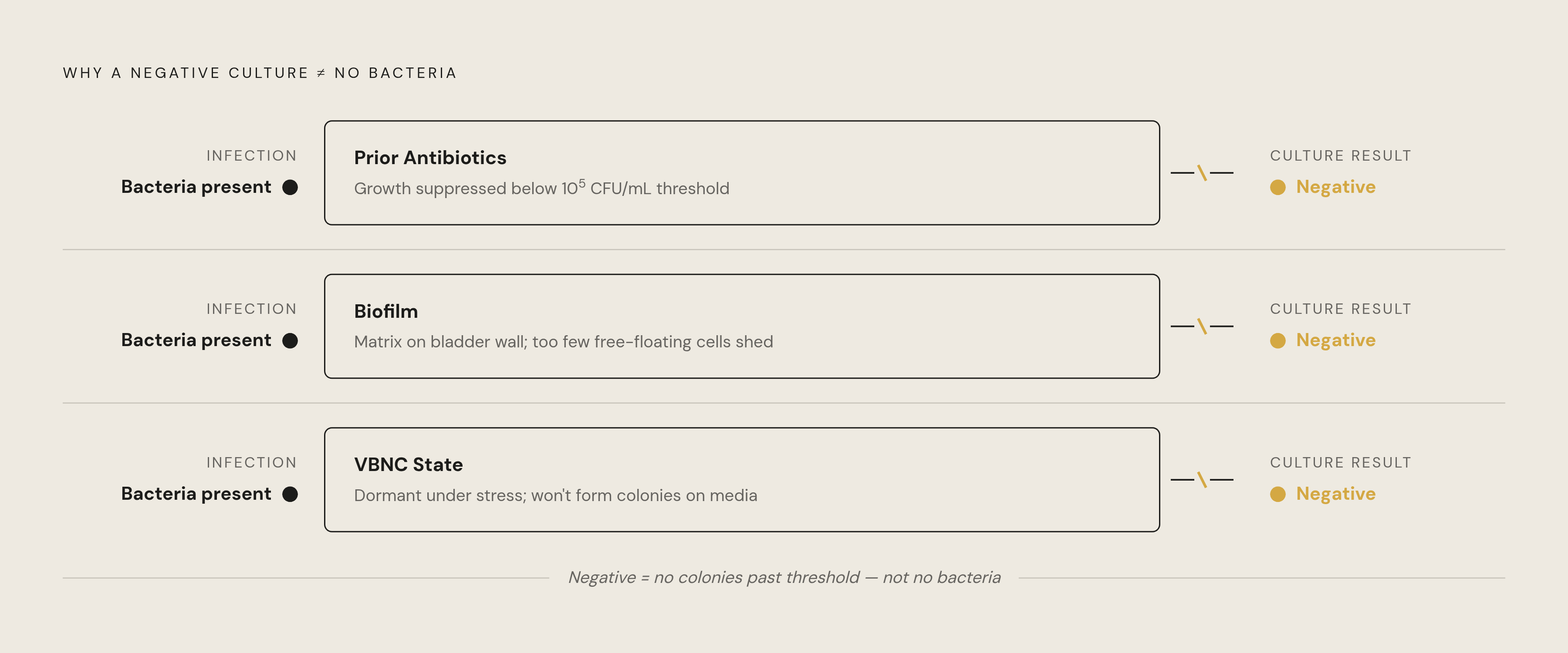
Prior antibiotic use is the most common one, and it's often invisible unless someone asks directly. Even a single dose, taken before the sample was collected, can suppress bacterial growth below the detection threshold without actually clearing the infection. The symptoms stick around. The culture reads clean. This is exactly why a detailed medication history, including anything taken in the days before the test, isn't optional.
Biofilm-associated infection is the second, and it's a mechanical problem more than a testing problem. Bacteria can encase themselves in a self-produced matrix on the bladder wall, and from inside that shield, they shed only a small number of free-floating cells into the urine. Standard culture is built to detect planktonic bacteria, the free-swimming kind. It was never designed to sense a colony sitting protected on tissue. This matters most in recurrent and chronic UTI cases, where the infection has had time to settle in and organize.
Then there's a stranger phenomenon: viable but nonculturable, or VBNC, bacteria. Under antibiotic stress, common uropathogens like E. coli and Klebsiella pneumoniae can shift into a dormant state. They're alive. They may still be virulent. But they won't form colonies on standard media, so the culture comes back negative even though the organism hasn't actually left. An analysis in the Indian Journal of Urology laid this mechanism out directly, and it reframes what a "negative" result can mean when antibiotics were already in the picture.
A few other factors round this out without needing their own separate mechanism. Fastidious organisms, things like Gardnerella vaginalis and Ureaplasma urealyticum, need specialized growth conditions that routine culture protocols don't provide, since those protocols are optimized for the usual suspects. On top of that, ordinary technical issues, contamination during collection, delays getting the sample to the lab, transport conditions that aren't ideal, can all knock down bacterial viability enough to flip a true positive into a false negative.
The bladder isn't sterile. The bladder isn't sterile. It hosts its own microbiome, and dysbiosis within that community, an imbalance rather than one dominant invader, may be enough to drive symptoms on its own. Standard culture, built to hunt for a single dominant pathogen, is essentially blind to this kind of disruption.
What sterile pyuria signals when it appears alongside a negative culture
Sterile pyuria means the urinalysis shows more than 5 to 8 white blood cells per microscope field, but the culture finds no bacteria. Sterile pyuria means the urinalysis shows more than 5 to 8 white blood cells per microscope field, but the culture finds no bacteria. It's not a fringe finding either: it occurs in an estimated 2.6% of men and 13.9% of women, and in hospital settings, up to 23% of patients without a UTI have it.
White blood cells are inflammation markers. That's the whole point of them. They don't tell you what caused the inflammation, only that something did. So sterile pyuria should prompt a specific question, inflamed by what, rather than a reflexive reach for another antibiotic.
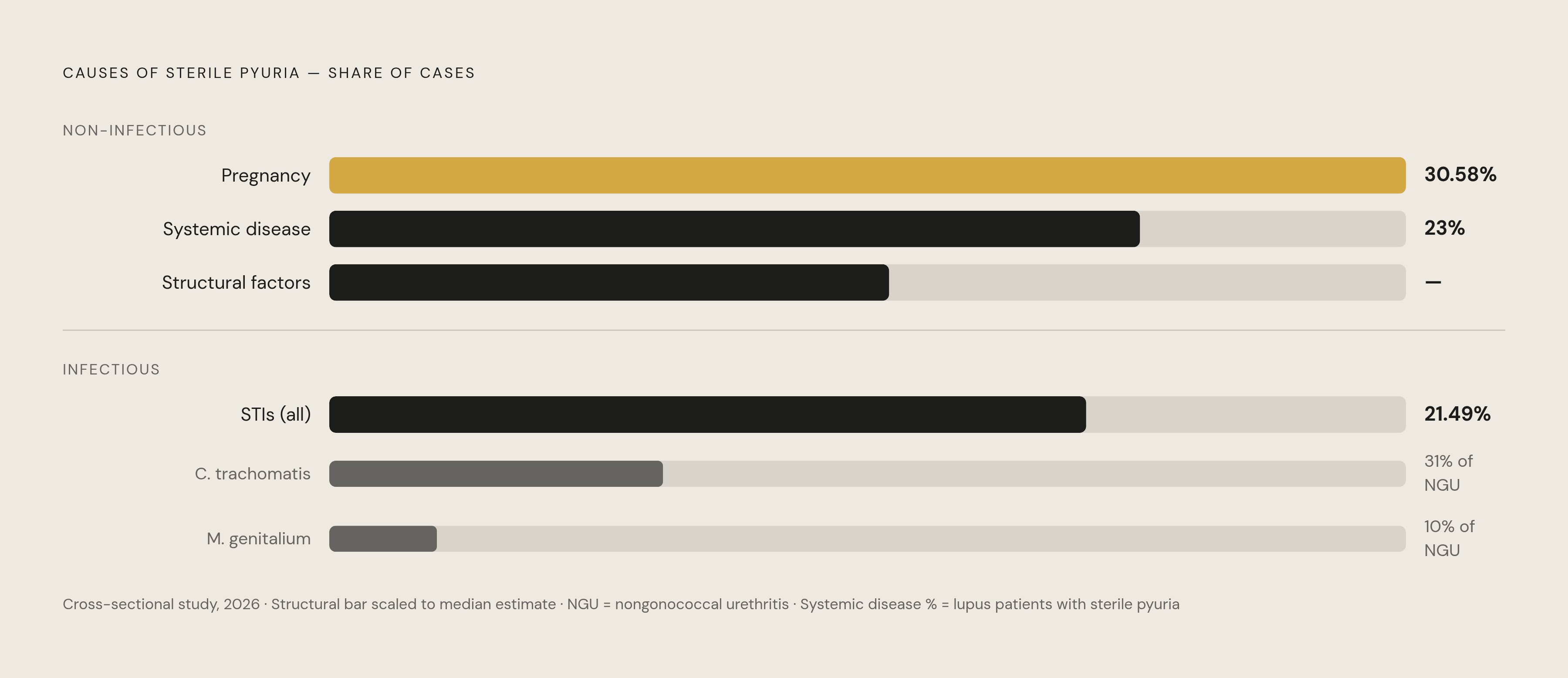
On the infectious side, sexually transmitted infections turn out to be the biggest overlooked cause. A 2026 cross-sectional study found STIs accounted for 21.49% of sterile pyuria cases, the largest infectious category by far. A separate study looking at men with nongonococcal urethritis and pyuria found Chlamydia trachomatis in 401 men, 31% of the group, and Mycoplasma genitalium in 134 men, or 10%. Renal tuberculosis sits on the same infectious list. It's rare, but it does real damage if it's missed, and it deserves consideration in immunocompromised patients, people from high-prevalence regions, or anyone with unexplained weight loss alongside the urinary symptoms.
The non-infectious side is just as crowded. Systemic disease can produce it: sterile pyuria occurred in 215 of 946 lupus patients in one dataset, about 23%. Pregnancy was actually the single largest non-infectious cause in that 2026 study, at 30.58% of cases. Structural and procedural factors add to the list too: stones, foreign bodies, stents, transvaginal mesh, radiation cystitis, polycystic kidney disease. And recent antibiotic treatment of an already-resolved UTI can itself leave sterile pyuria behind for up to two weeks afterward, which means the timeline of recent treatment matters almost as much as the current symptoms.
The conditions most commonly mistaken for a UTI when culture is negative
These aren't interchangeable diagnoses wearing the same symptoms as a costume. Each one has a distinct mechanism, a distinct trigger pattern, and a distinct treatment path. The overlap in symptoms is exactly what creates the diagnostic confusion, so it helps to look at what actually separates them.
Interstitial cystitis and bladder pain syndrome (IC/BPS) is chronic pelvic or bladder pain and pressure lasting more than six weeks, and it follows a specific rhythm: it is often linked to bladder filling and urination patterns. The RAND Interstitial Cystitis Epidemiology survey estimated 3 to 8 million women and 1 to 4 million men in one country. have symptoms consistent with it. Diagnostic delay isn't the exception here, it's closer to the rule: 70% of patients experience a delay because clinicians initially treat the symptoms as a UTI. To complicate things further, up to 50% of IC/BPS patients have had a genuine UTI in their past, so the two conditions aren't mutually exclusive, they just require careful separation. IC/BPS patients tend to void in order to relieve pain, while overactive bladder patients void out of fear of leaking. Different driver, different fix. extended culture and next-generation sequencing are increasingly discussed in IC/BPS workups, though their clinical relevance is still being sorted out, and IC/BPS patients can still develop a real UTI on top of their baseline condition.
Pelvic floor dysfunction works through a more mechanical route. A pelvic floor that's too tight, hypertonic, can prevent the bladder and urethra from fully emptying. That trapped urine produces burning, urgency, incomplete emptying, and a constant sense of needing to go, which is nearly indistinguishable from a UTI on symptoms alone. Repeated UTIs can tighten the pelvic floor, and that tightening then perpetuates incomplete emptying, which raises infection risk again. The cycle feeds itself. Treatment here runs through pelvic floor physical therapy.
Genitourinary syndrome of menopause (GSM) is a chronic, progressive condition tied to declining estrogen, and it affects vulvovaginal, urinary, and sexual tissue. Vaginal burning from GSM can closely mimic UTI burning, and urinary urgency from GSM may actually be underlying overactive bladder driven by tissue changes, not infection at all. It's underrecognized largely because both patients and clinicians reach for the UTI explanation first, since it's the more familiar story.
STI-related urethritis rounds out the list. In sexually active young adults with dysuria, Chlamydia trachomatis appears as one of the most common organisms on diagnostic testing. The clinical guidance here is direct: a sexually active patient with dysuria shouldn't be assumed to have a plain UTI without ruling out STI-related cervicitis, vaginitis, or pelvic inflammatory disease. When sterile pyuria is on the table, testing typically expands to include Chlamydia trachomatis, Mycoplasma hominis, Mycoplasma genitalium, and Ureaplasma urealyticum.
What more advanced testing can and cannot tell you
The standard pathway is simple in theory: urinalysis flags the likelihood of infection, and culture is supposed to confirm it. The gap between those two steps is exactly where culture-negative UTIs live, and it's also where newer testing tries to close the distance.
PCR testing detects genetic material directly, which means it can pick up "atypical" organisms that never grow well on standard media, Ureaplasma, Mycoplasma, Gardnerella among them. A 2024 meta-analysis put PCR's sensitivity at 99% and its specificity at 94% for UTI diagnosis, which is a meaningful jump. Practically speaking, when symptoms persist and culture comes back clean, ordering a PCR test is the logical next step to raise, especially if a fastidious or atypical organism seems plausible given the history.
Next-generation sequencing, or NGS, goes further still. It reads the DNA of everything present in the sample, which means it can flag pathogens that never grow in culture at all, along with antibiotic resistance markers and polymicrobial infections where more than one organism is involved. In one study using metagenomic NGS, the technology detected at least one pathogen in 87.9% of cases, and 57.6% of those had a positive mNGS result despite a negative standard culture. That same 2024 meta-analysis put NGS sensitivity at 90% and specificity at 86%. Turnaround runs around 36 hours, and cost is expected to fall in line with advanced multiplex PCR panels as the technology matures. Biotia's BIOTIA-ID Urine Test identifies more than 40 urogenital pathogens and reports back antibiotic resistance marker data alongside them.
But how does this affect what a patient actually does with the result? NGS detects DNA from everything in the sample, including organisms that are simply present without causing the current infection. A result full of detected organisms isn't automatically a clean diagnosis, it needs a clinician reading it in context, not pattern-matched against a list. Access is its own hurdle too: NGS is newer technology, and insurance coverage hasn't fully caught up with its clinical use, so patients may need to ask directly whether it's available and what it costs.
None of this is a guaranteed finish line, either. Conditions like IC/BPS and pelvic floor dysfunction won't show up on any urine test, no matter how advanced. A negative NGS result isn't a dead end. It's a signal to widen the workup past the bladder itself.
Why cycling through antibiotics without a confirmed infection makes things worse
Dr. Dana Rice, a board-certified urologist, has made the point: in a world of rising multi-drug resistant bacteria, giving antibiotics without culture confirmation isn't a harmless default. It's a decision with consequences attached.
The overtreatment problem isn't just a few individual missteps, it's structural. In reflex urine culture protocols studied at a major academic medical center, only 43.8% of reflex culture orders came back positive, and the majority were negative. Of the positive results, 69.5% represented asymptomatic bacteriuria, bacteria present without actual symptoms. Documented UTI symptoms appeared in only 28.4% of encounters that triggered a culture in the first place, and dysuria, the single most classic UTI symptom, appeared in just 15.1% of the cases that led to culture and antibiotic use. Despite all of that, 80.9% of asymptomatic bacteriuria encounters were treated with antibiotics anyway, according to a study in Antimicrobial Stewardship and Healthcare Epidemiology.
The system-level cost tracks with this. UTIs account for roughly 380,600 preventable adult inpatient stays annually in that country, adding up to $2.55 billion, a figure that reflects both overdiagnosis on one end and undertreated complications on the other.
There's a trap specific to culture-negative cases. Antibiotics taken before a culture is collected can suppress bacterial growth enough to push a genuinely infected sample into a culture-negative reading. Then, faced with that negative result and persistent symptoms, a clinician prescribes another round, on top of a sample that was already altered by the first course. Each cycle compounds both the diagnostic confusion and the resistance risk. A persistently negative culture isn't a green light for round three of antibiotics. It's a signal to look at the other explanations already on the table, IC/BPS, pelvic floor dysfunction, GSM, an STI, sterile pyuria from a non-bacterial cause.
How to describe your symptoms clearly enough to move the workup forward
Culture-negative UTI workups run almost entirely on clinical history, because no single test closes the case on its own. That makes the account of pattern, timing, and triggers a form of diagnostic data in itself.
A few specifics carry real weight:
- When symptoms peak, before urination, during, after, or constantly. IC/BPS classically gets worse as the bladder fills and eases after voiding.
- Whether urgency comes from pain or from fear of leaking, since that split is one of the clearer ways to separate IC/BPS from overactive bladder.
- Any connection to sexual activity, the menstrual cycle, or menopause status.
- Pelvic floor clues: pain with sitting, constipation, pain during sex.
- Antibiotic use in the days or weeks before this episode, including anything taken before the current sample was collected.
- Sexual history relevant to STI screening.
Ask a clinician a few direct questions rather than waiting for them to volunteer the options: could this be something other than a bacterial infection, is there a PCR or molecular test that might catch what standard culture missed, and should interstitial cystitis, pelvic floor dysfunction, or GSM be on the table.
Some patterns call for moving past primary care. Symptoms lasting more than six weeks, multiple negative cultures paired with symptoms that won't quit, or a cluster of signs pointing toward IC/BPS or a structural issue are reasonable grounds for a referral to urology or urogynecology. And a few symptoms override everything else regardless of what the culture says: fever, back or flank pain, and chills point toward the upper urinary tract, and those need prompt in-person evaluation rather than being managed at a distance.
Where telehealth fits in a culture-negative workup and where it does not
For a first, uncomplicated episode of UTI-like symptoms, a virtual visit can do a lot of the initial legwork: reviewing symptom pattern, duration, red-flag screening, and relevant history, largely the same information a clinician would gather in an exam room before ordering a test. That makes telehealth a reasonable starting point rather than a shortcut around real evaluation.
Where it runs into limits is exactly where this whole piece has been pointing. Once fever, flank pain, or chills enter the picture, or once someone is on their second or third negative culture with symptoms that won't resolve, the workup needs hands-on evaluation, physical exam findings, and access to advanced testing that a screen can't replace. Pelvic floor dysfunction needs a physical assessment to even suspect it. IC/BPS workups increasingly involve tools like extended culture or sequencing that require in-person coordination. A negative culture with ongoing symptoms is the moment to escalate the level of care, not repeat the same virtual conversation with a different antibiotic attached to it.
Sources
- When the lab falls silent: The challenge of culture-negative urinary tract infections
- UTI Symptoms with a Negative Urine Culture: The Relationship Between UTI Symptoms and Pelvic Floor Health
- A urinalysis to urine culture reflex protocol results in high rates of asymptomatic bacteriuria treatment
- ncbi.nlm.nih.gov