Yeast Infection vs BV Symptom Differentiation
Only about one-third of BV patients report textbook symptoms, making self-diagnosis unreliable.
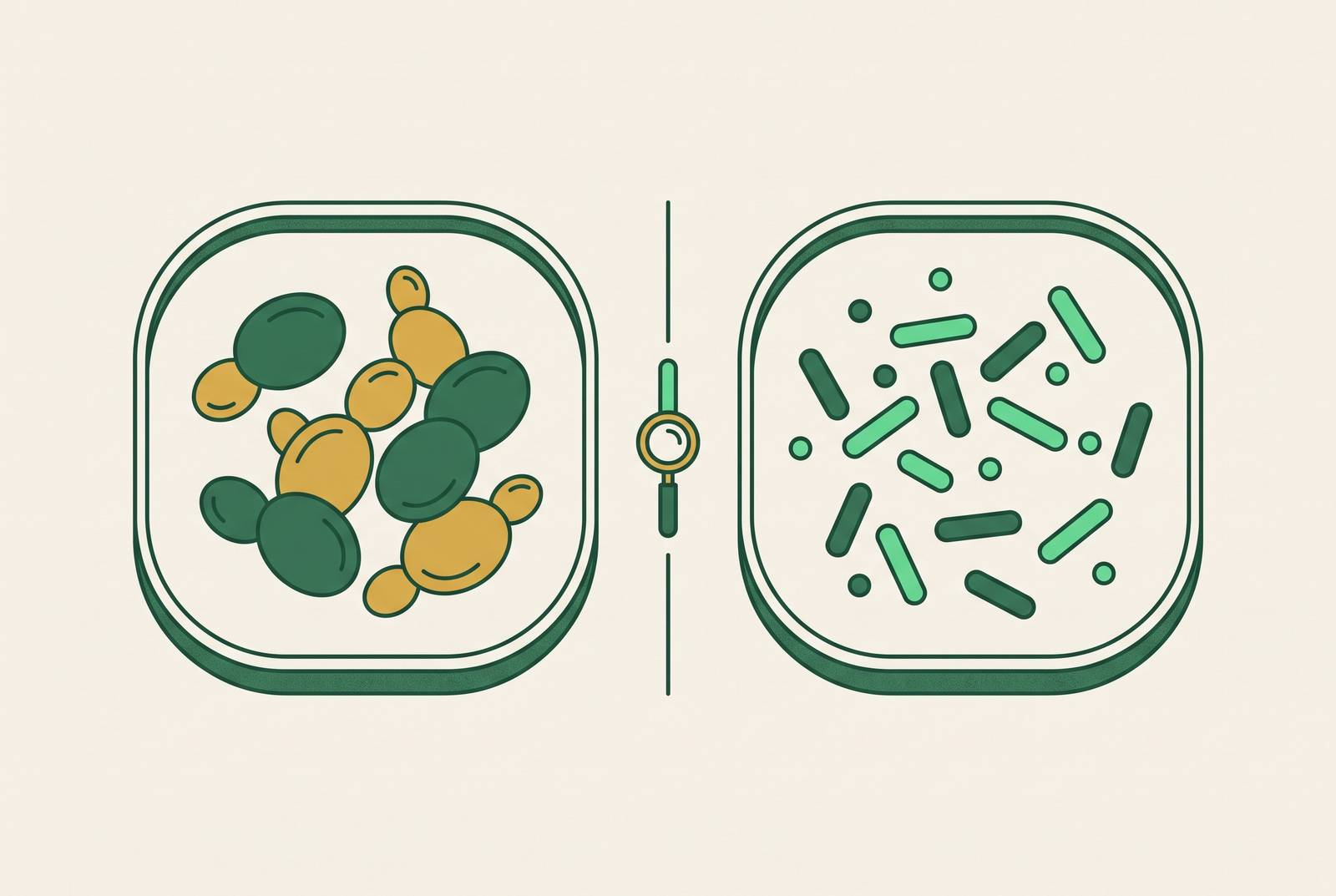
Yeast Infection vs BV Symptom Differentiation.
Why BV and yeast infections get confused so often
BV is the most common vaginal condition among women of reproductive age, yeast infections affect roughly 75% of women at least once in their lives, and BV affects 30% of women annually Frontiers in Reproductive Health. Put those numbers side by side and you get a population where nearly everyone has run into one of these at some point, often without being totally sure which one it was.
Part of the problem is that the "classic" symptom list isn't as classic as it sounds. A 2025 study out of Boston University, Massachusetts General Hospital, and Harvard Medical School, published in Frontiers in Reproductive Health, found that only about a third of patients actually diagnosed with BV reported the textbook symptom cluster. Even the signs doctors are trained to look for appear inconsistently in real patients, which should tell you something about trying to nail this down from the outside, on your own, with no lab involved.
Social media doesn't help. That same study found that posts describing BV symptoms cited burning in 45% of cases and itching in another 45%, numbers that don't line up well with what's actually seen in clinical BV cases Frontiers in Reproductive Health. That gap feeds the confusion loop: people read a post, match it loosely to what they're feeling, and walk away more convinced than the evidence supports.
Then there's a structural issue that tilts the whole thing toward one wrong answer. There's no over-the-counter treatment for BV, but antifungal creams for yeast infections sit right there on pharmacy shelves. So when someone isn't sure which one they have, the path of least resistance is to grab what's available, not necessarily what's correct. None of this means symptom-reading is useless. It means the goal isn't to self-diagnose with total confidence. It's to read the signs precisely enough to make a smart decision about the next step, whether that's a pharmacy purchase or a call to a clinician.
What is happening biologically in each condition
A healthy vagina's chemistry, disrupted, produces the symptoms of these two conditions, and understanding that chemistry explains why they need such different treatments Frontiers in Reproductive Health. A healthy vagina runs on Lactobacillus bacteria, which keep the environment slightly acidic and, in doing so, keep opportunistic organisms from getting a foothold. That acidity isn't decorative. It's the mechanism holding the whole ecosystem in balance.
BV happens when that balance tips. It's not a single invading pathogen causing an infection in the traditional sense, it's an overgrowth of Gardnerella vaginalis and related anaerobic bacteria that crowd out Lactobacillus, and that shift is exactly what pushes vaginal pH upward. A yeast infection, or vulvovaginal candidiasis, works through a different door entirely. It's a fungal overgrowth, with Candida albicans responsible for 85% to 90% of cases, and the organism is normally present in small amounts already, it just becomes a problem when conditions tip in its favor Doctronic Bacterial Vaginosis vs Yeast Infection: Key Differences - Viveve.
What tips those conditions differs by infection, too. Neither condition counts as a sexually transmitted infection, though sexual activity can still play a role in triggering either one.
Why does any of this matter for someone just trying to feel better? Because cause dictates cure. Antibiotics target bacteria, antifungals target fungi, and treating one condition with the tool built for the other doesn't just fail to help, it can actively work against you. Yeast is associated with recent antibiotic use (kills protective bacteria), pregnancy, uncontrolled diabetes (blood sugar over 200 mg/dL), weakened immune system, tight synthetic clothing, and birth control pills containing estrogen Doctronic.
Reading discharge: the single most distinguishing visible sign
Of all the symptoms on the table, discharge is the one that carries the most diagnostic weight, because it varies clearly in appearance, texture, and how it pairs with odor. BV discharge tends to run thin and watery, gray or grayish-white, often in a higher volume than usual, and in some cases carries a slight yellow or even greenish tinge. Yeast discharge looks and feels almost nothing like that: thick, white, and clumpy, the texture people describe as cottage cheese, visually distinct enough that it rarely gets confused with BV discharge once you know what to look for.
But color by itself isn't the full story. Thin, white discharge appears in either condition, so texture, paired with whatever else is happening (odor, itch, timing), carries more weight than color alone. Some women with BV notice no discharge whatsoever. Absence doesn't rule anything out. Read discharge as one strong clue among several.
Odor and itching: the two clues that most reliably separate the conditions
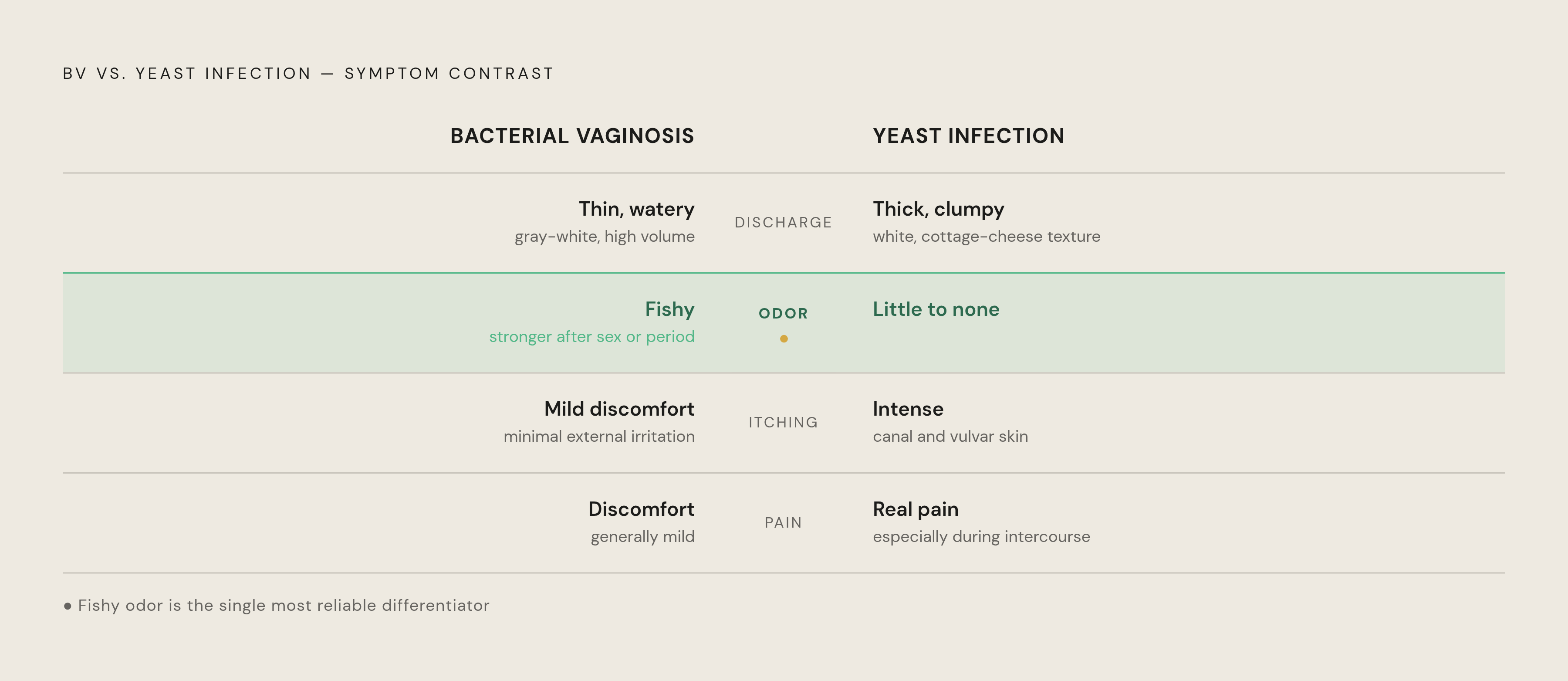
If discharge is the clue you see, odor is the clue you smell, and it's arguably the most telling one BV produces. BV odor has a specific, recognizable quality, a fishy smell that tends to get stronger after sex or during a period, when vaginal pH climbs further. Yeast infections, by contrast, generally don't produce much odor at all, and that absence is itself informative. No smell doesn't mean nothing's wrong, but it does start nudging the picture away from BV.
Itching tells a similar but separate story. Yeast infections tend to bring intense itching that hits both inside the vaginal canal and the external vulvar skin, often becoming the single loudest complaint a patient has. BV, on the other hand, usually produces milder irritation, discomfort rather than itch, and noticeably less external inflammation. Pain follows the same split: yeast infections can cause real pain, especially during or after intercourse, while BV tends to sit more in the discomfort range than actual pain, according to Dr. Jennifer Velotta, an OB/GYN at University Hospitals.
That same 2025 Frontiers study found social media posts overstated pain as a BV symptom, showing up in 23% of posts compared to only about 21% of actual BV patients reporting it. Itching gets similarly overstated online. Neither symptom belongs exclusively to BV, and both occur in other vulvovaginal conditions, including vulvodynia, which makes leaning too hard on any single symptom risky.
So how do you actually put this together? A useful mental shortcut: a strong fishy odor paired with thin gray discharge and mild or no itch points toward BV. Flip that around (no odor, thick white clumpy discharge, real itch and redness) and yeast becomes the more likely explanation. Neither pattern is a diagnosis. But it's a far better starting point than guessing.
What vaginal pH tells you
pH sits in an odd spot: genuinely useful, but easy to over-trust. A healthy vagina typically runs between 3.8 and 4.5. Yeast infections tend to stay inside that normal range, while BV usually pushes pH above 4.5. In one study of 250 women presenting with discharge suggestive of BV, the mean pH among confirmed BV cases came out to 6.2, and a pH reading above 4.5 carried 85% sensitivity and 66% specificity for detecting BV Doctronic Bacterial Vaginosis vs Yeast Infection: Key Differences - Viveve. That's a meaningfully useful screen. It's also far from perfect, given that a third of true negatives would still get flagged.
At-home pH strips make this test accessible, with results in a few minutes, basic kits under $10, and accuracy landing somewhere around 65% to 80% compared to an actual clinical diagnosis Bacterial Vaginosis (BV): Causes, Symptoms & Treatment. That's a reasonable first signal. Strips can't tell you which organisms are actually present, and they can't distinguish BV from trichomonas or other conditions that also push pH upward. They won't tell you how severe an imbalance is, or whether BV-associated bacteria are present. And period blood or recent sex can both temporarily raise pH on their own, generating a false positive that has nothing to do with BV at all.
So where does that leave pH testing? As a rough first filter, useful for deciding whether it's worth pursuing further care, not a tool for making the final call solo. For those wanting more resolution, comprehensive at-home lab-based swab tests exist too, running up to nearly $200, and newer metagenomic platforms are starting to combine microbiome data with clinical history to help shape treatment protocols. Those are a different category of tool entirely from a $10 pH strip, not a replacement for the basic screening conversation happening here Bacterial Vaginosis (BV): Causes, Symptoms & Treatment.
Why self-diagnosis goes wrong
Accuracy for self-diagnosing a first-time episode runs around just 35% Doctronic. That's not a knock on anyone's judgment, it's a reflection of how much overlap these conditions actually have, and it holds even among people who've dealt with one of these infections before and still misjudge it Doctronic.
Getting it wrong sets off a specific chain of problems. Treat BV with an OTC antifungal (which, remember, is the only OTC option on the shelf) and nothing improves, because there's no OTC BV treatment to begin with, and the underlying bacterial imbalance can actually get worse. Flip it around: treat a yeast infection with antibiotics meant for BV, and there's no antifungal action happening at all, so the fungal overgrowth just continues. Neither mismatch is a minor inconvenience. Both mean more days of discomfort and a delayed path to whatever actually works.
It's also worth considering that BV and yeast infections aren't the only things that produce these symptoms. Trichomoniasis, chlamydia, and gonorrhea can all mimic either condition closely enough to fool a symptom-only read, which is exactly why leaning on pattern-matching alone carries real risk.
Certain symptoms shouldn't be handled through guesswork or a pharmacy aisle at all. Fever, lower abdominal or pelvic pain, bleeding between periods, a strong or worsening odor paired with green or frothy discharge, pregnancy (since untreated BV during pregnancy has been linked to complications including premature birth), any first-time episode, or symptoms that return right after finishing a full course of treatment. Any of those can point to pelvic inflammatory disease, an STI, or something else entirely that needs a prescription and a clinician's eyes on it. Knowing when to stop guessing and escalate is, in its own way, just as valuable as knowing how to read the symptoms in the first place.
How each condition is treated
BV treatment runs through prescription antibiotics, full stop. About 10% to 15% of people need a second round of treatment Bacterial Vaginosis (BV): Causes, Symptoms & Treatment. Probiotics come up often in conversations about BV, but the research backing them as an actual treatment is thin. A review on the NIH Bookshelf points to a real lack of solid evidence for lactic acid bacteria as therapy, so they're worth mentioning as a topic of interest.
Yeast infections follow an entirely separate treatment path. Uncomplicated cases respond well to a single 150 mg dose of oral fluconazole, which is first-line per the CDC STI Treatment Guidelines, or a three-day course of topical azole creams. Recurrent cases, defined as four or more episodes a year, call for something stronger: extended antifungal courses lasting 10 to 14 days, followed by a maintenance schedule to keep things from coming back.
Newer drugs have entered the picture for people who don't respond well to the standard options. Ibrexafungerp, sold as Brexafemme and approved in 2021, was the first oral non-azole treatment for acute vulvovaginal candidiasis, and the 2025 CANDLE trial found that a monthly single-day dose (300 mg taken twice, 600 mg total) meaningfully cut down recurrence compared to placebo. Oteseconazole, sold as Vivjoa and approved in 2022, is aimed at reducing recurrent candidiasis in patients who are not of reproductive potential, and it comes with a requirement to use effective birth control during treatment given a documented fetal toxicity risk, according to UCSF's Reproductive Health Hub.
There's also a treatment angle that goes beyond the patient herself. The StepUp trial found that treating a male partner at the same time, combining oral and topical antibiotics, meaningfully cut down BV recurrence in his female partner, and New York State's Department of Health AIDS Institute updated its guidance in February 2026 to reflect that finding.
Recurrence, generally, is the theme to take seriously here. BV comes back in more than half of cases within six months of treatment, and across a lifetime, as many as 80% of people who get it once will get it again Bacterial Vaginosis (BV): Causes, Symptoms & Treatment. One round of antibiotics clearing up symptoms this week doesn't mean the story's over. It's a reason to stay in touch with a clinician rather than treat a single prescription as the final word. Standard treatment is oral metronidazole 500 mg twice daily for 7 days, or clindamycin cream Bacterial Vaginosis vs Yeast Infection: Key Differences - Viveve. WHO published evidence-informed clinical recommendations on BV case management in 2024. OTC miconazole cream is available for $10–$20 at pharmacies, appropriate only if the patient has a confirmed prior diagnosis. For recurrent BV, the maintenance approach is vaginal metronidazole weekly for 3 months; avoiding longer courses of oral metronidazole is important due to neuropathy risk, per UCSF.
Getting a clinically reliable answer
That's not something achievable at home with a strip and a guess, it requires an actual provider running an actual exam. For anyone dealing with a first-time episode, a recurring infection that won't quit, or any of the red-flag symptoms mentioned earlier, an in-person pelvic exam remains the most reliable route to an answer.
Telehealth has opened up a real option, though, particularly for cases that aren't first-time or complicated. Message-based, asynchronous consultations let a licensed clinician assess a lot of yeast infection cases just from a clear symptom description and history, especially useful for someone who's had a confirmed diagnosis before and recognizes the pattern coming back. When the picture is genuinely ambiguous, a message-based consult with a clinician beats guessing at the pharmacy and grabbing whatever's on the shelf. That kind of care fits well for recognized recurrences, follow-ups after an initial diagnosis, and figuring out whether something needs to escalate to in-person care. It fits poorly for first-time episodes, red-flag symptoms, or anything that might overlap with an STI, all of which call for a closer look than a message thread can provide.
Given that BV alone touches about 30% of women every year, and plenty of them face real barriers to getting in front of a provider quickly, telehealth isn't just a nice-to-have convenience here, it's a practical necessity for a lot of people Frontiers in Reproductive Health. Before that conversation even starts, describe symptoms using the specific, concrete language covered in this piece. Discharge texture and color, whether there's odor and what it's like, how intense the itch is, a pH strip reading if one was used. Precise language is exactly what lets a clinician triage accurately without ever seeing the patient in person.
BV still has no over-the-counter path. If BV seems likely based on the signs covered here, a prescription is the only real way through it, and telehealth offers a legitimate, affordable route to that prescription, without necessarily requiring an in-person visit for a recognized recurrence. The clinical gold standard is the Amsel criteria (pH above 4.5, clue cells on microscopy, positive whiff test with KOH, thin discharge), requiring a provider, not self-assessment; confirmation by a clinician with pH testing and microscopy is the most reliable approach.
Sources
- BV vs Yeast Infection: What’s Causing Your Symptoms? (2026) - Doctronic
- Frontiers | Comparison of bacterial vaginosis symptoms reported in social media vs. those reported by patients
- Bacterial Vaginosis or Yeast Infection? Here’s How to Tell | University Hospitals
- Bacterial Vaginosis vs Yeast Infection: Key Differences - Viveve
- Bacterial Vaginosis (BV): Causes, Symptoms & Treatment
- Bacterial vaginosis: Learn More – Which treatments are effective for bacterial vaginosis? - InformedHealth.org - NCBI Bookshelf
- BV vs Yeast Infection: How to Tell the Difference - Doctronic