Telehealth vs In-Person Visit for Skin Conditions
Telehealth works for chronic flare-ups but fails for suspicious lesions and melanoma.
Skin conditions do not wait for an open slot on a calendar. The average wait for a nonurgent dermatology appointment in the United States runs 36.5 days, putting most patients in front of a real choice: expert care online this week, or expert care in person next month. The wait for nonurgent dermatology appointments is why choosing between telehealth and in-person care matters. A patient with a spreading rash or a worsening flare cannot always afford weeks of waiting, and a patient with a suspicious new mole cannot always afford to settle for whatever is fastest. The decision between telehealth and an in-person visit is a navigation problem shaped by supply. It is a navigation problem shaped by supply, and getting it wrong has clinical consequences on both sides. What follows is an attempt to make that navigation decision clearer, condition by condition, so patients and clinicians alike can route each case to the setting that actually fits it.
How the two telehealth models work
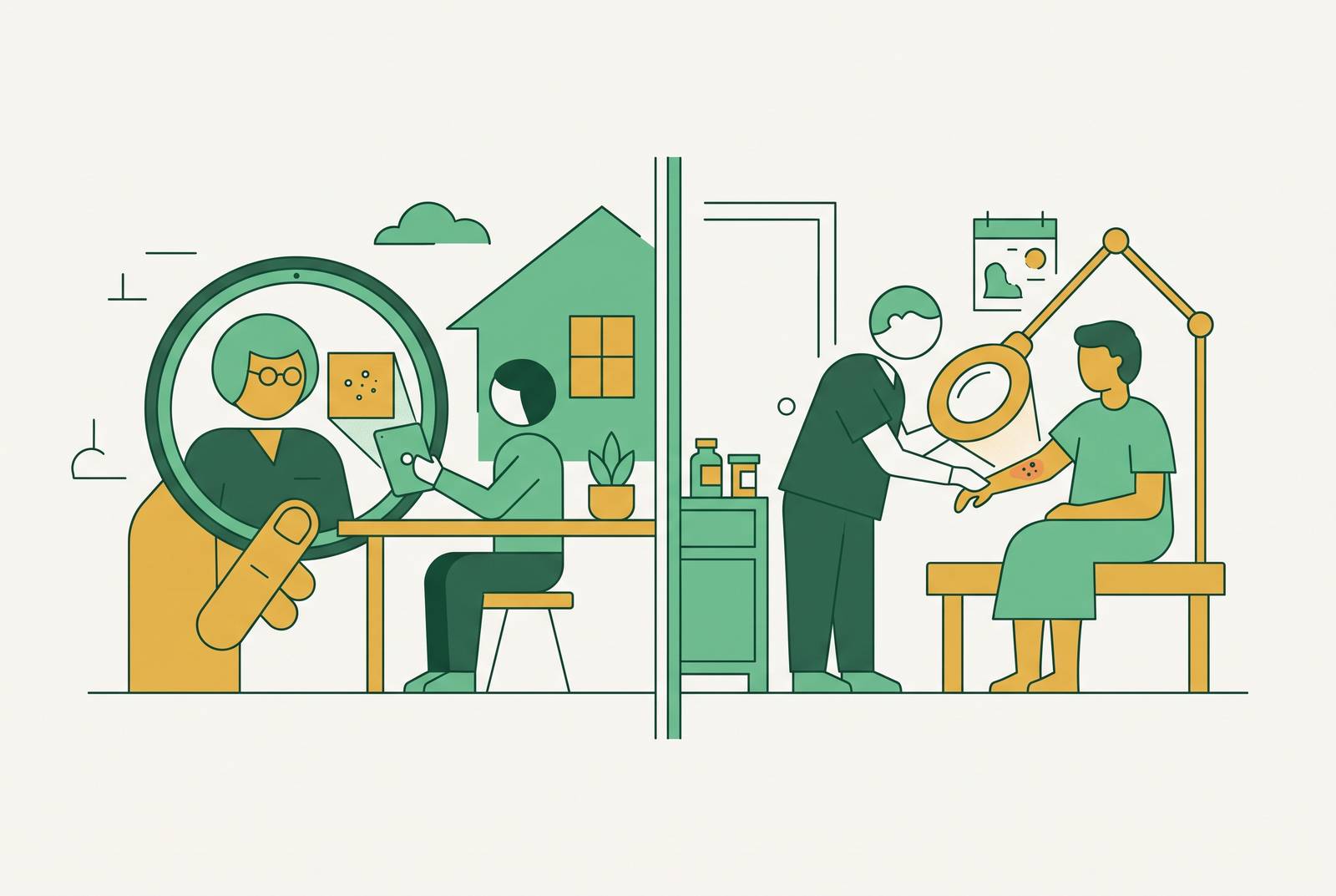
Telehealth in dermatology is not one thing. Two distinct models operate under that label, and they are not interchangeable: synchronous teledermatology uses real-time video, while asynchronous store-and-forward care involves submitting photographs and clinical history for a clinician to review later, on their own schedule. Which one fits depends entirely on the condition in front of the patient.
Asynchronous care has become the more common model for chronic skin conditions, and the reason is mechanical. It separates the moment a symptom appears from the moment a clinician is available to look at it. A patient does not need to wait for an appointment slot to document a flare. A photo taken the instant a rash worsens carries more diagnostic value than a description recalled three weeks later in an exam room, after the skin has already started to calm down.
That advantage comes with a cost, though. Asynchronous care runs entirely on image quality, and poor-quality images are a genuine source of diagnostic error, both for clinicians reviewing photos directly and for the AI systems increasingly used to triage them. This is why image-quality gatekeeping tools, built to catch a blurry or poorly lit photo before it ever reaches a clinician, are showing up in more workflows. A hybrid model also exists: a video visit paired with photos uploaded before or after the call. That combination tends to get used for lesion-specific conditions, while acne-type conditions are more often handled through video alone.
AI is starting to do more than sort image quality. In a case series, an LLM-enabled workflow achieved approximately 84% top-diagnosis concordance with clinician teleassessment, and AI-assisted history taking and decision support are enhancing the asynchronous process. The technology is still an assistant to the clinician's judgment, not a replacement for it, but it is changing how much of the asynchronous process runs before a human ever looks at the case.
Telehealth Can Match In-Person Care for Chronic, Inflammatory, and Managed Conditions
The clinical trial evidence for telehealth is strongest exactly where the disease itself is chronic. A 2026 randomized clinical trial followed 300 adults and children with atopic dermatitis and found that asynchronous online care produced improvements equivalent to in-person care, measured across clinician-assessed severity, patient-reported symptoms, and overall disease assessments. It is a controlled trial directly comparing two care models on a condition that affects both children and adults, and it found no meaningful gap between them.
Psoriasis shows a similar pattern over a longer time horizon. A 12-month randomized trial found that an asynchronous online model matched in-person management for clinical outcomes. A full year is long enough to capture the dose adjustments, flare management, and follow-up that psoriasis typically requires, and the online model held up across that entire stretch.
Acne has the most mature evidence base among the three. A 2023 randomized trial found that teledermatology and in-person visits produced similar improvements in acne severity and similar patient satisfaction over six months. Patients saved real time using the online model, though clinicians spent slightly more total time per case using teledermatology than they did face to face. That detail matters: the efficiency gain in these trials belongs mostly to the patient, not the clinician, which says something honest about where the value of telehealth actually sits.
What connects all three conditions is the structure of the disease itself. Acne, psoriasis, and atopic dermatitis all require a feedback loop rather than a single decisive encounter. A clinician picks a treatment, the patient tries it, and the skin responds somehow, better, worse, or unpredictably. Telehealth shortens that loop because a patient can submit a photo the moment a reaction appears, instead of waiting for a flare to fade before describing it secondhand at the next scheduled visit. The evidence here supports equivalence, not superiority. Telehealth for these conditions is holding up as a genuine substitute. It is holding up as a genuine substitute, which for a chronic disease that requires repeated contact over months or years, is the more useful claim.
Where Telehealth Concordance Breaks Down
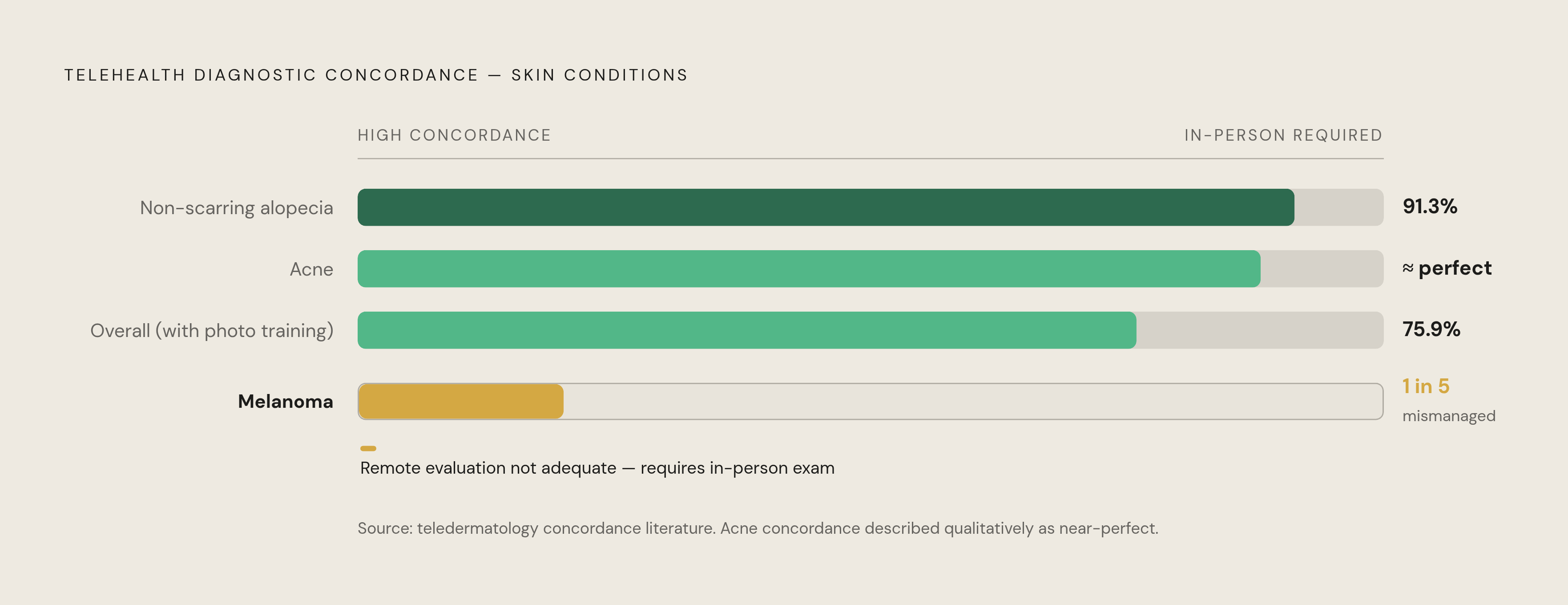
The equivalence documented above does not extend to every corner of dermatology, and the boundary is not fuzzy. A 2023 systematic review and meta-analysis in BMJ Open found an overall diagnostic concordance rate between telehealth and in-person dermatology that rose to 75.9% when patients received training on how to take their photos, with acne approaching near-perfect concordance. Suspected melanoma sat at the other end of that range, requiring in-person evaluation.
The starkest finding concerns malignant lesions directly. Management of a subgroup of malignant lesions through teledermatology performed significantly worse than in-person dermatology, with as many as one fifth of melanomas potentially mismanaged when handled remotely. That is not a marginal gap in a low-stakes category. Melanoma is a cancer where delayed or incorrect management carries real consequences, and the evidence says telehealth, as currently practiced, is not reliably catching what an in-person exam would catch.
Three categories fall on the in-person side of that line without much ambiguity. Lesions that are new, changing, or otherwise suspicious often need dermoscopy, a biopsy, or histopathology to reach a diagnosis. Store-and-forward teledermatology for skin cancer produces uneven results depending heavily on image quality and whether dermoscopy was used. Rashes that are widespread, spreading fast, or blistering may need palpation, lab work, or urgent triage that a screen cannot provide. And any condition that requires a procedure, a biopsy, an excision, an injection, cryotherapy, simply cannot happen through a video call or a photo submission, no matter how sharp the image is.
The 2026 AAD Annual Meeting put a fine point on this distinction. Telehealth improves efficiency and expands access through video visits, portal messaging, and e-consults, but the clinical question is always which pathway fits the condition rather than which pathway is more convenient. That framing is the hinge of this entire piece. Convenience and clinical fit happen to line up for a long list of conditions. They do not line up for all of them, and melanoma is the clearest proof of what goes wrong when they are treated as the same thing.
A practical routing framework: matching the visit type to the condition and the clinical decision
The question that should guide a patient's choice is what kind of clinical decision actually needs to be made for the specific condition in front of them, since that decision determines the pathway. That decision determines the pathway, and the routing logic breaks down fairly cleanly once the condition is named.
A wide range of conditions fit asynchronous telehealth well. Mild-to-moderate acne has a strong evidence base, responds well to the kind of iterative treatment adjustments asynchronous care handles efficiently, and shows near-perfect diagnostic agreement with in-person exams. Atopic dermatitis and eczema are chronic conditions that need ongoing flare management, and the feedback-loop advantage of asynchronous care carries real clinical weight there. Psoriasis management, meaning dose adjustments and longitudinal follow-up rather than a first-time diagnosis in a complicated case, fits the same model. Non-scarring alopecia belongs here too. A 2025 retrospective analysis from UPMC found that clinicians reached a definitive diagnosis remotely in 91.3% of non-scarring alopecia cases. Rosacea follows the same chronic-management logic as acne, and prescription refills or follow-up visits for conditions already diagnosed are probably the cleanest use case asynchronous care has.
Some conditions benefit more from a video visit than from photos alone. Inflammatory conditions where a clinician needs to ask real-time questions, about symptoms, about triggers, about whether a patient is actually using a regimen as prescribed, benefit from a live conversation. A 2,064-encounter cross-sectional study found inflammatory conditions were handled comparably well under both the hybrid model and the video-only model, which suggests real flexibility in how these cases can be routed. First-time presentations of a chronic condition, where a clinician wants to build out a history interactively before committing to a treatment plan, also tend to benefit from video over a static photo submission.
Then there is the category that needs an exam room, no substitute available. Any lesion that is new, changing, asymmetric, or otherwise suspicious for malignancy belongs there. Rashes that are spreading fast, blistering, or showing signs the illness has gone systemic belong there. Anything that needs a procedure to diagnose or treat it belongs there. And any presentation where a photo simply cannot capture what matters clinically, subtle color variation, texture, an irregular border, belongs there too.
A simple heuristic holds up across most of this: if the condition is chronic and already diagnosed, telehealth is usually the right first step. If a lesion is new, changing, or looks suspicious, in-person examination should not wait for a more convenient week.
Convenience is a clinical variable, not a concession, for chronic skin conditions
Convenience gets treated as a lesser reason to choose a form of care, as though picking the easier option must mean settling for less, but that view doesn't hold up. For chronic skin conditions, that assumption does not hold up. A treatment plan a patient cannot easily follow through on is a weaker treatment plan, full stop, regardless of how well it was written on paper. Barriers to follow-up reduce the quality of care a patient actually receives, even when the prescription itself is exactly right.
Consider a patient starting a new acne medication. At some point they will need to figure out whether the dryness they are experiencing is normal or a sign the treatment needs to change, whether the dose should go up, or whether the whole approach is even working. None of those judgment calls require an exam room. All of them shape whether the patient sticks with treatment long enough for it to actually work.
The time savings involved are not trivial. Teledermatology cuts visit-related time by roughly one hour and 22 minutes per encounter in acne trials, time that would otherwise go to missed work, childcare arrangements, or transportation. Those costs fall hardest on patients with the fewest resources to absorb them, and can keep a patient from continuing treatment at all.
None of this argues for eliminating in-person care. Most patients do not want that, and nothing in this framework asks for it. For the right conditions, routing a patient to the faster, more accessible option preserves quality, because it is the version of care most likely to actually get followed through, and following through is the whole point of a treatment plan.
What good asynchronous care requires from the patient
Asynchronous care works by shifting part of the diagnostic groundwork onto what the patient submits, and the quality of that submission shapes the quality of everything a clinician can conclude from it. A clinician reviewing a photo is working with what that photo shows, so the photo has to carry real diagnostic information.
Image quality is the variable a patient has the most control over, and suboptimal image quality contributes to diagnostic error in both human and AI-assisted teledermatology review. The fix is not complicated. When patients received brief training on how to take their photos, diagnostic concordance between telehealth and in-person exams rose to 75.9%. That is a meaningful jump, and it came from something as simple as teaching patients what a clinically useful photo actually looks like.
A few habits make the difference. Lighting should be even and natural where possible, since harsh shadows or warm indoor bulbs distort color in ways that can hide or exaggerate a lesion's true appearance. Multiple angles help, since a single photo can miss texture or border detail that becomes obvious from a different angle. Scale matters too. A lesion photographed without any reference for size gives a clinician less to work with than one that clearly shows how it compares to surrounding skin.
None of this is complicated to do. It does ask the patient to take the submission seriously, treating a photo less like a snapshot and more like a piece of clinical documentation. That is the trade asynchronous care makes: it hands the patient real speed and real access, and in exchange it asks for a few extra minutes of care in how the case gets presented. For the conditions where asynchronous care is the right fit in the first place, that trade is a small price for what it buys back in time, access, and continuity of treatment.
Sources
- How does online dermatology compare to in-person care?
- Store-and-Forward Teledermatology for Assessing Skin Cancer in 2023: Literature Review
- Online Care Provides Equivalent Outcomes to In-Person AD Care
- Use of hybrid versus video-only teledermatology varies by condition: A cross-sectional study of 2064 encounters
- From diagnosis to intervention: a review of telemedicine’s role in skin cancer care - PMC
- Telehealth for Skin Condition Triage: When Photos Are Enough