Bacterial Vaginosis Diagnosis When Tests Come Back Negative
Standard BV tests miss roughly half of confirmed cases, leaving real symptoms unexplained.

A negative bacterial vaginosis test doesn't mean the discharge, odor, or irritation someone's dealing with is nothing. It means the test used didn't catch what's happening, and those are two different outcomes. Every standard BV diagnostic carries a specific blind spot, built into how it works, and knowing where that blind spot sits separates "everything looks normal" from an answer that actually fits the symptoms.
Most people treat a negative result as the end of the conversation. That's the wrong instinct. A negative BV test closes one narrow question (did this particular assay find this particular signal) while leaving the actual clinical question, why does the discharge smell different, why does the itching keep coming back, wide open.
Why BV resists easy detection
A healthy vagina runs acidic, somewhere between pH 3.5 and 4.5, held there by Lactobacillus doing most of the work. BV shows up when that balance tips: Lactobacillus loses ground, and a much more varied crowd of anaerobic bacteria moves in to fill the space.
That variation is what makes detection unreliable. BV is polymicrobial. Gardnerella, Prevotella, and Mobiluncus are all commonly implicated, and the mix differs from one person to the next. There's no single culprit a lab can point to every time. Any test built around one organism is already working from an incomplete picture before the swab even touches the sample.
Biofilm makes this worse. Gardnerella and its usual companions build a protective film along the vaginal wall, and that film does two jobs at once. It shields bacteria from a swab, so a sample might only catch the free-floating organisms near the surface while missing what's embedded underneath. It also blocks antibiotics from reaching what it's protecting, which is part of the reasoning behind pairing boric acid with metronidazole in some treatment approaches. Boric acid is thought to break the biofilm down enough for metronidazole to actually reach the bacteria it's meant to kill.
Then there's the gray zone routine care tends to skip past. In one set of vaginal samples scored using the Nugent method, 108 came back BV-positive, 208 came back negative, and 69 landed in an intermediate zone that's neither. That's a meaningful portion of the sample falling into a category a yes-or-no test was never built to describe.
How the four main BV tests work
Most BV workups lean on some combination of wet mount microscopy, the whiff test, vaginal pH, and Amsel criteria, which bundles several of these together. PCR and NAAT testing exist as pricier, more targeted alternatives. Nugent gram stain scoring is the research gold standard, but it rarely appears in a routine visit because it takes specialized training to read correctly.
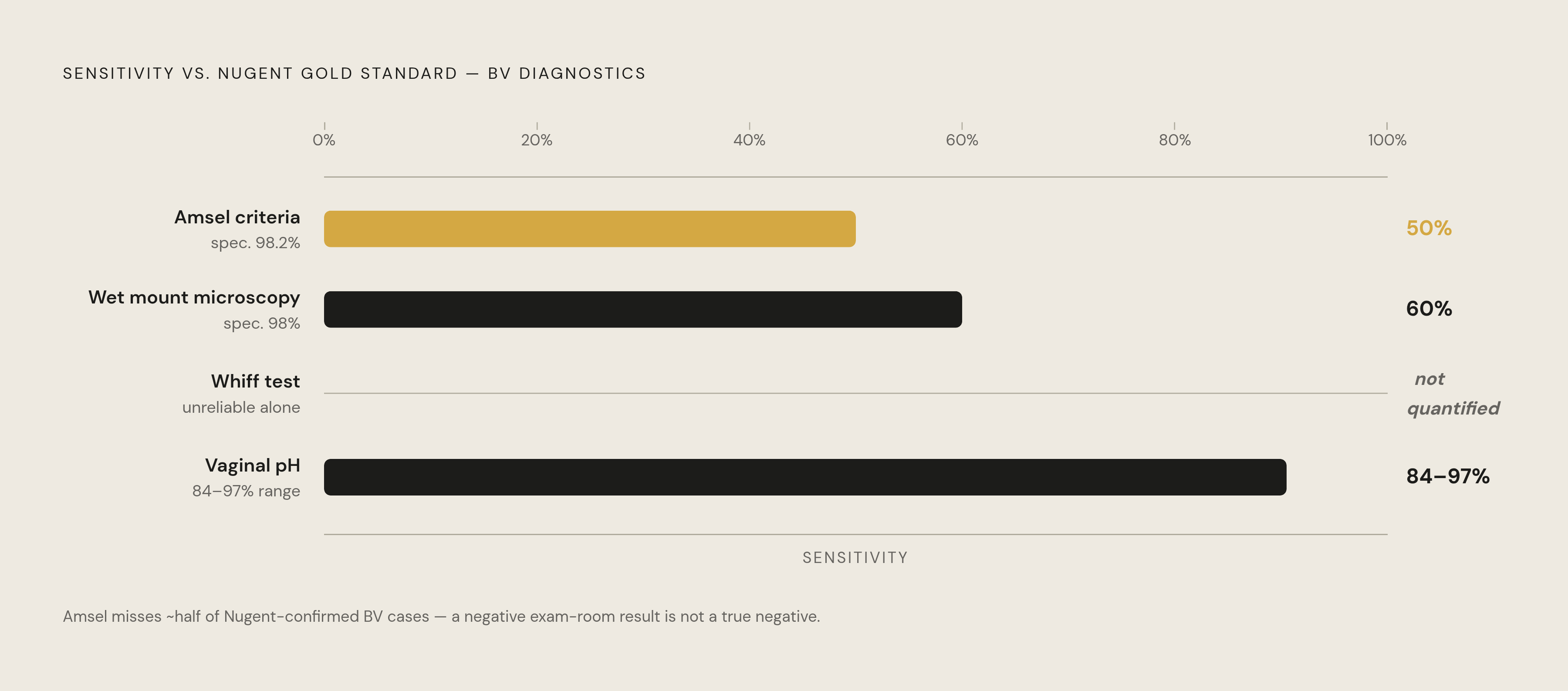
Wet mount microscopy looks for clue cells and telltale bacterial patterns under a drop of discharge. It runs about 60% sensitive and 98% specific. The specificity means something: a positive result is trustworthy. But 60% sensitivity means roughly four out of every ten actual BV cases won't show up under the microscope. Interpretation also depends on the skill of whoever's reading the slide, so a negative wet mount, standing alone, tells you almost nothing.
The whiff test and pH work as a pair, and neither is strong enough to stand alone. The whiff test adds potassium hydroxide to a sample; a fishy odor counts as positive, but by itself the test isn't especially sensitive or specific. Vaginal pH above 4.5 fares better, with sensitivity running 84% to 97% and specificity between 57% and 78%. Recent intercourse, douching, cervical mucus, and blood all push pH upward too, so a false positive from one of those causes occurs often enough to matter.
Amsel criteria is what most exam rooms actually use, and it requires three of four signs: grayish-white discharge, pH above 4.5, a positive whiff-amine result, or clue cells covering more than 20% of the sample. Measured against Nugent scoring, Amsel is only 50% sensitive, meaning roughly half of lab-confirmed BV cases could walk out of an exam room labeled negative. Specificity sits much higher, at 98.2%, with a positive predictive value of 87.5% and a negative predictive value of 88.8%.
That 50% figure is the one to sit with. In one set of 203 vaginal lavage samples where Nugent scores of 7 to 10 confirmed BV, only 75 also met Amsel criteria. A clinical exam relying on Amsel alone would have missed nearly two-thirds of cases a lab had already confirmed. Among the four Amsel components, clue cells carry 100% specificity, so their presence is a real signal that can be trusted. Their absence proves nothing, and that gap is where a lot of missed diagnoses live.
Specific reasons a test comes back negative even when something is wrong
A test built to catch Gardnerella specifically will miss BV driven mainly by Prevotella, Mobiluncus, or other anaerobes. A single-organism panel trying to catch a condition that's rarely caused by just one organism is going to fail some of the time by design. Biofilm compounds the problem, shielding bacteria from the swab entirely, which helps explain why some patients with clearly persistent symptoms test negative visit after visit.
Douching, recent intercourse, or antibiotics taken before a test can all artificially lower the pathogen load a sample picks up. These are widely recognized as prep factors that can skew results.
Then there's the intermediate Nugent score, landing between 4 and 6, ambiguous by design: not BV-positive, not BV-negative. In everyday practice, where Amsel criteria replace Nugent scoring, that entire middle zone tends to vanish from view. The 69 out of 385 samples that landed there in one study give a real sense of how many people that gray area actually holds. Related to it is sub-threshold dysbiosis, where the microbiome has shifted noticeably but hasn't crossed whatever line a binary test draws.
Any one of these is reason enough to ask for a different test, or a broader one.
Conditions that mimic BV but test negative for it
Sometimes the test isn't missing anything, because the condition simply isn't BV. A BV-specific test coming back negative, in that case, is doing what it was built to do.
Cytolytic vaginosis runs in the opposite direction from BV. Instead of losing Lactobacillus, the vagina has too much of it, and the resulting overacidity irritates the tissue. Symptoms overlap heavily with both BV and yeast infections: itching, abnormal discharge, painful urination, pain during sex. Because Lactobacillus is elevated rather than depleted, standard BV tests come back clean every time. One clue that helps separate it out: symptoms often worsen during the luteal phase, the second half of the menstrual cycle. Cytolytic vaginosis gets missed or misdiagnosed often enough that it's a genuine clinical problem, and since it isn't treated with antimicrobials at all, a missed diagnosis usually means someone ends up on rounds of antibiotics that do nothing for the actual condition. That distinction is increasingly recognized in clinical literature.
Desquamative inflammatory vaginitis, or DIV, is less defined and less understood. It causes purulent discharge, irritation of the vulvovaginal and vestibular tissue, and pain during sex, but it stems from a different underlying mechanism than the bacterial imbalance driving BV. So it also returns negative on BV-specific testing. Identifying it usually takes a specialist willing to look past the standard panel.
Mixed vaginitis adds a further wrinkle. In one breakdown of vaginitis presentations, BV accounted for 42% of cases, vulvovaginal candidiasis for 14%, and mixed infections for 16%, a meaningful share on its own. When two organisms are present together, one tends to dominate whatever signal the test picks up, pushing the other toward a false negative. Standard BV testing can miss the BV component sitting inside what's actually a mixed infection, and treating only the flagged organism leaves the other one to keep causing symptoms.
How recurrence changes the diagnostic picture
Recurrent BV is defined by repeated documented episodes, and roughly half of everyone who gets BV once will get it again. That recurrence rate alone raises the real question: is standard testing catching what's happening each time, or is it just getting trusted out of habit?
A Dutch retrospective cohort study found that diagnostic testing simply wasn't performed in 37% of patients with recurrent BV. The patients most likely to have a nuanced or mixed presentation, the ones where testing matters most, are often the ones treated empirically, based on history rather than a fresh sample. Someone with cytolytic vaginosis, DIV, or a mixed infection can end up on antibiotics that make the actual condition worse instead of better, simply because no one confirmed what was present that particular time.
Partner therapy has entered this conversation for good reason. Research has found that treating male partners with a combination of oral and topical medication lowered the rate of BV recurrence in their partners. ACOG followed in October 2025 with guidance recommending concurrent partner therapy for recurrent BV, specifically oral metronidazole and topical clindamycin for male partners, marking the first formal US guideline to endorse partner treatment for BV (these medications aren't FDA-labeled for that use). In November 2025, the California Department of Public Health recommended that clinicians consider offering the same concurrent therapy to male partners of cisgender women in ongoing monogamous relationships with confirmed recurrent BV.
Anyone dealing with repeat episodes alongside a male partner, where this hasn't come up yet, now has real clinical backing to raise it.
Advocating for more thorough evaluation after a negative result
A negative result is one input into a larger conversation. Patients who understand what a given test actually screened for, and what it didn't, tend to walk out of an appointment with sharper questions than the ones they walked in with.
Ask these questions directly:
- Which specific test got run, and which organisms was it built to detect: a broad panel, or something narrow like a single Gardnerella target?
- Could the timing of the sample, recent sex, douching, or antibiotics taken beforehand, have skewed the result?
- Do the symptoms fit cytolytic vaginosis, DIV, or a mixed infection better than they fit BV?
- If this keeps recurring, has partner therapy come up as an option?
None of these require a medical degree to ask. They require knowing that "negative" describes what one particular test measured, not necessarily what's happening in the body. That gap between the two is why a result deserves a second look before anyone treats it as final.