Hormonal Acne Diagnosis and Prescription Treatment Pathways
Skin cells convert testosterone into a potent acne driver that blood tests typically miss.
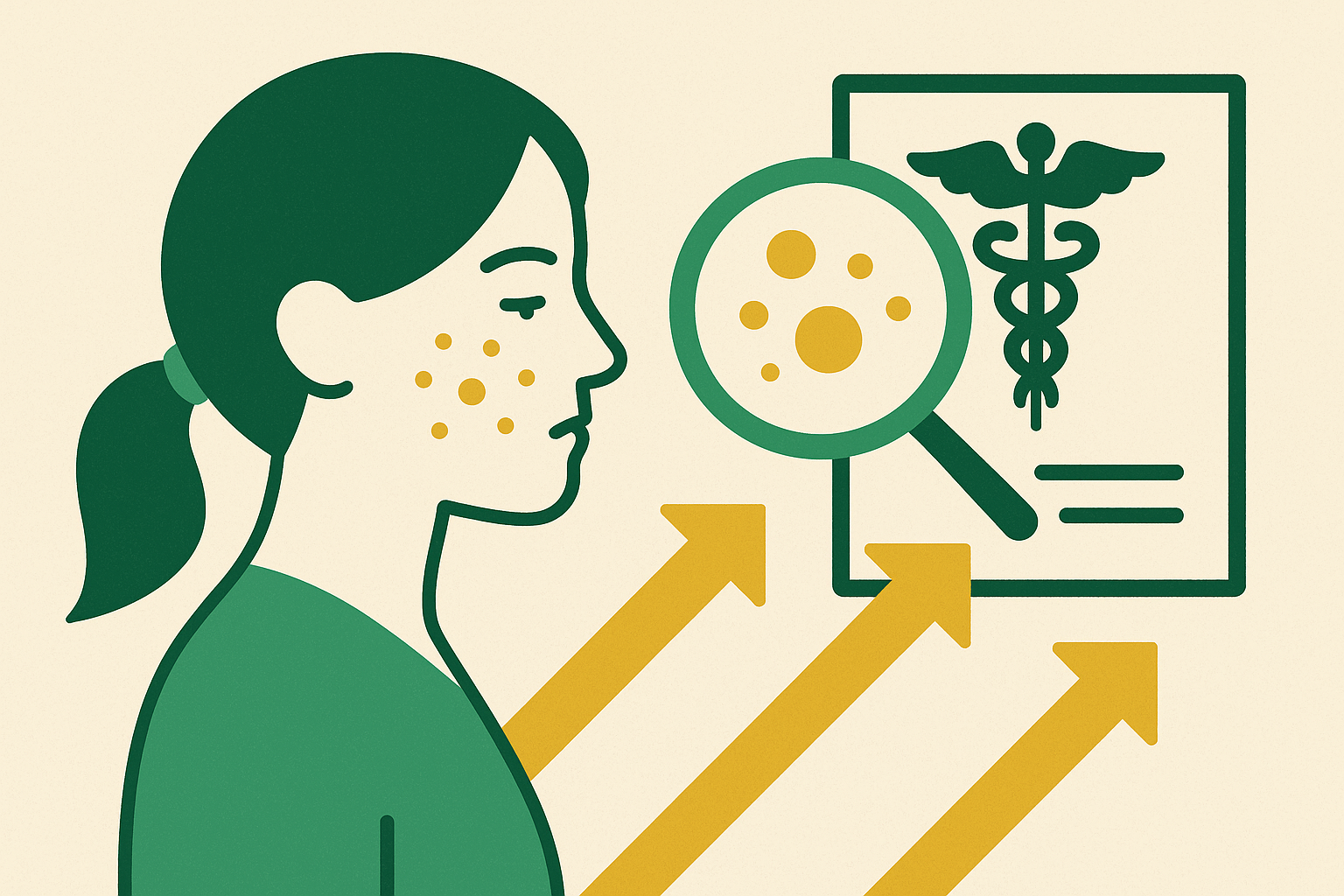
Hormonal acne starts in the skin, not the bloodstream. The real action happens in the pilosebaceous unit, the hair follicle and its attached oil gland, where androgens trigger a chain reaction, and a standard hormone panel can't fully capture it.
Androgens push the sebaceous gland to grow and crank out more oil. That extra oil thickens the lining of the follicle, a process called follicular hyperkeratinization, and clogs the opening. A 2025 narrative review by Tommasino and colleagues lays out four pieces that feed into each other: follicular hyperkeratinization, excess sebum, colonization by the bacterium Cutibacterium acnes, and inflammation. None of these sit in isolation. Each one makes the next worse.
The androgen doing most of this work at the cellular level is 5α-dihydrotestosterone, or 5α-DHT. The body makes it when it converts testosterone through an enzyme called 5α-reductase type 1. That enzyme lives mainly in sebocytes (the cells that make oil), keratinocytes (skin cells), and dermal fibroblasts, and it runs at notably higher activity in the facial sebaceous glands than elsewhere on the body. The skin is where testosterone gets turned into something more potent, right at the site where acne forms.
That local conversion changes how to think about the whole condition. A patient's testosterone can read completely normal on a lab report, but her skin can still be generating excess 5α-DHT and pumping out oil. Spironolactone, a drug that blocks the androgen receptor, reduces acne lesions even in women whose blood tests show no hormone excess. The drug doesn't need elevated circulating hormones to work, because the problem it's treating lives in the follicle, not the serum.
The sebaceous gland isn't a passive target either. Once it starts overproducing oil, that oil becomes food for Cutibacterium acnes, an aerotolerant anaerobic bacterium that thrives in exactly that environment. Androgens may also stoke inflammation inside the gland directly, adding a second route to breakouts beyond just feeding bacteria. So the gland is doing double duty: making the fuel and hosting part of the fire.
Hormonal acne is, by definition, hormone-driven. But the hormone activity that matters most often happens locally, inside the skin, and doesn't always show up in a blood draw. That gap between what's happening in the follicle and what a hormone panel can see shapes how dermatologists approach diagnosis.
Clinical presentation, not a hormone panel, as the primary diagnostic tool for most patients
If the hormone activity driving acne mostly happens inside the follicle, then a blood test measuring circulating hormones will miss a lot of what's actually going on. So most acne diagnoses start with a conversation and a physical exam, not a lab order.
Certain clinical patterns point toward a hormonal component. Breakouts that flare before a menstrual period, acne that doesn't respond to standard topical treatments or antibiotics, and acne that shows up alongside irregular periods or other signs of excess androgen all push a clinician toward a hormonal diagnosis. These patterns come from the direct clinical features identified by Tommasino and colleagues in 2025, and they function as a kind of pattern recognition that doesn't require a single lab value to confirm.
The American Academy of Dermatology's guideline position backs this up: routine hormone testing isn't recommended for most people with acne. The decision to order labs turns on something specific, whether there are additional signs pointing to a systemic hormone excess, not just the presence of acne itself.
Hirsutism (excess hair growth in a male pattern), irregular or absent periods, hair thinning on the scalp that follows an androgenic pattern, trouble conceiving, polycystic ovaries, clitoromegaly, and truncal obesity carry real weight when they appear alongside acne. Any one of these alongside acne changes the clinical picture.
When those signs appear, the workup stops being optional. Damoulaki and colleagues, writing in 2025, lay out the standard approach at that point: measure total and free testosterone along with dehydroepiandrosterone sulfate, or DHEAS. That's a targeted test ordered because the clinical picture called for it, not a routine screen run on every patient who walks in with a breakout.
What the two-step approach really does is match the diagnostic tool to the biology. Testing everyone's blood hormones by default would catch systemic hyperandrogenism, but it would miss the local, skin-level sensitivity that drives most hormonal acne, and it would send a lot of patients with normal labs down a path of confusion about why their acne is still called "hormonal." Starting with the clinical picture and reserving labs for patients showing systemic signs follows directly from what section one establishes: the follicle, not the bloodstream, is usually where the problem lives.
Acne as the first sign of PCOS
Sometimes acne isn't the whole story: it's one visible symptom of a broader condition called polycystic ovary syndrome, or PCOS, and for a meaningful number of patients, the dermatology appointment is the first place that condition gets noticed.
The numbers make this hard to dismiss. Damoulaki and colleagues report that across studies, somewhere between roughly one fifth and two fifths of women with acne also have underlying PCOS. A dermatologist evaluating acne is, in a real sense, also screening for an endocrine condition that reaches well beyond the skin.
Diagnosing PCOS itself follows the Rotterdam criteria, which require meeting two of three conditions. First, ovulation that happens irregularly or not at all, counts as one criterion. Second, signs of excess androgen, either visible (like acne or hirsutism) or found through bloodwork, with acne counted as an accepted marker here. Third, polycystic ovarian morphology seen on a transvaginal ultrasound, or an elevated anti-Müllerian hormone level. Other causes, such as congenital adrenal hyperplasia or an androgen-secreting tumor, need to be ruled out first.
PCOS doesn't just add another label. It adds a second biological driver on top of the one described in section one. Insulin resistance, common in PCOS, ramps up androgen production in both the ovaries and adrenal glands, and it lowers sex hormone-binding globulin, the protein that normally keeps free testosterone in check. Less of that protein means more free testosterone circulating and acting on the skin. So a patient with PCOS-associated acne is often dealing with two compounding inputs: the local skin sensitivity from section one, plus a systemic hormone imbalance feeding into it.
There's a third piece, too. IGF-1 signaling, which runs elevated in many PCOS patients, further amplifies both oil production and the follicular thickening that clogs pores. That pathway matters later, because it's part of why insulin-sensitizing drugs eventually enter the treatment conversation.
What does this mean for the actual visit? When a dermatologist notices hirsutism, irregular periods, or metabolic warning signs alongside acne and refers that patient for further evaluation, she is catching something with consequences that reach into fertility and long-term metabolic health, often at its earliest visible point. The skin, in these cases, is giving an early warning that the rest of the body hasn't yet made obvious.
Mechanisms of prescription options in the androgen-sebum pathway
Every major prescription option for hormonal acne interrupts that sequence at a different point, and picking between them is a question of mechanism, not a simple ranking of strength.
Spironolactone works at the receptor level. It blocks the androgen receptor inside the sebaceous gland itself, so the gland stops responding to 5α-DHT as strongly, regardless of what's circulating in the blood. That addresses the local skin sensitivity described in section one. The SAFA trial, a large double-blind randomized controlled trial involving 410 women followed over 24 weeks, found significant improvement in quality-of-life scores, the trial's primary outcome, along with improvement on investigator global assessment, a secondary measure. Side effects were minimal, mostly headache and lightheadedness. One older prescribing habit, routine potassium monitoring, turns out to carry low clinical value unless a patient already has specific risk factors for high potassium, a finding that simplifies how the drug gets prescribed in practice. It's typically avoided in patients trying to conceive, due to potential risk to a developing fetus, and it's inexpensive and widely covered by insurance, which keeps it accessible for a lot of patients.
Combined oral contraceptives work a step further upstream, at the source of production, not at the receptor. They suppress the ovaries' own androgen output and raise sex hormone-binding globulin, which binds up free testosterone before it ever reaches the sebocyte. Not every COC performs the same here. Third-generation progestins like desogestrel carry reduced androgenic activity, while drospirenone, a fourth-generation progestin, carries genuine antiandrogenic properties of its own, so which progestin is in the pill actually matters for acne outcomes. Tommasino and colleagues found that COCs reduce both inflammatory and non-inflammatory lesions effectively, with broadly similar results across different progestins. For patients who also need contraception, a COC serves two purposes in one prescription, which is worth factoring into the conversation between patient and clinician. For PCOS-associated acne specifically, Damoulaki and colleagues name COCs with antiandrogenic progestins as first-line therapy.
Clascoterone, sold under the brand name Winlevi, takes a third approach: it blocks the androgen receptor, like spironolactone, but does it topically, right at the skin. The active compound, cortexolone 17α-propionate, stops dihydrotestosterone from acting on the receptor in skin tissue, cutting sebum production and inflammation at the source without needing to travel through the bloodstream. It's FDA-approved for patients 12 and older, male and female, making it the first topical treatment built to target the androgen pathway in both sexes. Skin and plasma enzymes called esterases break clascoterone down quickly into an inactive form, so very little of it reaches systemic circulation, and that keeps the side-effect profile lighter than oral antiandrogens carry. That matters for anyone who can't take an oral antiandrogen, including patients planning pregnancy and male patients, who now have a topical option aimed at this specific pathway for the first time. As a branded product without a generic version yet, cost can be a real barrier for some patients considering it.
Metformin occupies a different role. It's an adjunct used specifically in PCOS-associated acne, addressing the insulin resistance driver described in section three. By improving insulin sensitivity, metformin reduces ovarian and adrenal androgen production and indirectly raises sex hormone-binding globulin. Damoulaki and colleagues note that where insulin resistance is present, metformin can improve both acne and ovulatory function, but it's positioned as rational support in a PCOS case, not as something prescribed for acne on its own.
Hormonal therapies versus antibiotics
Antibiotics treat one piece of the four-part pathway: the bacterial colonization. Hormonal therapy treats the oil production that gives bacteria the environment they need to begin with. That difference in where each treatment intervenes explains why one tends to hold up better over time.
Tommasino and colleagues state this directly in their 2025 review: compared with antibiotics, hormonal therapies provide more durable control of acne and avoid the problem of antimicrobial resistance that comes with repeated antibiotic use. The 2025 EuroGuiDerm guideline update reflects the same concern from the prescribing side: it sets a general limit of three months on systemic antibiotic use for acne unless specific circumstances justify going longer. That limit exists because of resistance, not because the drugs stop working on contact.
Antibiotics are aimed at Cutibacterium acnes colonization, one of the four mechanisms identified earlier. Hormonal therapy is aimed at the sebum overproduction that lets that colonization happen in the first place, a step earlier in the chain. Treating the earlier step tends to produce a more lasting effect, since it removes the conditions the bacteria need rather than just suppressing the bacteria themselves for a few months at a time.
Isotretinoin sits at the far end of this hierarchy, reserved for acne that hasn't responded to anything else, usually severe nodular or scarring disease. Its risk of causing birth defects and the monitoring it requires make it a last-resort choice, particularly for women of reproductive age, according to Damoulaki and colleagues. It's the option that exists for the patients everything else has failed, not a first or even second option in most hormonal acne cases.
Reproductive goals, comorbidities, and cost in prescription choice
None of the four options above ranks as simply "best." Each fits a different patient depending on what that patient needs beyond clear skin, and the choice gets made through a conversation, not a formula.
Reproductive plans come first in that conversation. Spironolactone carries a risk to a developing fetus, so it's generally avoided in patients trying to conceive. Doctors don't yet know how safe clascoterone is during pregnancy, which makes it a less certain choice for that same group. Combined oral contraceptives bring a built-in benefit for patients who also want contraception, but they aren't suitable for everyone, including patients with certain cardiovascular risk factors or those who simply don't want to be on hormonal birth control. None of this gets decided by the clinician alone. It gets worked out between clinician and patient, weighing what she wants for her body and her future alongside what will clear her skin.
A second filter is whether PCOS and insulin resistance are part of the picture. When they are, metformin becomes a reasonable addition because it addresses the insulin resistance that feeds the androgen excess driving the acne, and it may improve both acne and ovulatory function at the same time. That's a different calculation than treating acne alone, and it only applies once the broader diagnostic picture from section three has been established.
Cost and access round out the decision. Spironolactone is cheap and broadly covered by insurance, which makes it an easy first step for many patients. Clascoterone, as a newer branded topical without a generic version, can be harder to access for patients facing out-of-pocket costs. Combined oral contraceptives vary widely in cost and coverage depending on the specific formulation and the patient's insurance plan.
None of these factors overrides the biology described earlier. They sit on top of it. The mechanism has to fit the pathway driving a given patient's acne, and from there, reproductive goals, comorbidities, and what a patient can actually afford determine which mechanistically sound option becomes the one she actually takes home from the pharmacy.
Sources
- Efficacy and Safety of Hormonal Therapies for Acne
- Guidelines of care for the management of acne vulgaris - Journal of the American Academy of Dermatology
- Update of the EuroGuiDerm evidence‐based guideline for the treatment of acne—Short version - Nast - 2026 - Journal of the European Academy of Dermatology and Venereology - Wiley Online Library