BV and Menstrual Cycle Interactions
Lactobacillus levels rise and fall with estrogen, making BV risk cyclical.

Bacterial vaginosis isn't an infection in the way a common illness caused by an outside germ is an infection, with a foreign invader overtaking healthy tissue. Giraldo and Eleutério (2025) make the point directly: the bacteria present during BV are the same bacteria that live in a healthy vaginal ecosystem all along. What changes is the balance between aerobic and anaerobic species.
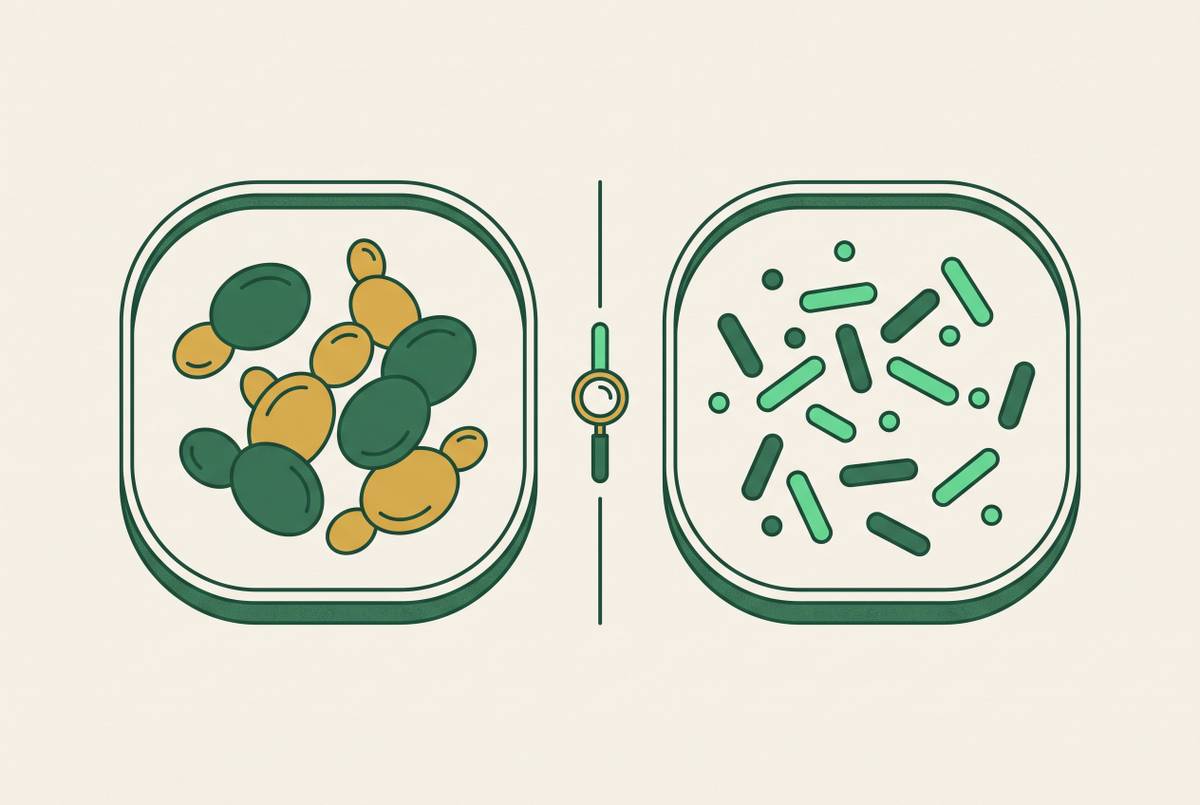
That distinction matters because it reframes what BV actually is. A healthy vaginal microbiome runs on Lactobacillus dominance. These bacteria keep the environment acidic, and that acidity suppresses the anaerobic species that cause trouble when they're allowed to expand. Lactobacillus crispatus does this job best; when its numbers stay high, the whole system tends to stay stable. When Lactobacillus levels drop, anaerobic bacteria, particularly Gardnerella species, move in fast.
Lactobacillus levels don't stay fixed through a month. They rise and fall with estrogen, so the vaginal microbiome runs on the same hormonal clock as the menstrual cycle itself. A system that takes its cues from hormones will have moments when it's strong and moments when it's exposed. Those moments are not random. They repeat, cycle after cycle, in a pattern tied to the hormonal shifts that drive it.
How estrogen protects the vaginal environment during follicular and ovulatory phases
During the follicular and ovulatory phases, rising estrogen builds the conditions Lactobacillus needs to thrive. This is active maintenance that works through a specific mechanism.
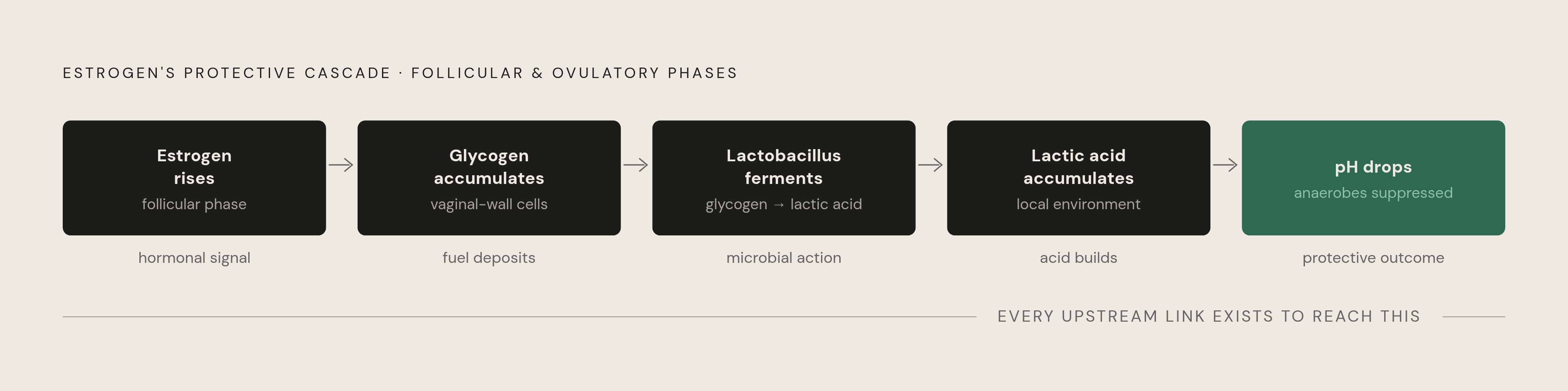
Estrogen drives glycogen production in the cells lining the vaginal wall. Lactobacillus feeds on that glycogen and converts it into lactic acid, and lactic acid is what keeps vaginal pH low. Low pH is hostile territory for the anaerobic bacteria that cause BV. So the chain runs like this: estrogen rises, glycogen increases, Lactobacillus gets its fuel, lactic acid accumulates, pH drops, and anaerobes stay suppressed. Each link reinforces the next, so this phase of the cycle functions less like a lucky accident and more like a system running the way it's supposed to.
This is the stretch of the month when the vaginal microbiome is at its most resilient. Lactobacillus crispatus holds its ground, pH stays low, and the kind of bacterial reshuffling that produces BV has the hardest time getting a foothold. Understanding what "working correctly" looks like matters, because it sets up a sharp contrast with what happens next.
What menstruation does to vaginal pH and bacterial balance
Menstruation is where that protected system takes its hardest hit, and it happens every cycle, to every person who menstruates, through two mechanisms arriving at once.
Menstrual blood is alkaline. When it enters the vaginal environment, it directly raises pH, undoing the acidic barrier that had been keeping anaerobic bacteria in check. At the same moment, estrogen drops sharply at the start of menstruation. That drop cuts off glycogen production, and without glycogen, Lactobacillus loses the fuel it needs to keep producing lactic acid. Pull those two threads together: pH goes up right as the mechanism that would normally pull it back down loses its power source. That combination opens a window where anaerobic bacteria can expand largely unopposed.
This isn't a theoretical concern. Morison and colleagues, writing in Sexually Transmitted Infections, documented this exact relationship in a population study of rural Gambian women, finding that BV prevalence rose in connection with menstrual cycle phase. The biology and the epidemiology point the same direction.
The vulnerability doesn't end when the bleeding stops, either. Lactobacillus crispatus takes time to reestablish dominance after menstruation, so the days immediately following a period carry their own elevated risk. Microbiome diversity climbs during menses and only gradually narrows back down as estradiol rises through the follicular and luteal phases. Symptoms often show up after a period ends rather than during it, because recovery lags behind the disruption. The disruption happens during menstruation. The bacterial overgrowth that follows simply takes a few days to announce itself.
Why BV-associated bacteria form hard-to-displace communities
Once anaerobic bacteria get their opening during the menstrual window, they don't just outcompete Lactobacillus one species at a time. They start working together, and that cooperation is what makes the resulting imbalance so hard to undo.
Lee and colleagues, in a 2025 ISME Journal paper, extended earlier work on these feeding relationships using metaproteomics, building on prior findings that Prevotella bivia supplies ammonia to Gardnerella and to Peptostreptococcus, and that Gardnerella vaginalis supports the growth of Fannyhessea vaginae inside a shared biofilm. They trade resources, propping each other up, and form something closer to a functioning economy than a simple infection.
That structure explains a pattern familiar to anyone who has dealt with BV more than once: treatment that works, followed by symptoms that return. Antibiotics can knock down populations of these bacteria without dismantling the cooperative network that let the community form. Kill off one member; the syntrophic relationships that remain can help the community rebuild.
A 2025 preprint from Klatt and colleagues adds detail to how this plays out before recurrence sets in. Gardnerella and Fannyhessea showed increased transcriptional activity ahead of recurrent episodes, with that activity concentrated in pathways for glycogen and maltose metabolism and iron scavenging. In plain terms, these bacteria were actively competing for the same resources Lactobacillus depends on to survive. The same study found the host side of the equation working against recovery too: cervical tissue showed reduced expression of a family of adhesion molecules alongside increased IL-6 and EREG, markers of impaired epithelial integrity and ongoing inflammation. CEACAM7 in particular stood out as a link between inflammation and microbial activity, and it's a detail researchers are likely to build future diagnostic and treatment approaches around.
Hormonal Conditions That Disrupt Normal Cycling and Amplify BV Risk
The menstrual cycle is the clearest example of hormone-driven vulnerability, but it isn't the only one. Any condition that interferes with normal estrogen support for Lactobacillus, or that disrupts regular cycling altogether, tends to widen or prolong the same window.
Polycystic ovary syndrome offers a clear illustration. Chudzicka-Strugała and colleagues, in an analysis of PCOS patients with suspected BV, found a marked increase in G. vaginalis in more than half of those patients. Elevated pH tracked closely with the presence of clue cells and leukocytes, and as lactic acid bacteria were eliminated, leukocyte counts rose alongside increasing pH. PCOS disrupts the normal estrogen-progesterone balance and often produces irregular or absent cycles. That irregularity removes the dependable follicular-phase recovery window that would otherwise let Lactobacillus reassert itself. Fewer regular cycles can mean fewer chances for the microbiome to reset.
The flip side of that logic applies to hormonal contraception. Combined methods that suppress the natural rise and fall of estrogen and progesterone also smooth out the sharp estrogen drop and alkaline blood exposure that define the menstrual vulnerability window. Stabilizing the hormonal environment, by this mechanism, may lower BV risk rather than raise it. The same hormonal logic driving menstrual vulnerability runs in the other direction when cycling itself is dampened.
What BV symptoms look like
Recognizing BV starts with knowing what it tends to look like, and how that differs from the condition it's most often confused with.
BV typically shows up as a thin, grayish discharge with a noticeable fishy odor. A yeast infection looks and feels different: thick, white discharge, strong itching, and usually no distinct odor. The symptom profiles are distinguishable once you know what to look for. The trouble is that both conditions tend to surface in the days following menstruation, since yeast infections can also follow the same pH and flora shifts that menstruation sets off. That overlap in timing leads a lot of people to reach for an over-the-counter antifungal when what they're actually dealing with is BV. Treating BV as a yeast infection doesn't just fail to resolve it. It can delay effective treatment and let the bacterial imbalance deepen in the meantime.
What if the symptoms seem to come out of nowhere every single time? They don't, once the cyclical pattern is on the table. Recurrence that seems random in the moment usually isn't, when it's mapped against the menstrual cycle.
That mapping is useful information to bring into a clinical conversation. Telling a provider "I get this after every period" does more than describe a symptom. It reframes a single episode as a recurrence pattern, which changes the kind of care conversation that follows. Habits can also make the post-menstrual window riskier than it needs to be. Douching, for instance, adds disruption at exactly the point when the microbiome is already working to recover, and Klatt and colleagues (2025) found that practices like this amplified recurrence risk. Naming the pattern out loud, to a clinician, is a legitimate form of self-advocacy. It turns a vague complaint into a specific, trackable signal.
BV's Health Consequences and Cycle-Linked Recurrence
Recurrent BV is not a pattern to shrug off. Klatt and colleagues note that BV carries real clinical and public health consequences beyond discomfort, including obstetric complications, pelvic inflammatory disease, and an increased risk of sexually transmitted infections, including HIV.
The community dynamics described earlier compound that risk over time. Because BV-associated bacteria form cooperative, syntrophic communities rather than acting as isolated invaders, each episode that goes untreated or under-treated may make it easier for that same community to reestablish itself at the next menstrual window. Recurrence in this model isn't just frequent. It feeds itself, cycle over cycle.
There's a cost to this pattern that doesn't show up in a lab result, too. Recurrent symptoms without a clear explanation wear on self-esteem and on relationships, and that emotional toll sits alongside the clinical risks rather than separate from them. Taken together, these consequences are the reason this pattern deserves consistent medical attention rather than quiet repetition. Understanding why the recurrence happens on a schedule is also the first step toward managing it, which raises the question of what standard treatment actually accomplishes, and where it falls short.
Why antibiotic treatment alone does not resolve recurrence
Antibiotics clear symptoms. They don't necessarily rebuild the microbiome conditions that would prevent the next episode at the next menstrual window, and the data show that gap clearly.
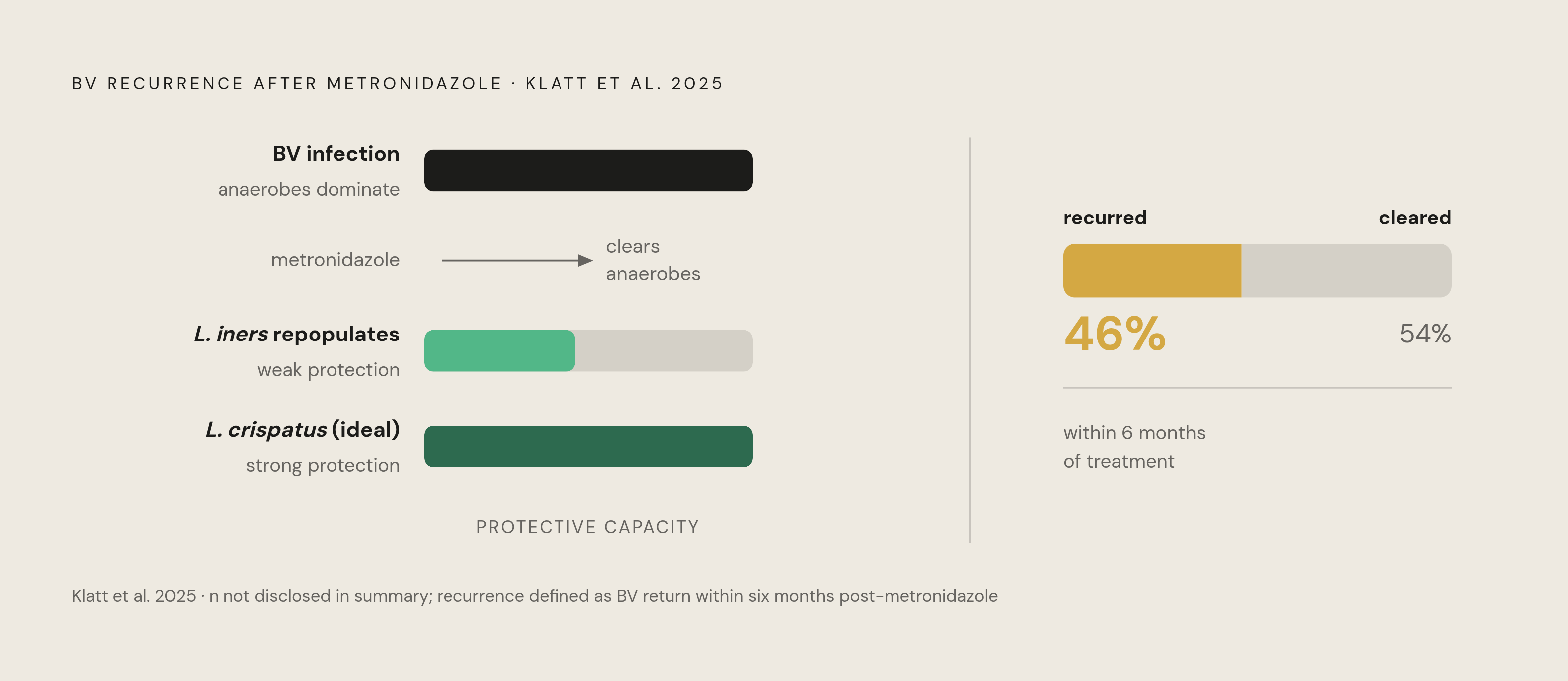
Klatt and colleagues (2025) followed participants over time and found that recurrence occurred in 46% of them within six months of metronidazole treatment, roughly half the group. Recurrence wasn't a random relapse. It was preceded by host-microbiome disruptions that persisted even after the antibiotic course had ended.
Part of the explanation lies in which bacteria move back in once treatment clears the field. Antibiotics suppress the harmful anaerobes, but the species that often repopulates the vagina afterward is Lactobacillus iners rather than Lactobacillus crispatus. L. iners is a far less protective species. It doesn't rebuild the same acidic, stable environment that L. crispatus maintains. The microbiome looks clear on a follow-up exam but remains fragile underneath, fragile enough that the next menstrual cycle, with its alkaline blood and estrogen drop, can tip it back into dysbiosis.
Sources
- Bacterial vaginosis: a sexually transmitted disease?
- Syntrophic bacterial and host–microbe interactions in bacterial vaginosis
- Host-microbe interactions characterized by gene expression of cervical adhesion molecules, cytokines, and growth factors define the recurrence of bacterial vaginosis
- Bacterial Vaginosis (BV) and Vaginal Microbiome Disorders in Women Suffering from Polycystic Ovary Syndrome (PCOS)
- Bacterial vaginosis in relation to menstrual cycle, menstrual protection method, and sexual intercourse in rural Gambian women - PMC
- Vaginal microbiota changes during a natural menstrual ...