Prescription Retinoids for Acne and Skin Aging
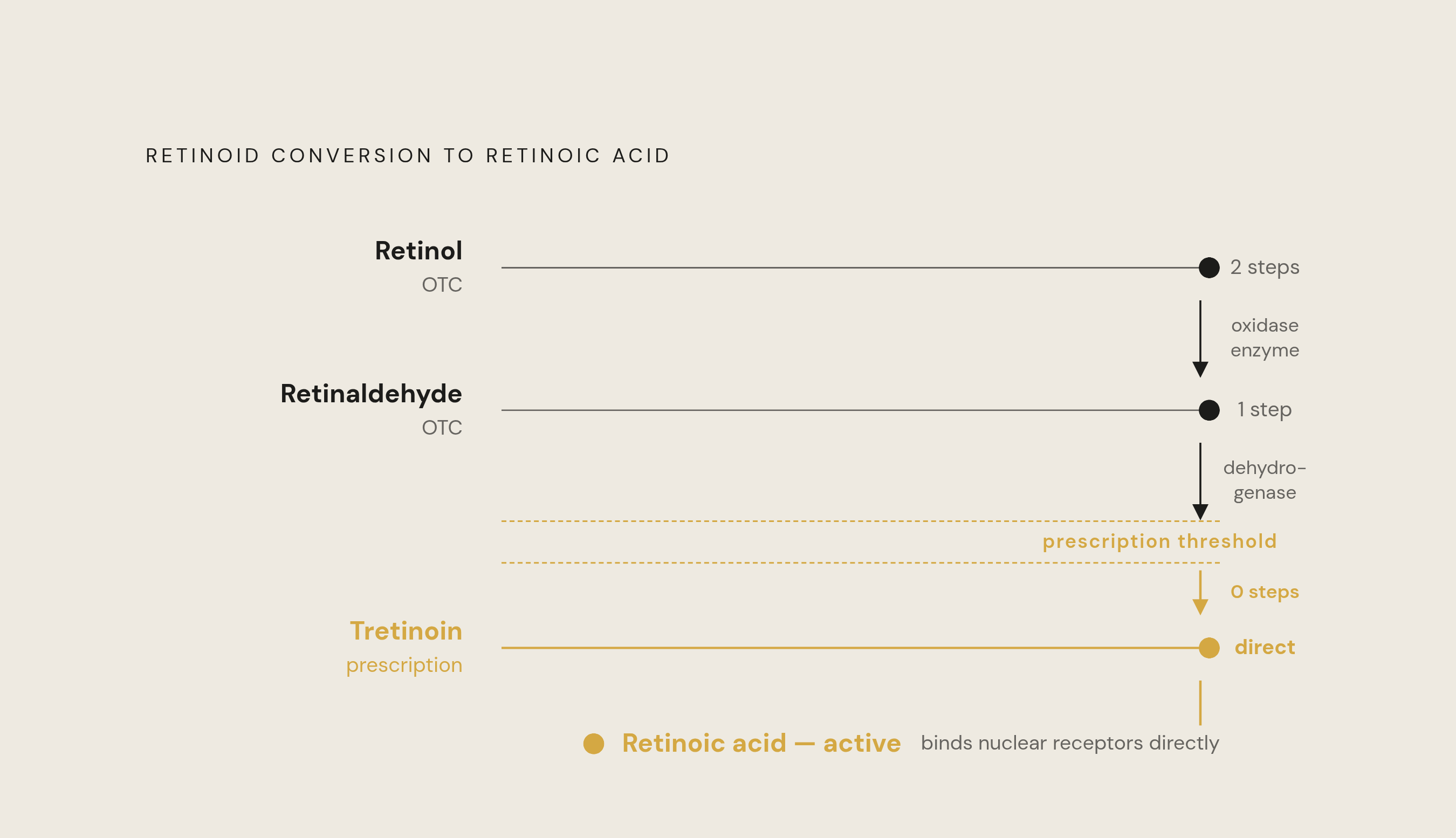
Prescription retinoids and the vitamin A derivatives sold over the counter come from the same family, but they don't work at the same speed or strength. Retinol, the most common over-the-counter ingredient, needs two separate enzyme conversions inside the skin before it becomes retinoic acid, the form the skin can actually use, while prescription retinoic acid requires none. Retinaldehyde, also sold without a prescription, needs just one conversion step. Retinoic acid itself, the form found in prescription tretinoin and related drugs, skips the conversion process entirely and binds directly to receptors in skin cells the moment it's applied.
Retinoid strength tracks the number of steps standing between the product in the tube and the active molecule. Fewer steps means a faster, stronger effect, and it also means more potential for irritation. That's the tradeoff built into the chemistry, and it's why a prescription retinoid can't simply be swapped for a stronger dose of an over-the-counter one.
Once retinoic acid is active in the skin, it binds to nuclear retinoic acid receptors and retinoid X receptors inside keratinocytes and fibroblasts, the cells that make up the skin's outer layer and its supportive tissue underneath. That binding changes how those cells read their own genetic instructions. Retinoids don't sit on the surface doing cosmetic work. They reach into the cell nucleus and change gene transcription directly, which is a different order of biological activity than most skincare ingredients achieve.
That distinction sets the practical boundary between the two categories. Over-the-counter retinoids make sense for sensitive skin, mild acne, and early anti-aging prevention, where a slower, gentler conversion process is an advantage. Prescription retinoids are built for moderate-to-severe acne, significant photoaging, or situations where the over-the-counter route has already been tried and hasn't done enough. Neither category is better in the abstract. They're matched to different jobs.
How retinoids address the biology of acne and photoaging
Tretinoin treats two conditions that look nothing alike on the surface, acne and sun-damaged skin, using the same underlying biological lever: control over how skin cells divide, shed, and rebuild their supporting structure. The clinical results differ because the downstream pathways differ, but the starting mechanism is identical.
In acne, the problem begins inside the sebaceous gland duct, where dead skin cells build up faster than they shed and clog the pore. Retinoids correct that by regulating the shedding process inside the duct, cutting back the enzyme activity that drives oil production, and blocking sebocyte division, the cell division that keeps oil glands overactive. The acne benefit comes from interrupting the blockage at the point where it starts, not from drying out the surface of the skin.
Photoaging runs on a different kind of damage. Matrix metalloproteinases are the enzymes that chew through collagen and elastin faster than sun-damaged skin can rebuild them, so blocking them gives the skin's repair process a chance to catch up.
Photoaging differs from the aging that happens regardless of sun exposure in one important way: it's largely preventable, and a meaningful part of it can be reversed. Tretinoin's mechanism carries clinical weight beyond cosmetic promise. The FDA approved tretinoin for acne in 1971 and for photoaging in 1995, specifically for the palliative treatment of photodamage, and a review in Advances in Therapy identifies tretinoin as the topical retinoid with the strongest clinical evidence behind its anti-aging activity.
None of that means tretinoin undoes aging at the structural level. One drug, one receptor-level mechanism, two very different clinical results, and clear limits on both.
That one mechanism producing two different outcomes raises a natural question: if the biology is shared across the retinoid class, why does it matter which specific retinoid gets prescribed?
How tretinoin, tazarotene, adapalene, and trifarotene differ in practice
It matters because potency, tolerability, and FDA approval don't move together in lockstep across this drug class. Tretinoin, tazarotene, adapalene, and trifarotene all work through the same retinoic acid receptor pathway, but they differ enough in how hard they hit and how well patients tolerate them that treating one as interchangeable with another isn't a neutral substitution.
Tretinoin comes in concentrations from 0.01% up through stronger prescription strengths, and it carries FDA approval for both acne vulgaris and facial wrinkles, with mottled hyperpigmentation and rough skin texture folded into that same photodamage approval. A 2025 updated review in the Journal of Clinical Medicine traces that evidence base across acne, photoaging, and even skin cancer.
Tazarotene sits a step up in strength. A 2025 analysis in Scientific Reports ranked it among the stronger performers for treating facial aging, and it carries FDA approval as an adjunctive treatment for fine wrinkling, mottled hyper- and hypopigmentation, and benign facial lentigines, the flat brown spots that show up with sun damage. The cost of that extra strength is more dryness, redness, and irritation than tretinoin typically causes, which makes tazarotene a better fit for patients with more advanced photoaging who can tolerate a stronger agent.
Adapalene occupies both sides of the counter. At that higher strength, adapalene sits alongside tretinoin and tazarotene as a prescription-tier option for moderate-to-severe acne.
Tretinoin's reach extends well past acne and wrinkles. Smaller randomized trials and prospective studies support its use for melasma, post-inflammatory hyperpigmentation, stretch marks, flat warts, alopecia areata, androgenetic hair loss, hypertrophic scars and keloids, actinic keratosis, and as a pretreatment before chemical peels or laser resurfacing. That range is part of why tretinoin holds its position as the reference point for the whole class.
None of these comparisons settle which drug is "best." A dermatologist weighs diagnosis, skin type, how a patient's skin has handled topical treatments before, cost, and personal preference before landing on a formulation and strength. That weighing is the actual clinical work, and it's the reason the next question, who should start with which retinoid, doesn't have a one-size answer.
Choosing a retinoid and strength by patient type
Matching a patient to the right retinoid and the right strength is where the comparative facts above turn into a real decision, and getting that match wrong is the single biggest reason people give up on a treatment that would have worked if they'd started differently.
Skin type and sensitivity history set the starting point. Someone with sensitive skin generally does better beginning at a lower strength, tretinoin 0.025% rather than jumping to a stronger concentration, and building tolerance from there rather than risking an irritation flare that ends treatment in week one.
Darker skin tones call for extra care in that same starting decision. Retinoids benefit people across all skin colors, but patients with darker skin face a higher risk of developing hyperpigmentation as a side effect. That risk should shape which agent gets chosen and what strength it starts at, not rule retinoids out.
Certain presentations are signals to involve a dermatologist before starting anything: skin allergies, generally dry skin, moderate-to-severe acne scarring, or hormonal acne. Each of those complicates how skin will respond, and a clinician's judgment at the outset heads off problems that are harder to untangle once treatment is underway.
Tazarotene generally isn't a first retinoid for most patients. It tends to get reserved for people with more advanced photoaging who've already shown they tolerate a milder retinoid well, or for patients with a specific clinical reason to need the extra strength.
For mild acne or early anti-aging prevention, starting with over-the-counter adapalene or retinol is a reasonable first move. Stepping up to prescription tretinoin makes sense once the over-the-counter route hasn't done the job, or when the presentation is moderate-to-severe from the start.
Oral isotretinoin sits in a category by itself. It's reserved for severe or treatment-resistant acne, it's governed by the iPLEDGE REMS program, and none of the topical strategies described above apply to it the same way. Topical and oral retinoids solve different problems and carry different risk profiles, and conflating the two leads to confusion about what each can realistically do.
The through-line across every one of these starting decisions is that a clinician's assessment, not a product label, is what makes the match reliable.
The adjustment period most patients misread as failure
Redness, dryness, peeling, and skin that looks worse before it looks better: these are the side effects that convince most patients a retinoid isn't working, and they're also the most predictable, most temporary, and most manageable part of the entire treatment.
Expect some combination of erythema, dryness, flaking, stinging or burning, and heightened sensitivity to sun in the first weeks of use. These effects are transient and ease as the skin adjusts with continued, consistent use. They're part of the skin adapting to a drug that's actively changing how its cells divide and shed, not a sign that something has gone wrong.
The breakouts that follow are existing congestion arriving early, not an allergic reaction or evidence the wrong drug got prescribed.
A standard protocol limits how rough that adjustment period feels. Start at a lower strength or a lower frequency, every other night rather than nightly, and apply only a pea-sized amount across the whole face before bed. Broken or sunburned skin shouldn't get the product at all until it's healed.
Photosensitivity isn't a side note during this period. Daily sunscreen, applied before sun exposure and reapplied through the day, along with protective clothing and avoiding peak sun hours, function as part of the treatment itself.
Certain other actives make the adjustment harder if they're layered in at the same time.
Patience has a specific number attached to it. Visible improvement is measurable by 8 to 12 weeks of consistent use. Most "this retinoid didn't work for me" stories trace back to patients expecting faster results and stopping before that window closes. Beyond that initial window, studies following patients over longer stretches of use show continued improvement in skin outcomes rather than a plateau, which is the clearest argument for staying the course through the rough early weeks.
The specific risks that require clinical oversight before and during treatment
Long-term retinoid use is generally safe, but certain situations call for a clinician's direct involvement. Pregnancy, darker skin phototypes, and severe or scarring acne each carry stakes that online guidance can inform but shouldn't try to replace.
Pregnancy is the clearest line. Topical retinoids should be avoided during pregnancy. Topical forms have limited systemic absorption, but systemic retinoids carry documented teratogenic risk and can cause severe birth defects, so anyone who becomes pregnant while using a retinoid of any kind should stop immediately and contact a clinician.
Oral isotretinoin carries a teratogenic risk in a different category altogether from anything applied topically. A five-year retrospective study published in the Journal of Clinical Medicine tracked the adverse event profile of oral isotretinoin across a large patient group, finding xerosis, meaning dry skin, in 70% of patients, with retinoid dermatitis and cheilitis, inflammation and chapping around the lips, as the other leading effects.
Darker skin phototypes carry an elevated risk of hyperpigmentation with retinoid use, and that risk should guide which agent gets chosen and how closely a patient gets monitored. It's a reason to involve a clinician who accounts for that risk directly, not a reason to avoid retinoids.
Certain reactions mean stopping immediately and calling a dermatologist: severe swelling, blistering, widespread skin erosion, or irritation that doesn't ease up. These sit outside the range of normal adjustment symptoms and need direct clinical attention.
Acne with a real risk of scarring, a diagnosis that isn't clear, or a situation that might call for a biopsy needs in-person dermatology. Telehealth isn't built to handle those cases.
How telehealth has changed who can access a retinoid prescription and what that evaluation looks like
Telehealth has opened up clinician-supervised retinoid prescribing to most people dealing with mild-to-moderate acne or photoaging, and for that access to actually help someone, the evaluation behind it needs to be as thorough as what a patient would walk through in person. Convenience alone doesn't guarantee the right match. The quality of the questions asked during that evaluation does.
A typical asynchronous telehealth visit for skin concerns involves an online questionnaire, photographs of the affected skin, and a short medical history, all reviewed by a licensed clinician who either writes a prescription or recommends an in-person visit instead. Dermatologists have historically been the main prescribers of tretinoin, but primary care physicians, nurse practitioners, and physician assistants can all prescribe it too, and telehealth widens access to that entire group of qualified prescribers.
What separates a thorough telehealth evaluation from a rushed one comes down to the questions being asked. A clinician doing this well is asking about skin type, past sensitivity to products, any prior retinoid use, current medications, reproductive status, and the specific problem the patient is trying to solve, not simply glancing at a photo and sending off a prescription. Those questions are exactly the inputs that the matching logic described earlier depends on: skin type, sensitivity history, diagnosis, and goals. A telehealth visit that skips them isn't really doing the clinical work the format is capable of.
Isotretinoin remains the clear exception to how far telehealth can stretch. The iPLEDGE program's enrollment and monthly compliance requirements don't fit inside an asynchronous, photo-and-questionnaire model. Oral retinoids stay a separate category from the topical prescriptions telehealth has made far more reachable.
Sources
- Retinoids: Dermatologist Approved Skin Care - Dermatology Advisor
- An Updated Review of Topical Tretinoin in Dermatology: From Acne and Photoaging to Skin Cancer
- Isotretinoin Treatment for Acne Vulgaris: A Five-Year Retrospective Analysis of Clinical and Biochemical Adverse Effects
- Use of Retinoids in Topical Antiaging Treatments: A Focused Review of Clinical Evidence for Conventional and Nanoformulations
- Update: Mechanisms of Topical Retinoids in Acne - JDDonline - Journal of Drugs in Dermatology
- Divergent System Organ Class Safety Profiles of Isotretinoin Versus Topical Retinoids: An EudraVigilance Disproportionality Analysis
- Safety and Efficacy of Fixed-Dose Combination of Adapalene and Benzoyl Peroxide in Acne Vulgaris Treatment: A Systematic Review of Clinical Trials
- Racial differences in tolerability of topical retinoids: A 15-year single-center retrospective cohort study