Hormonal Birth Control Options for People With Skin Conditions
Different progestins affect acne and melasma in opposite ways.
Skin doesn't respond to "birth control" as one category. It responds to specific hormones, in specific doses, and the progestin in any given method matters just as much as whether estrogen is present at all. For anyone managing acne, melasma, or rosacea, the method-by-method differences are the whole decision. They're the whole decision.
To understand why one pill clears skin and another pill (or shot, or implant) makes it worse, start with what's actually happening at the level of the sebaceous gland.
How to read a progestin: the androgenic index that separates skin-friendly from skin-risky formulations
Skin is hormonally regulated tissue. Estrogen, progesterone, and androgens (including testosterone) all shape how much oil the skin produces, how inflamed it gets, and how fast skin cells turn over and shed.
Estrogen tends to work in skin's favor. It suppresses androgen activity and raises sex hormone-binding globulin, or SHBG, a protein that binds up free testosterone circulating in the blood. Bound testosterone can't reach the receptors on oil glands and switch on oil production, so more SHBG generally means less sebum and less inflammation. Androgens do the reverse: they tell the sebaceous glands to ramp up oil output, which clogs pores and feeds the bacteria that cause breakouts.
Progestin is where things get complicated, because progestins aren't one thing. They sit on a spectrum:
- Anti-androgenic progestins block androgen receptors outright, cutting sebum production further, though this can tip some people into dry, tight skin.
- Neutral progestins neither help nor meaningfully worsen acne.
- Androgenic progestins act like testosterone at the receptor, undoing some or all of estrogen's benefit.
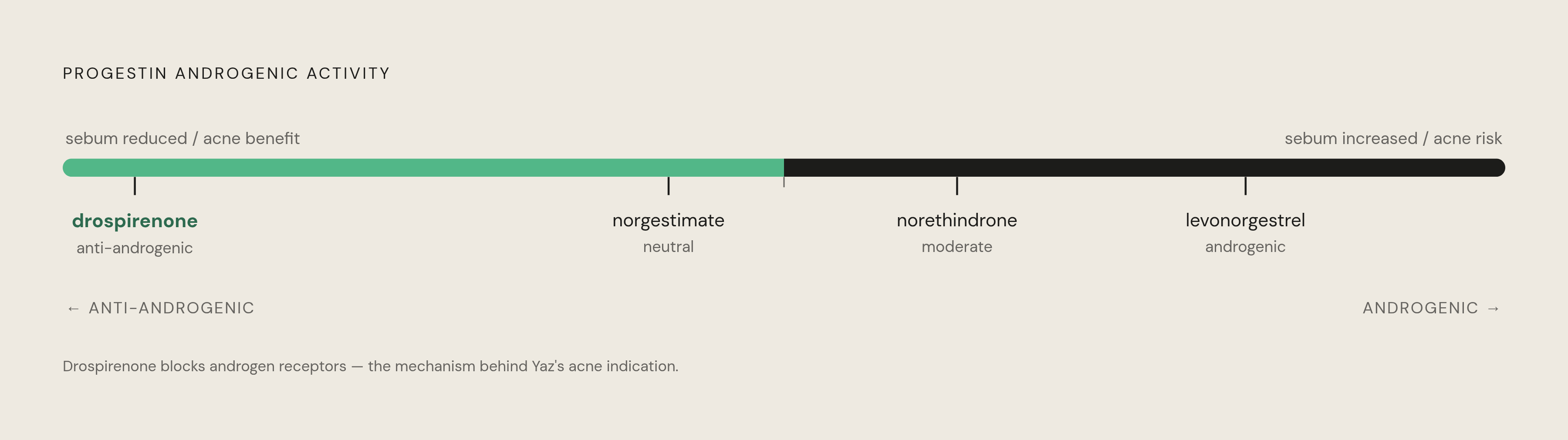
Estrogen's effect across combined methods stays fairly consistent from one formulation to the next. Progestin's effect doesn't stay consistent from one formulation to the next. Two pills with the same estrogen dose can produce opposite skin outcomes depending on which progestin rides along with it, which matters closely for anyone prioritizing skin. Drospirenone lands on the anti-androgenic end. Norgestimate sits closer to neutral, while norethindrone carries more androgenic activity. Others, further down the androgenic end, can work against everything estrogen is trying to do.
Combined oral contraceptives, the patch, and the vaginal ring: what the evidence says about acne benefit
Combined methods, the pill, the patch, and the vaginal ring, all deliver estrogen alongside a progestin. Combined oral contraceptives carry the strongest clinical evidence for acne improvement among hormonal contraceptives: the estrogen component raises SHBG and dials down androgen activity, giving skin a baseline benefit regardless of which specific product is used.
A 2025 review in Clinical, Cosmetic and Investigational Dermatology found that after six months on a combined oral contraceptive, roughly two-thirds of participants reported fewer inflamed pimples. That's a meaningful number. But sit with the other third for a second: about one in three people saw no such improvement. Formulation differences and individual sensitivity to androgens likely explain a good chunk of that gap. "Which pill" matters as much as "pill or not.""
Several combined oral contraceptives carry an FDA indication specifically for acne:
Yaz (drospirenone/ethinyl estradiol): FDA-approved for moderate acne. Drospirenone's anti-androgenic action makes this one of the more skin-targeted formulations on the market. Ortho Tri-Cyclen: FDA-approved for acne, built on norgestimate, a progestin considered relatively low on the androgenic spectrum. Estrostep FE: also FDA-approved for acne. Beyaz: another drospirenone-containing pill with an FDA acne indication, similar mechanism to Yaz.
Not every drospirenone-containing formulation available in other markets carries an FDA acne indication, which matters for anyone comparing notes across borders.
Progestin-only methods, the implant, hormonal IUDs, the shot, and the mini-pill, and why the skin math changes
Taking estrogen out of the equation shifts the whole calculation. Without estrogen's SHBG boost and androgen suppression, a progestin's own androgenic tendencies aren't held in check anymore. Free androgen activity can climb, oil production can rise, and for some people, acne gets worse rather than better.
This is the category where caution matters most:
Hormonal IUDs (Mirena, Kyleena, Liletta, Skyla): despite releasing progestin locally rather than systemically, all four are flagged as methods most likely to worsen acne. Nexplanon, the single-rod arm implant releasing etonogestrel, carries the same flag. Depo-Provera, the injectable medroxyprogesterone acetate shot given roughly every three months, is likewise associated with acne worsening. The mini-pill (progestin-only pill) lacks estrogen's balancing act entirely. It can raise free androgens and worsen acne, with breakouts tending to cluster along the jawline and chin, a pattern that's a useful clue in itself when trying to figure out whether acne is hormonally driven.
There's a rosacea signal here too, worth taking seriously even though the science is still settling. A 2024 research letter in the Journal of the American Academy of Dermatology found a significant uptick in rosacea risk among women using levonorgestrel-releasing IUDs, compared with those using non-hormonal or other contraceptive methods. Researchers point to possible local vascular and immune changes, but the exact mechanism is still being worked out. Not proof of causation, but a real enough association that it belongs in a conversation with a clinician.
Progestin-only methods also strip away estrogen's cushioning effect on skin hydration. For some, that means sebum drops enough to trigger dryness, eczema flares, or a general spike in sensitivity, the flip side of the same coin that can worsen acne in others.
Melasma: why some skin conditions call for avoiding hormonal methods altogether
Melasma shows up as brown or gray patches on the face, usually the cheeks, forehead, or upper lip, and it's driven by melanocytes overproducing melanin in response to hormonal signals combined with UV exposure. Synthetic estrogen in hormonal birth control is one of those signals, and it can stimulate melanin production noticeably in people with a genetic predisposition toward it.
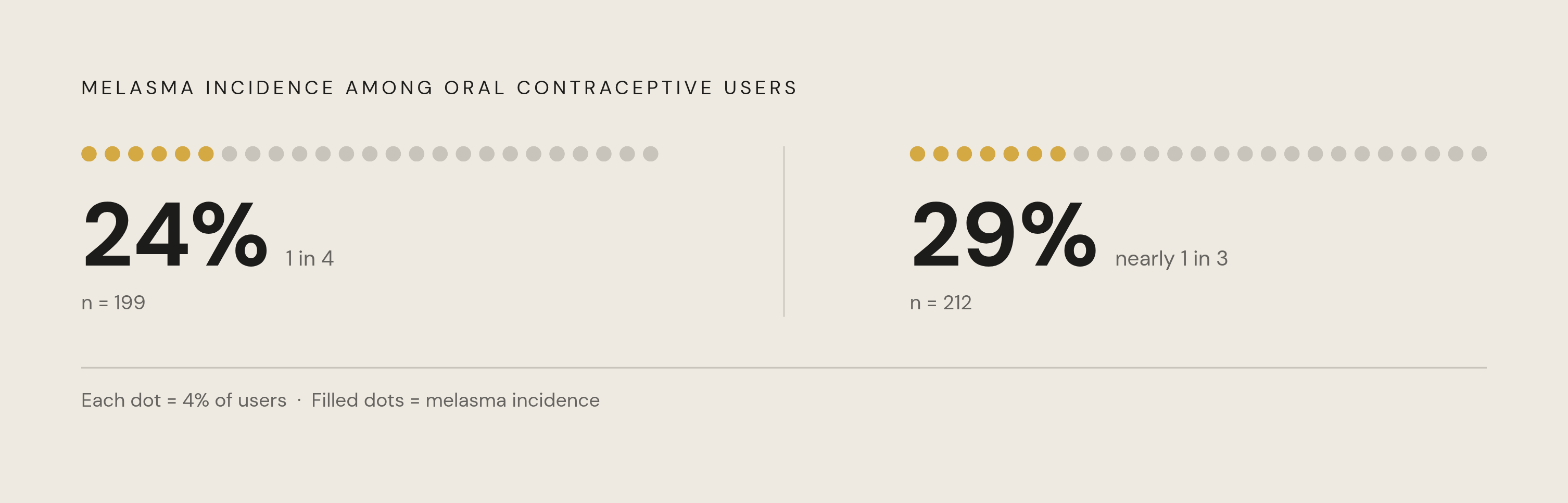
Two figures put real numbers on how common this is. In one study of 199 participants taking oral contraceptives, 24% developed melasma. In a second study of 212 participants, 29% reported melasma as a side effect.
Sit with those numbers for a moment: roughly one in four to nearly one in three people in these samples developed melasma while on oral contraceptives. Roughly one in four to nearly one in three people in these samples developed melasma while on oral contraceptives, a substantial minority rather than a rare edge case buried in the fine print. Roughly one in four to nearly one in three people in these samples developed melasma while on oral contraceptives, so anyone with a personal or family history of melasma should raise it before starting or continuing a hormonal method, not after patches appear on the skin.
Spironolactone as a parallel or complementary tool for hormonally driven acne
Spironolactone started life as a potassium-sparing diuretic, prescribed for blood pressure and fluid retention. Dermatology adopted it off-label because of its anti-androgen effect: it blocks androgen receptors directly, cutting sebum production at the source rather than relying on estrogen to do the work indirectly.
The evidence behind this use has grown substantially. A 2025 review in JAAD Reviews searched Medline, Embase, Web of Science, and Cochrane from inception through February 2025 and turned up 16 randomized controlled trials plus 52 nonrandomized studies looking at spironolactone for acne vulgaris in women. Two well-designed, placebo-controlled trials showed benefit at daily doses of 50 to 100 mg. A separate 2025 study found 80% of female patients saw significant improvement on a median dose of 100 mg per day, and broader clinical evidence puts success rates for women with hormonal acne patterns somewhere in the 75 to 85% range. Broader review-level evidence has backed this up further, pointing to real clinical benefit without a meaningful rise in side effects.
The AAD acne guidelines support spironolactone as an option, factoring in severity, how well a patient tolerates it, personal preference, and physician judgment, built on accumulating evidence, and a real endorsement.
What makes it a useful complement rather than just an alternative: spironolactone goes after the hormonal driver of acne directly, not the bacteria. That sidesteps antibiotic resistance entirely, and it's part of why prescribing rates have climbed to something close to what's seen with oral antibiotics for acne.
The decision framework: matching method to condition when you talk to a clinician
Three skin profiles, three different starting conversations.
Acne-prone skin: Combined hormonal methods, particularly drospirenone-containing pills like Yaz, or neutral-progestin options like Ortho Tri-Cyclen and Estrostep, carry the strongest evidence as a starting point. Progestin-only, long-acting methods (the implant, hormonal IUDs, the shot) carry a real risk of making acne worse, and this should be discussed before an implant goes in or an IUD gets placed, not after.
Existing or high-risk melasma: Non-hormonal options, a copper IUD or barrier methods, offer the most protection. If a hormonal method is still needed for other reasons, lower estrogen doses paired with rigorous, daily sun protection become the harm-reduction conversation to have.
Rosacea: The evidence here is thinner. There's no proven causal link between combined pills and rosacea, but the JAAD research letter on levonorgestrel IUDs and rosacea risk should be brought up directly with a clinician. Individual hormone sensitivity may play a bigger role than the population-level data can capture.
None of this locks anyone into a single lane. Choosing a contraceptive method and treating a skin condition are separate decisions that can run in parallel. Spironolactone, topical retinoids, and antibiotics can all be layered onto any contraceptive method already in place, which matters most for people who can't or don't want to switch off a method that's working for other reasons.
A short list of questions to bring into that appointment:
- What's the androgenic index of the progestin in this specific formulation?
- Does the acne pattern look hormonal, cycle-linked, clustered on the jawline and chin, or does it look non-hormonal?
- Is there a family history of melasma, and how should that change which method gets chosen?
- If a long-acting method is chosen and skin gets worse afterward, what are the options short of removing it?
Individual hormone sensitivity doesn't follow a script. What clears one person's skin can flare another's, and that variability holds up consistently across every method described here. That's not a reason to guess: it's the reason this conversation belongs with a clinician who can weigh the specific progestin, the specific skin history, and the specific tradeoffs, rather than a general rule about "the pill" that was never true to begin with.