What to Do When a Prescription Is Not Working
Four diagnosable causes explain most skin prescriptions that don't deliver results.
When a skin prescription is not working, the next step is to understand why. Most apparent failures trace back to an identifiable cause, such as the diagnosis, the formulation, the surrounding routine or the time treatment needs. Understanding that cause gives patients a way to move forward with their clinician instead of abandoning treatment or cycling through products alone.
Why a prescription stops working is usually diagnosable, not random
The phrase “not working” describes an outcome, but it does not explain it. A treatment that never helped presents a different question from one that helped at first and then seemed to lose its effect. Skin that gets irritated during treatment also needs to be assessed differently from skin that stays the same.
The diagnostic task is to connect that outcome to its cause. Access to a prescription is only part of what medical care offers, because a stronger ingredient cannot correct a mistaken understanding of the problem. Without that explanation, stopping treatment or buying something new may simply carry the unresolved problem into another routine.
The four mechanisms that explain most prescription failures
The first mechanism is a wrong diagnosis from the start. Skin problems can look alike, which makes self-diagnosis hard to trust: dehydrated skin can be mistaken for oily skin, rosacea or fungal acne for stubborn acne, and a product reaction for a chronic condition. Strong benzoyl peroxide aimed at fungal acne illustrates the mismatch. Layering retinol on an already-compromised barrier can similarly treat an assumed condition while aggravating the barrier damage. Neither an OTC product nor a prescription can compensate for that mismatch.
The second mechanism is an inadequate concentration or formulation. Dr. Shainhouse, a board-certified dermatologist, explains the problem this way. “It may be the proper ingredient, but the concentration is so low that by the time some of it reaches the target area in the skin, there's not enough to have a qualifiable or quantifiable effect.” The ingredient’s form also matters, since OTC retinols must convert to retinoic acid inside the skin, while prescription options such as tretinoin are already active. The right ingredient on the label does not, by itself, establish that a product can deliver the needed effect.
The third mechanism is interference from the surrounding routine. Exfoliating acids added to a prescription retinoid without clinician approval, an OTC acne cleanser used with a prescription acne cream, or skipped SPF during treatment with photosensitizing actives can undermine the plan. More treatment is not necessarily better treatment. Layering too much can strip the barrier and cause irritation and more breakouts, so the prescription may seem to be at fault for a problem caused by the combination.
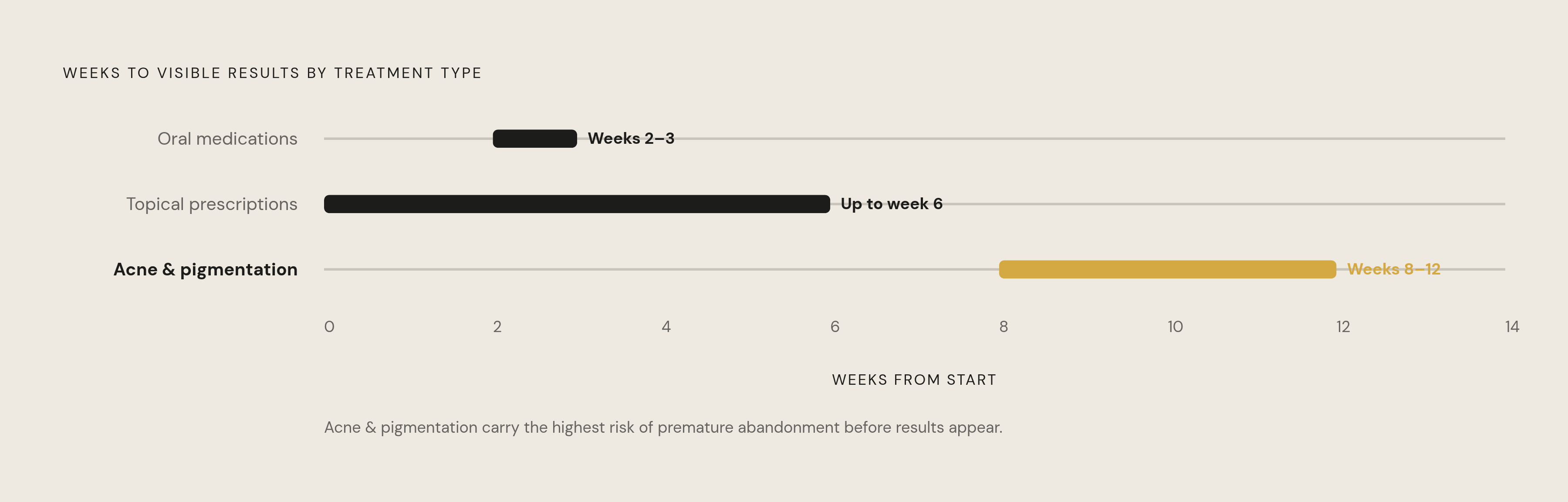
The fourth mechanism is insufficient time on therapy. Oral medications usually show results in two to three weeks, while topical prescriptions can take up to six weeks, and acne and pigmentation usually start to look better at weeks eight to twelve. These windows describe different treatments and outcomes. Stopping treatment before it has had the expected time to work can make a plan that works seem to have failed.
Misreading the skin's response during treatment — and the purge versus reaction distinction
Waiting gets much harder when skin looks worse. Redness, dryness and peeling can occur during the initial adjustment to prescription retinoids, a period called retinization. These changes can be temporary. They are not, however, a reason to assume that every uncomfortable response is harmless. Dr. Fricke explains that a dermatologist can choose the right starting concentration to keep discomfort as low as possible during this time.
Purging creates another difficult judgment call because breakouts temporarily increase as cell turnover accelerates and congestion clears. A purge stays in areas where breakouts already occur and resolves within weeks. A reaction that spreads, brings unexpected symptoms or keeps getting worse past the expected adjustment period calls for a return to the prescriber. Stopping during a genuine purge or increasing the dose to hurry it along can both keep treatment from working as well as it should.
Changing only part of a treatment can also make the picture harder to interpret. Topical antibiotics used alone risk resistance over time, which is one reason clinicians combine them with benzoyl peroxide or retinoids. Leaving out one part may therefore change how well the prescribed combination works. Access to a clinician during treatment matters as much as the original prescription when the patient is trying to distinguish adjustment, harm and an altered treatment plan.
When the condition itself has changed and the original diagnosis is now outdated
A routine that helped for six months and no longer does raises a different possibility. The original diagnosis may have been right, but the condition may have changed. Treating that shift as a simple need for higher strength can miss the reason the old plan has stopped helping. Reassessment is therefore part of managing an ongoing condition.
Hormonal changes make the distinction clear. Deep, cystic breakouts that regularly appear along the jawline are often hormonal in origin. A surface product cannot address the hormonal change itself, even if topical treatment has a role in managing the skin. That pattern calls for a targeted clinician-directed strategy rather than another attempt to intensify the same routine.
Treatment can also become part of the new problem. Hydroquinone, widely considered the gold standard for hyperpigmentation, can cause paradoxical darkening called ochronosis when used improperly or for too long. Dr. Fricke identifies pigmentation that is becoming darker or more persistent, and chronic redness that keeps returning, as reasons for dermatology care. Without updated care, chronic conditions can lead to scarring, deepening pigmentation or the masking of a more serious underlying problem.
What to actually do when a prescription appears to fail
Start by checking whether the routine is interfering with treatment. Simplify it to the prescription, a basic moisturizer and SPF, and review additional OTC actives, including exfoliating acids, benzoyl peroxide and extra retinols. This means removing unapproved additions while keeping prescribed components of a combination treatment. The AAD recommends applying moisturizer or sunscreen after prescription medications.
Next, check expiry and storage conditions. Heat from hot showers and other temperature extremes can affect product stability, so a bathroom may expose products to conditions that degrade active ingredients. The FDA states that temperature changes and exposure to sunlight and air can alter the color and texture of cosmetics, while moisture can make bacterial and fungal growth easier. That guidance concerns cosmetics, but how all products are stored belongs in a review of the whole routine. A degraded product presents a different problem from an unsuitable treatment plan.
Then match the concern to the prescriber’s role. Changing, worsening, spreading or unexpectedly unresponsive symptoms need reassessment, as do significant, persistent or worrying tolerability problems. A pharmacy can flag the need for follow-up, but revising the diagnosis and treatment plan belongs with the prescriber. Ask whether the treatment still fits what the skin is doing now. Dr. Fricke explains that a dermatologist can distinguish the need for stronger treatment, a combination approach or attention to an underlying medical condition.
While that question is being resolved, let the simplified routine give the skin time to stabilize before reintroducing actives. Avoid picking or manipulating breakouts, which increases scarring risk. Manage controllable triggers, including stress, sleep, diet and contact surfaces such as phone screens and pillowcases. These steps support treatment without substituting for reassessment.
When OTC products genuinely cannot substitute for a prescription, and how to tell
OTC products have a useful place in mild concerns and maintenance. The boundary appears when the condition needs a depth of action, concentration or mechanism that those products cannot provide. Dr. Fricke at Alamo Heights Dermatology says prescription products “penetrate deeper, act faster, and have more predictable results” because they contain higher concentrations of clinically proven actives. That distinction makes diagnosis the basis for choosing between them.
Dr. Fricke identifies painful, cystic or scarring breakouts, increasingly dark or persistent pigmentation, recurring redness or itching, and symptoms that worsen on a consistent OTC regimen as reasons for prescription intervention. These are not simply signs that a favored brand has disappointed.
Hormonal acne shows why the distinction is not always about strength. An oral or systemic treatment guided by a clinician works through a mechanism that an OTC surface product cannot match. Other prescription plans depend on active ingredients or combinations whose roles cannot be reproduced by assembling more products from the shelf. Returning to OTC treatment after a prescription appears to fail may therefore move away from the needed mechanism. The question of whether OTC care is enough deserves a clinical answer.
How telehealth and asynchronous care have changed what follow-up actually looks like
Advice to return to a clinician is only useful if follow-up is reachable. Telehealth offers a way to have that conversation without needing an in-person appointment for every change. The important feature is not the screen or platform, but the clinician’s ability to review what has changed and decide whether the plan still fits.
Synchronous care uses real-time video and can lead to a diagnosis, updated plan or new prescription during the same session. It is suited to first presentations or significant changes in a condition. Asynchronous care, also called store-and-forward care, lets a patient send photos and details of symptoms for a clinician to review later. It is particularly useful for monitoring an established diagnosis when the question is whether treatment needs adjustment. Regular updates can help clinicians track response without frequent in-person visits.
The distinction matters for prescribing as well as convenience. AHPRA’s October 2025 guidance update in Australia treats questionnaire-only and asynchronous-only prescribing as not good practice for new prescriptions. That position separates monitoring from initiating treatment without a real-time conversation. AI tools can help by flagging possible drug interactions, tracking how treatment is working and helping clinicians review it. Those roles do not replace diagnosis or prescribing by a clinician.
For clinically supervised services, submitting updated photos, describing changes and receiving a revised plan is an ordinary follow-up workflow. Remote care nevertheless has limits. Conditions that spread, suspicious lesions and problems that need a physical examination must be assessed in person.
The through-line — systematic steps keep patients in productive treatment, not cycling through products alone
The useful shift is from choosing another product to asking what the response reveals about the condition and the plan. To make that shift, patients need enough understanding to describe the change, recognize when reassessment matters and ask what mechanism the next decision is meant to address.