How Telehealth Prescriptions Are Written and Filled
A step-by-step breakdown of how online prescriptions move from patient to pharmacy.
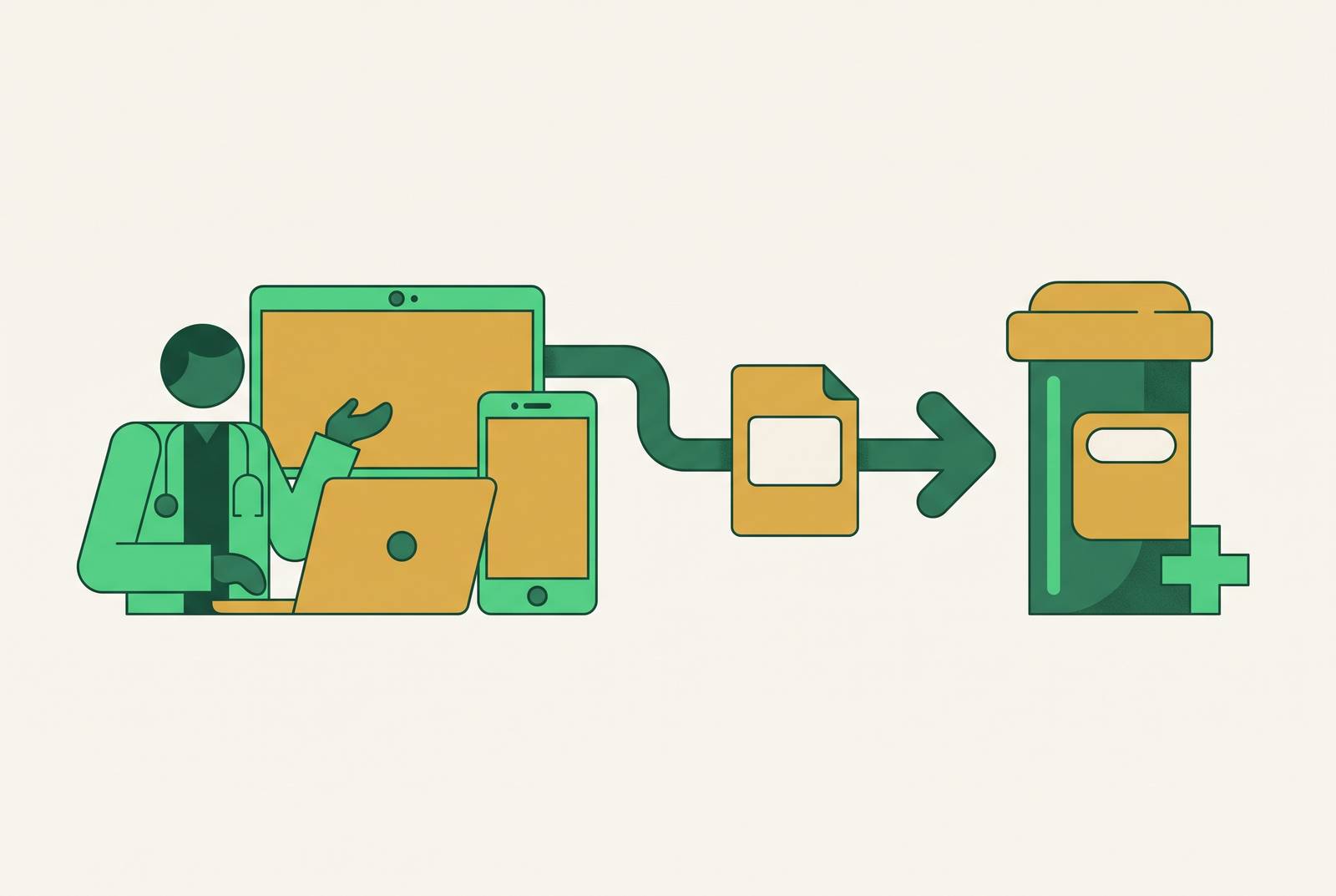
Telehealth prescriptions follow a sequence. This article explains how intake, clinician review, electronic transmission, pharmacy fulfillment, and follow-up fit together. Understanding those steps helps patients know what they need to provide, what happens next, and why a quick consultation does not always mean medication is ready immediately.
Why the telehealth prescription process confuses patients — and why the confusion is fixable
A patient may see a form, an approval message, and a pharmacy notification without seeing the work between them. Intake gathers the clinical facts, review checks whether treatment is right for the patient, electronic transmission sends the prescription, and the pharmacy fills it. When those distinctions are hidden, a wait at one stage can look like a failure at another. Much of the frustration comes from not knowing which step needs the patient’s input and which is already moving without it.
Patients do not need to understand the software to understand who is responsible for the next step. They do need to know that submitting a request is not the same as receiving approval, and that approval is not the same as having medication ready. Those distinctions explain both why some prescriptions move in minutes and why others need more than a short form.
How synchronous and asynchronous telehealth visits differ — and what each means for prescribing
The first distinction is how the consultation happens. Synchronous care means a live video or phone call with a clinician. Asynchronous care, also called “store-and-forward” care, means submitting information that a licensed provider reviews later. That information can include questionnaire responses, photographs, audio recordings, scanned lab results, or wearable device data. The provider then responds with a diagnosis, treatment plan, prescription, or referral.
With an asynchronous visit, the patient fills out the intake before the clinical review, without having to book a live appointment. This model can be clinically sound for dermatology follow-ups, behavioral health check-ins, post-procedure photo reviews, and medication titration. Neither model is better just because of how the visit happens. The useful distinction is whether the encounter gives the clinician the information needed for the particular decision.
What happens during patient intake and why the information collected there drives the whole encounter
Intake is the clinical foundation of the visit. The patient supplies symptoms, medical history, current medications, allergies, and relevant measurements. In an asynchronous encounter, those answers may form the full basis of the consultation. Missing or wrong information is a main cause of prescription delays because the clinician lacks the facts needed to decide safely.
Preparation makes that information more useful. An accurate medication list includes names, doses, and frequency, while photo-based visits need clear, well-lit images. For a birth control intake, questions may cover age, height, weight, and blood pressure. Blood pressure is not an optional detail when considering combined hormonal contraceptives, which carry elevated clot and stroke risk in patients with hypertension. Patients are also usually asked for their insurance information and which pharmacy they want to use, to help avoid delays later.
The purpose of intake also changes with the request. A refill checks whether an established treatment remains appropriate for a stable condition. A new prescription requires enough information to establish a diagnosis and rule out contraindications, meaning reasons the treatment may be unsafe. AI-assisted questionnaires can help put the history of symptoms and medications in order and flag patterns. They do not decide whether the patient should receive the medication.
What the clinician does during review — and where AI fits into that judgment without replacing it
A licensed clinician makes that decision. The reviewer may be a physician, nurse practitioner, or physician assistant licensed in the patient’s state. Their task is to assess the submitted information and the appropriateness of the requested treatment. Human review is a legal and clinical requirement.
AI can help sort possible diagnoses, flag drug interactions that might occur, and bring red flags that call for more care to the clinician’s attention. FDA guidance issued January 6, 2026 clarified that many low-risk AI-enabled software tools fall outside medical device regulation when clinicians can independently review the basis of their recommendations. California signed legislation on September 30, 2026 requiring a licensed professional to have the final say in clinical care decisions when software is used. The distinction is between help with reviewing information and authority to decide treatment.
Review can end in several valid ways. The clinician may approve a prescription, request more information, recommend an in-person visit, or decline to prescribe. A request for clarification can mean the intake has reached the limit of what the clinician can safely conclude.
Which medications telehealth can and cannot prescribe, and what determines the boundary
The main legal dividing line is between non-controlled and controlled substances. Non-controlled medications can generally be prescribed through telehealth without the patient having to make an in-person visit. These include blood pressure and thyroid medications, allergy medications, antidepressants, most antibiotics, hormonal contraceptives, topical prescription treatments, and GLP-1 medications. The clinician still needs enough information to prescribe safely.
Controlled substances in DEA Schedule II–V follow different rules. The DEA and HHS jointly issued a Fourth Temporary Extension (90 FR 61301) on December 31, 2025, keeping pandemic-era telemedicine prescribing flexibilities active through December 31, 2026. Under that extension, a DEA-registered practitioner may prescribe Schedule II–V controlled substances through real-time audio-video telemedicine without first doing an in-person exam, if the conditions set out in the extension are met. Schedule II prescriptions require an audio-video platform meeting HIPAA standards.
These permissions have a defined time boundary. The extension expires December 31, 2026, and the rules for 2027 are not yet settled. Some care also needs an in-person visit no matter which legal class the medication is in. Suspicious moles or lesions need assessment by an in-person dermatologist, while IUDs and implants require in-person insertion. Telehealth can support a consultation without being able to provide every part of the resulting care.
How e-prescription transmission works and what happens between clinician approval and pharmacy receipt
Once the clinician approves treatment, the prescription goes electronically to the pharmacy designated during intake. The patient does not need to carry or deliver it. E-prescribing connects with pharmacy networks nationwide, and most major chains and many independent pharmacies receive transmissions in real time. Synchronous consultations usually take 8–15 minutes, and the prescription is sent as soon as the consultation ends. That speed describes the handoff.
At this stage, confirm that the designated pharmacy is where you want to collect the prescription. Changing it after transmission requires the clinician or platform to re-send it. If local pickup is not the preferred option, check whether the platform offers home delivery through an integrated pharmacy partner. For a new prescription, allow time for the pharmacy to fill it, including any insurance verification. The prescription has now moved from a clinical decision into a separate fulfillment process.
What pharmacy fulfillment involves — pickup, delivery, insurance, and where delays actually happen
After transmission, the pharmacy’s queue, stock availability, and insurance checks largely determine the wait. These processes are mostly independent of the telehealth platform. A prescription can arrive quickly and still take longer to fill. That distinction matters when an approval message seems to promise more speed than the pharmacy can deliver.
With local pickup, the chosen pharmacy processes the prescription through its normal workflow. Straightforward non-controlled medications are typically available the same day. For home delivery, an integrated mail-order or specialty pharmacy ships the medication to the patient’s address. This route is common for prescription skincare, birth control, GLP-1 medications, and chronic-condition maintenance drugs.
Insurance adds another checkpoint. The pharmacy must confirm that the prescribed medication and quantity are covered under the patient’s plan. Prior authorization, which is common with GLP-1s and some specialty medications, can significantly extend fulfillment time. When insurance will not cover the medication, many telehealth platforms and care coordinators can help find generic alternatives, pharmacy discount programs, or assistance programs. A delay at this stage often stems from coverage or supply.
How telehealth prescribing works for specific condition categories patients commonly encounter
For acne, aging, and hyperpigmentation, a photo-based asynchronous workflow is standard. The patient uploads photographs and a detailed medical history, which a telehealth dermatologist reviews before prescribing. Treatments available through this route include prescription-strength retinoids, clindamycin, prescription-strength azelaic acid, and oral medications such as doxycycline or spironolactone. Tretinoin is prescription-only in the United States, with no over-the-counter version at any strength, so access still depends on clinical review even when the visit happens through photos.
Hormonal birth control often uses a predominantly asynchronous intake. Licensed providers can prescribe pills, patches, and rings through virtual consultations, and the measurements discussed earlier help them decide whether a method is right for the patient. The workflow is therefore more than a request for a preferred product. It connects medical history and risk screening to a prescribing decision. Both the first visit and later checks can take place virtually when the provider has the information needed.
For hypertension, diabetes, thyroid conditions, and asthma, stable maintenance treatment is well suited to telehealth refills. Here, the clinician is checking an existing plan. New symptoms, dosage changes, or signs of instability can change that task and lead to an in-person evaluation or lab work before approval. Controlled medications used for ADHD, anxiety, or certain sleep conditions face the additional legal rules described earlier. Patients who get those medications through telehealth should check how their platform plans to keep care going before year-end because access after December 31, 2026 is not settled.
GLP-1 medications for weight management follow the standard intake, consultation, e-prescription, and fulfillment sequence. They are not controlled substances, so federal law allows telehealth prescribing without an in-person visit. Legitimate GLP-1 telehealth programs usually have check-ins each month to see how the patient is doing, adjust dosage, and help manage side effects.
What follow-up care looks like and when telehealth should hand off to in-person care
Filling the prescription is not the end of the care relationship. Most platforms provide secure messaging with the prescribing clinician, medication reminders, and coordination with a primary care provider when appropriate. The follow-up schedule depends on the condition and treatment. Prescription skincare follow-ups assess tolerance and allow formulation changes, sometimes through messaging without a new full intake. At birth control follow-ups, providers check for side effects and re-screen blood pressure when there is a clinical need.
New or worsening symptoms, adverse reactions that require examination, and medication changes needing lab work or blood pressure monitoring can make in-person care the right next step. A handoff responds to a different clinical need. A trustworthy service makes that boundary clear rather than treating every encounter as another opportunity to prescribe.
Understanding the whole sequence gives patients a more useful measure of good care than speed alone. It helps them distinguish a missing intake detail from a pharmacy delay, and a reasonable follow-up request from an unexplained barrier. It also makes clear when to ask for more assessment.