Antibiotics for UTI by Type and When Each Is Used
New antibiotics target bladder infections differently than kidney infections.

Antibiotics for UTI are chosen by infection type. The key distinction is whether the infection stays in the bladder or extends beyond it. Understanding that boundary explains why nitrofurantoin, TMP-SMX, and fosfomycin lead treatment for uncomplicated cystitis, while more serious infections call for a different strategy.
Why the same diagnosis can lead to very different prescriptions
A friend’s UTI prescription may differ from yours, and your latest prescription may differ from an earlier one. That does not necessarily mean someone received the wrong drug. Infections with the same everyday label can have different symptoms and risks of resistance and need different treatments. Before choosing an antibiotic, a clinician needs to establish where the infection is and how ill the patient has become.
The 2025 Infectious Diseases Society of America (IDSA) guidelines spell out how to sort these infections. They are the first-ever IDSA guidelines on complicated UTI, building on the 2010 uncomplicated UTI guidance. Their central dividing line is whether infection is confined to the bladder. Other details then refine the prescription after that first assessment.
How the 2025 guidelines redrew the line between uncomplicated and complicated UTI
The 2025 IDSA guidelines define uncomplicated UTI as infection confined to the bladder in a woman or man without fever. Typical symptoms include pain with urination, urgency, frequency, and suprapubic pain. There should be no flank pain, tenderness at the costovertebral angle, or signs of illness affecting the body more broadly. Men can now explicitly have an uncomplicated UTI, a meaningful change from older practice.
By contrast, fever, chills, rigors, unstable circulation, or flank pain suggest that infection has extended beyond the bladder. Pyelonephritis, or kidney infection, falls within complicated UTI. Urinary devices, including a catheter, stent, or percutaneous nephrostomy tube, also enter the complicated-UTI framework. These distinctions change the antibiotic strategy.
Diabetes, immunocompromise, and urologic abnormalities no longer automatically make an infection complicated, although they can still influence treatment. The 2025 guidelines from a European professional association make a parallel shift toward “localised” versus “systemic” infection. Both approaches put the infection’s reach at the center of the decision. Bacterial prostatitis, epididymitis, and orchitis require separate approaches and are outside this framework.
First-line antibiotics for uncomplicated cystitis and why fluoroquinolones were displaced
For uncomplicated cystitis in women, the main first-line options are nitrofurantoin, trimethoprim-sulfamethoxazole (TMP-SMX), and fosfomycin. Nitrofurantoin is used for a five-day course and has shown exceptional durability against emerging resistance. That durability matters because a useful treatment today should not needlessly narrow treatment choices tomorrow. It is a key part of antibiotic stewardship.
TMP-SMX is given to women as a three-day course, but its use depends on local resistance. It is not recommended for empiric use, meaning treatment chosen before susceptibility results are available, where resistance rates are high. Trimethoprim alone is a three-day alternative for women where TMP-SMX is unavailable or not tolerated. Fosfomycin is a single-dose oral treatment, so it has the simplest schedule of the three. The clinical trial registered as NCT06518291 is directly comparing nitrofurantoin with fosfomycin in women with cystitis, reflecting continued interest in their relative performance.
Fluoroquinolones are no longer first-line drugs because resistance has risen among urinary bacteria in the community and these drugs have their own adverse-event risks. Authors affiliated with the European Medicines Agency (EMA) and EAU have called for more prudent prescribing in primary care. A large retrospective cohort also associated guideline-concordant nitrofurantoin or TMP-SMX prescribing with fewer 30-day revisits than fluoroquinolones, and substantially fewer than beta-lactams. That link supports the first-line approach, though other prescriptions may still be right. Fluoroquinolones still have a role, but the reason for choosing them should fit the infection.
When complicated UTI and pyelonephritis require a different antibiotic strategy
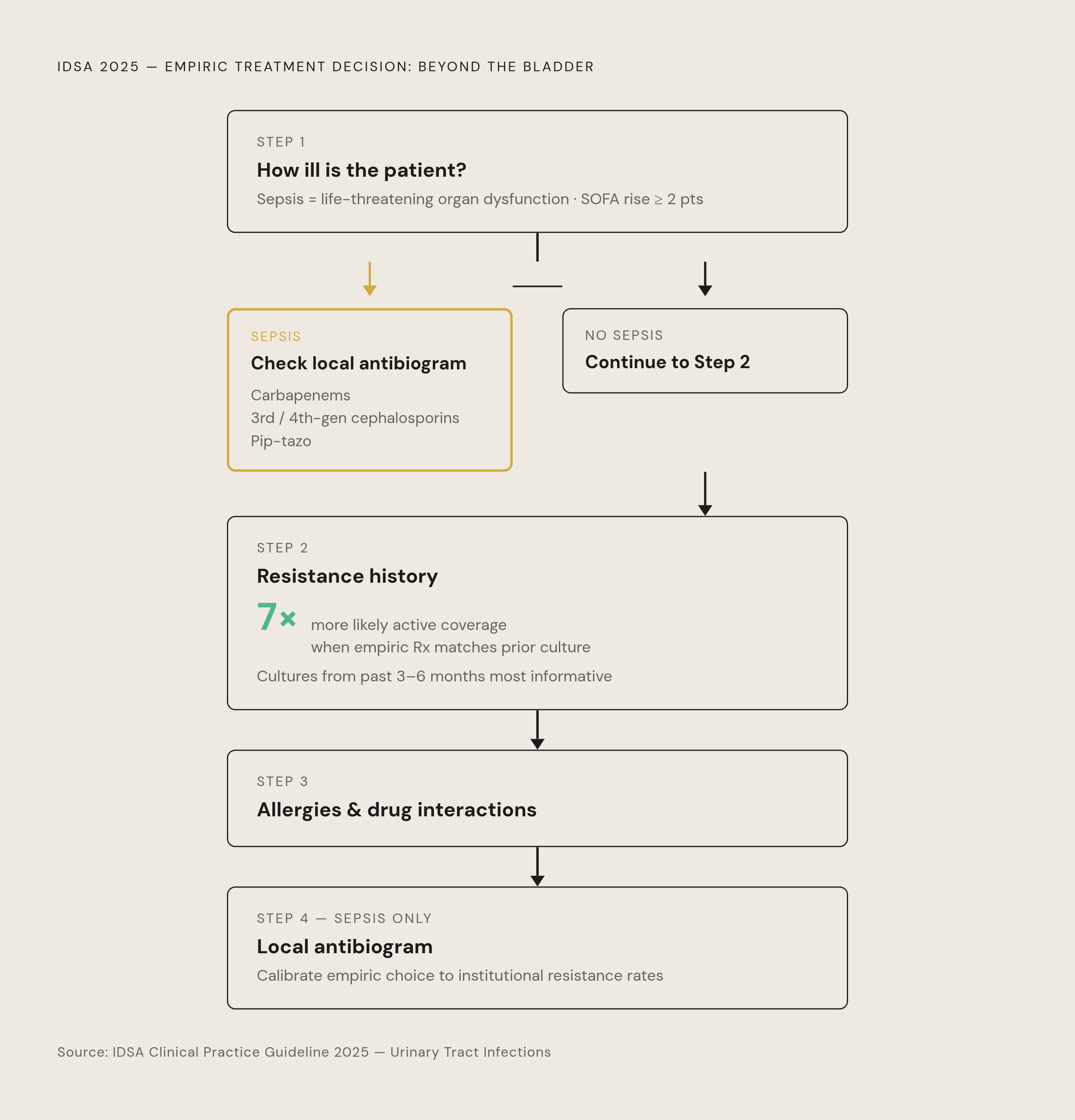
Once infection extends beyond the bladder, the 2025 IDSA guidelines use a four-step framework for empiric antibiotic selection. First comes how ill the patient is, especially whether the patient has sepsis. The Sepsis-3 Task Force defines sepsis as life-threatening organ dysfunction, with a rise of ≥2-point in the SOFA score.
Second comes the patient’s history of resistance, including past urine cultures and antibiotics they have taken. Cultures from the past three to six months are generally most informative, and matching empiric treatment to earlier culture results increases the likelihood of active coverage by at least sevenfold. Third comes checking for allergies and drug interactions that could affect care. Fourth, for a patient with sepsis, comes a relevant local antibiogram, which summarizes susceptibility patterns. The framework therefore moves from immediate danger to the evidence most likely to identify an effective drug.
For complicated UTI with sepsis, options include third- or fourth-generation cephalosporins, carbapenems, piperacillin-tazobactam, and fluoroquinolones. Newer beta-lactam/beta-lactamase-inhibitor combinations, cefiderocol, and aminoglycosides are reserve options. Without sepsis, the same cephalosporins, piperacillin-tazobactam, or fluoroquinolones may be used, while carbapenems and newer agents are reserved for patients with resistant-organism histories.
For oral outpatient treatment of non-septic complicated UTI, fluoroquinolones and TMP-SMX are preferred options. Oral beta-lactams are alternatives, with preference for agents that reach higher urinary concentrations, such as cefpodoxime. Earlier-generation oral cephalosporins and amoxicillin-clavulanate have more variable supporting data. Regardless of severity, the framework advises avoiding fluoroquinolones after fluoroquinolone exposure within the past 12 months.
How resistance patterns shape which drug a clinician actually reaches for
Uropathogenic E. coli (UPEC) causes the large majority of uncomplicated UTIs. Resistance in that species helps show whether a drug chosen empirically will work. A first-line drug in one region may be unsuitable for empiric treatment in another.
However, the relevance of the data matters as much as the reported resistance rate. A prospective Dutch study of community-practice urine samples found lower resistance than national and regional datasets suggested. Empirical success reached 95% for nitrofurantoin and was similarly high for fosfomycin and trimethoprim in that population. The finding raises a careful question about whether broader surveillance can overstate resistance in community patients and encourage unnecessary escalation. It does not establish that resistance is low everywhere.
ESBL-producing bacteria add another layer because they are associated with longer hospitalization and more complications. Their prevalence varies sharply by geography, which further limits the value of a universal prescription. The practical task is to match the patient to the most relevant resistance evidence.
The special case of UTI in men and why fluoroquinolones remain contested there
Men with lower UTI symptoms should receive antibiotics, with urine culture and susceptibility testing guiding the choice. Nitrofurantoin and TMP-SMX are options for uncomplicated infection in men, with seven-day courses, and trimethoprim alone is an alternative. However, the 2025 IDSA complicated-UTI guidelines do not themselves enumerate first-line drugs for uncomplicated male cystitis.
That distinction matters when interpreting duration advice. IDSA’s seven-day recommendation for non-fluoroquinolone antibiotics applies specifically to complicated UTI and excludes uncomplicated cystitis in men, and nitrofurantoin is excluded from complicated-UTI therapy. The EAU guidelines also note that male cystitis without prostatic involvement is uncommon. Where that involvement cannot be ruled out, they mention TMP-SMX and fluoroquinolones for their tissue penetration, but only when susceptibility testing justifies them.
The EMA/EAU letter challenges the tendency toward empiric and prolonged fluoroquinolone use for male UTIs in primary care. The aim is to stop treating male sex alone as proof that a broad or prolonged course is needed. Straightforward bladder symptoms without fever now call for classification and culture-guided treatment rather than an automatic fluoroquinolone prescription.
Gepotidacin and what a first-in-class approval means for the uncomplicated UTI toolkit
The FDA approved gepotidacin in 2025 for females aged 12 and older with uncomplicated UTIs caused by certain susceptible bacteria. It is the first novel oral antibiotic mechanism approved for UTI in decades. Yet high cost limits its place in treatment, and it should be held as a last-line option, with nitrofurantoin or TMP-SMX retaining priority. Its value is in expanding the available choices, especially for resistant infections.
Gepotidacin inhibits two distinct Type II topoisomerase enzymes through a unique binding site, stabilizing a pre-cleavage complex and preventing bacterial DNA replication. It can retain activity against fluoroquinolone-resistant E. coli. The EAGLE-2 and EAGLE-3 phase 3 trials compared it with nitrofurantoin in thousands of participants. Both stopped early after an interim analysis showed that gepotidacin had met its primary efficacy endpoints, with non-inferiority in EAGLE-2 and superiority in EAGLE-3. The results were consistent in groups with recurrent and drug-resistant infections, which supports keeping the drug in reserve.
Why guideline implementation in real hospital systems is harder than writing the guideline
A written guideline cannot make every prescribing decision simple. Clinicians still have to combine symptoms, previous cultures, recent antibiotics, allergies, and local resistance information. Prescribing varies, and patients may get broader antibiotic coverage or longer courses than the guidelines recommend. Implementing the guideline requires applying the full decision process consistently.
The length of a course is another tool for stewardship, though it can get less attention than which drug is used. The 2025 IDSA guidelines specify that acute cystitis episodes in patients with recurrent UTI should receive as short a course as reasonable, generally no longer than seven days. Patient understanding can make that reasoning easier to discuss. Someone told that an infection is uncomplicated and bladder-confined can ask why a ten-day fluoroquinolone course was chosen. That question gives the clinician a chance to explain why the prescription differs from the guidance.
Recurrence, prophylaxis, and the role of non-antibiotic options
A large proportion of women who have one UTI develop recurrent infections within six months. Taking antibiotics again and again can, over time, select for multidrug-resistant urinary bacteria and leave fewer drugs that will work later. For recurrent infection, urine culture and susceptibility testing are part of the treatment decision. The 2025 guidelines also call for testing with treatment failure, prior resistant isolates, or an atypical presentation.
Low-dose antibiotic prophylaxis still works best to prevent infection, but it can lead to resistance, so non-antibiotic choices matter too. The 2025 American Urological Association guidelines offer cranberry as an option for women with recurrent UTIs, with a Moderate Recommendation and Grade B evidence. Its proanthocyanidins inhibit the adherence of P-fimbriated E. coli to uroepithelial receptors.
A prior analysis found that cranberry products reduced recurrences about 30–40% in premenopausal women with recurrent UTIs. But they worked less well than low-dose antibiotic prophylaxis. Guidelines also list other non-antibiotic options, with stronger evidence for some than others, and include drinking more fluids among changes in behavior.
How to use telehealth effectively for UTI — and when to go in person instead
For straightforward uncomplicated cystitis, asynchronous telehealth is a clinically validated care pathway. A 2023 analysis of a national program that treated 51,474 women between 2017 and 2021 found that the rate at which symptoms cleared was statistically similar to published rates for in-person care. Physicians followed IDSA-recommended antibiotic protocols in the large majority of encounters. The process uses adaptive symptom questions, clinician review, and, where appropriate, a prescription filled at a pharmacy, allowing evaluation and treatment within hours.
The boundary is whether remote assessment fits the symptoms and the patient. Fever above 100.4°F or 101°F, depending on the cutoff the provider uses, calls for an in-person assessment or emergency care. So do flank or costovertebral angle pain, nausea, or vomiting. Pregnancy, immunosuppression, and symptoms in male patients also call for care in person. Antibiotic courses that have failed or symptoms that last longer than seven days are further reasons to seek care in person.
These flags do not all prove that infection has spread beyond the bladder. Some call for testing or a closer look, including care guided by culture results in men. A Veterans Affairs cohort study found that, overall, treatment failure rates were the same for telehealth and in-person primary care, but the risk of failure was higher for elderly patients who used telehealth. Knowing the classification framework helps patients use remote care where it fits and recognize when the right next step is a different level of care.
Sources
- COMPARISON OF NITROFURANTOIN WITH FOSFOMYCIN in TREATING CYSTITIS IN WOMEN
- 2025 IDSA Guideline for Management of Complicated Urinary Tract Infections (cUTI) - Guideline Summary - Guideline Central
- Effect of UTI treatment guideline implementation on antibiotic duration and selection
- The case for more prudent prescribing of fluoroquinolones in primary care
- An integrative review on treatment guidelines for complicated urinary tract infections: a synthesis of evidence-based recommendations
- RECURRENT UNCOMPLICATED URINARY TRACT ...