Vaginal Dryness Causes and Non-Hormonal Management
Estrogen loss causes vaginal dryness at multiple life stages, but non-hormonal treatments work well.
Vaginal tissue depends on estrogen to stay thick, elastic, and lubricated. When estrogen drops, the lining of the vagina thins out, moisture production slows, and the tissue that once stretched and cushioned without complaint starts to tear and sting under ordinary friction. So much of the public conversation around vaginal dryness treats it as a mood, a mystery, or an inevitability of getting older, but it is none of those. It is a tissue response to a hormone change, and tissue responses to hormone changes can be addressed.
Around menopause, this pattern has a name: genitourinary syndrome of menopause, or GSM. The label describes a cluster of changes, inflammation, a loss of elasticity, and a shift in vaginal pH, that all trace back to the same estrogen drop. But the symptoms attached to that cluster reach further than most people expect. Pain during sex gets most of the attention, but GSM can also cause burning during urination, repeated UTIs, recurring yeast infections, and soreness during activities that have nothing to do with intimacy: walking, sitting, exercising.
Given how disruptive that list is, the condition should be heavily reported and heavily treated, but it is not. Part of the reason is embarrassment, plain and simple: symptoms involving the vagina are still hard for many patients to raise, even with a clinician they trust. But another part of the problem is a false belief that nothing can be done short of hormone therapy, which some patients cannot or do not want to use. Many patients quietly decide their symptoms are just a feature of aging or stress and never mention them at an appointment. A large share of women dealing with GSM symptoms never receive any treatment for them, prescription or otherwise, leaving a real treatment gap. That gap is the starting point for everything else in this piece, because closing it does not require a hormone prescription for most people. It requires knowing what options exist and which ones match the cause.
The multiple life stages and non-menopause causes that produce the same estrogen-driven mechanism
Menopause is the cause most people associate with vaginal dryness, but it is far from the only one. The same estrogen-depletion pathway switches on at several other points in reproductive life. A much younger reader, someone who has never thought about menopause, can be dealing with the exact same tissue mechanism for an entirely different reason.
Pregnancy and breastfeeding are one example. Delivery, and then lactation, sustain a hypoestrogenic state in the body, and that state can produce dryness, burning, and itching, along with sexual discomfort, in women who are otherwise young and healthy. A new parent dealing with this might reasonably assume something has gone wrong. Often, nothing has: the body is simply running on lower estrogen while it supports breastfeeding.
Hormonal birth control is another trigger. Any form of hormonal contraception can lower estrogen levels, and vaginal dryness is a documented side effect of that drop. Some patients who experience this discontinue their birth control, not realizing a non-hormonal remedy might solve the symptom without touching their contraceptive method.
Cancer treatment produces the same effect through a different door. Chemotherapy, pelvic radiation, and hormone therapy prescribed for breast cancer all suppress estrogen, and for this population, systemic estrogen treatment is frequently off the table for medical reasons related to the cancer itself. Non-hormonal management is often the only option available for these patients.
Autoimmune disease adds a non-hormonal cause to the list. Sjögren's disease impairs secretory glands throughout the body, vaginal tissue included, and produces dryness independent of estrogen levels. Certain antidepressants and antihistamines contribute the same way, reducing secretions as a side effect unrelated to hormone status.
Everyday irritants round out the picture. Scented soaps, laundry detergents, lotions, perfumes, douches, and certain condoms can all irritate the vaginal environment and intensify symptoms that started for another reason. Smoking accelerates estrogen decline on top of all this.
These causes together show that this is not a single-population issue confined to one stage of life. Cleveland Clinic documents that more than 15% of females experience vaginal dryness before menopause ever begins: more than one in seven people with a vagina will encounter this mechanism well before the life stage most commonly associated with it.
Non-hormonal management as the first-line recommendation
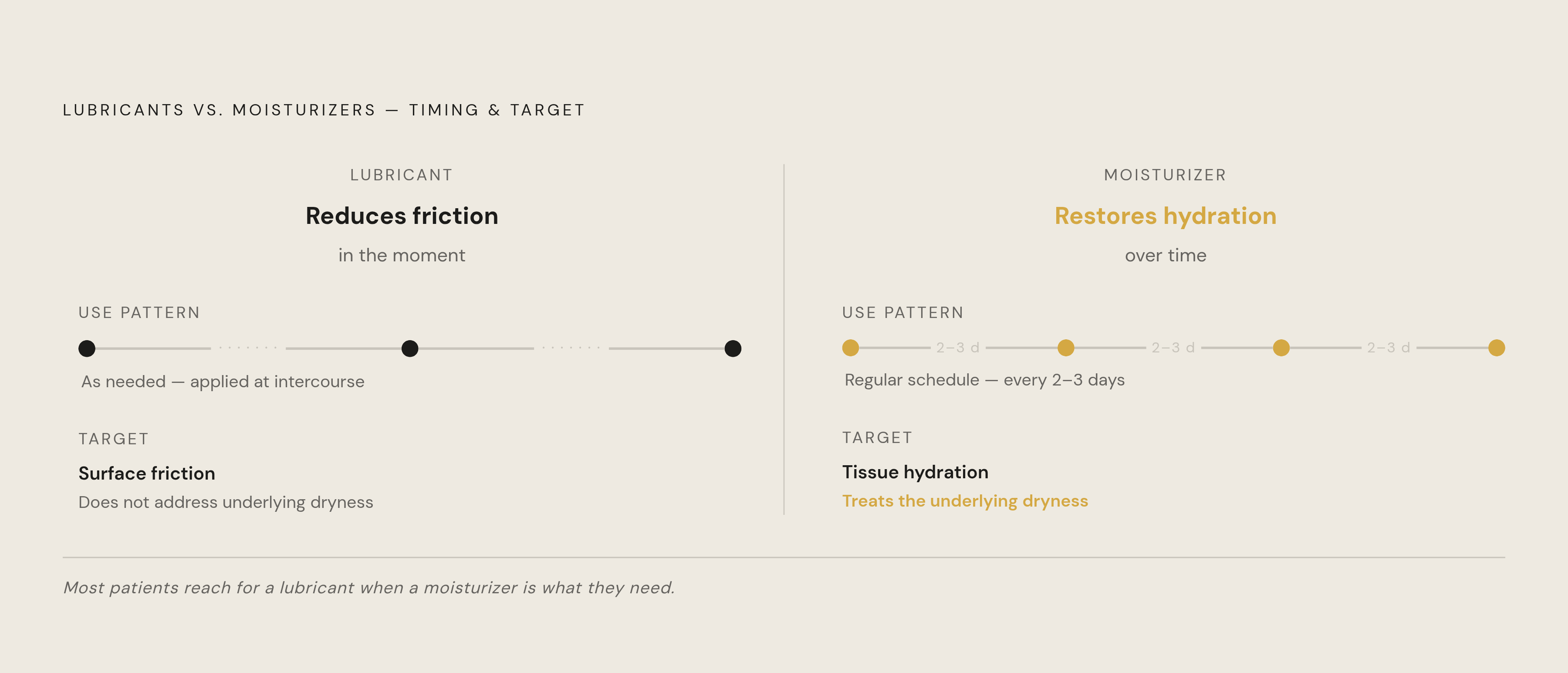
Given how many causes lead to the same tissue outcome, the logical next question is what to do about it. Clinical guidelines answer that question with more confidence than most patients expect: OTC moisturizers and lubricants are the starting treatment for vaginal dryness rather than a consolation prize for people who cannot use estrogen.
The 2025 AUA/SUFU/AUGS guidelines on GSM state this directly, carrying a Moderate Recommendation that clinicians recommend vaginal moisturizers and lubricants, alone or combined with other therapies, to improve vaginal dryness and painful intercourse. The logic behind that recommendation holds up on its own terms: most patients have mild-to-moderate symptoms that respond well to these options, and hormonal therapy introduces systemic exposure the body does not need at that level of severity. For patients where hormones are contraindicated, a breast cancer history, pregnancy, breastfeeding, non-hormonal treatment is required.
Two categories do different jobs here, and knowing which is which changes how a product gets used. Lubricants are applied at or just before intercourse to cut down friction in the moment. Moisturizers are used on a regular schedule, every few days, to restore and hold onto tissue hydration over time, addressing the dryness itself. Cleveland Clinic names Replens, Luvena, and KY Liquibeads as examples of moisturizers on the market, and recommends water-based lubricants as the most broadly suitable lubricant type. One detail matters beyond comfort: petroleum jelly and mineral oil can degrade latex condoms, which makes ingredient choice a contraceptive safety question as well as a comfort question.
Evidence on Hyaluronic Acid, Polycarbophil, and Emerging Ingredients
Among non-hormonal topical ingredients, hyaluronic acid (HA) carries the strongest evidence base, and that evidence has grown substantially as of 2026. HA works by holding water in the tissue's extracellular matrix, which reduces the sensation of dryness and slightly thickens the mucosa, cutting down friction and discomfort during activity.
A systematic review and meta-analysis by Dahab and colleagues, published in the International Journal of Gynecology & Obstetrics, pooled three placebo-controlled randomized trials. It found significant improvements in vaginal dryness-related quality of life and in female sexual function index scores, the two primary outcomes measured, along with improvement in vaginal health index as a secondary outcome. The review's conclusion was that HA is a safe and effective non-hormonal treatment for vulvovaginal discomfort in postmenopausal women, backed by moderate-quality evidence.
Individual product studies add detail to that broader conclusion. A 2026 prospective multicenter study of MucoGYNE Ovules, led by Ramez Ghadri and published in Gynecological Endocrinology, found clinical improvement in the large majority of participants. Vaginal health index scores rose by a mean of 6.1 points (plus or minus 3.1), a change statistically significant at p < 0.0001, with high adherence to the treatment regimen. A separate 2026 retrospective observational study of Gynexelle Hyalo-Duo, also in Gynecological Endocrinology, found rapid improvement across four measures, vaginal health index, vulvar health index, a symptom severity scale, and vaginal pH, within the first week of use, with no adverse events reported.
The postpartum population, covered earlier as a cause of dryness, has its own trial evidence for HA as a treatment. A randomized trial of Hydeal-D HA vaginal gel in 85 postpartum women (registered as NCT04560283) found that women assigned to the treatment arm saw significantly greater improvement in their Female Sexual Function Index score and a greater drop in vaginal pH, compared to women managed with watchful waiting alone. Across this body of research, randomized trials have consistently shown intravaginal HA increases epithelial thickness, vascularization, and lubrication while cutting down dryness and pain during intercourse.
Polycarbophil-based moisturizers bring a longer track record to the table and fit well alongside hormonal and non-hormonal regimens. Replens, mentioned above as a named moisturizer product, has been studied as an effective complement to vaginal estrogen cream, and it also performs as a standalone option for patients not using estrogen.
A few other ingredients deserve mention, with the evidence framed honestly. A 2021 randomized controlled trial in the Journal of Ethnopharmacology, with 60 participants, found aloe vera vaginal cream could help manage vaginal atrophy effectively. Vaginal vitamin E suppositories and oral sea buckthorn oil both have early, encouraging data, but neither has accumulated anywhere near the depth of trial evidence behind HA or polycarbophil. Promising is not the same as proven, and a reader deciding what to try first should weigh that difference.
One non-hormonal option sits outside the OTC aisle. Laser therapy, marketed as MonaLisa Touch, is a procedural treatment that Cleveland Clinic lists as a way to help vaginal tissue regenerate. It is a prescription-level intervention that calls for a direct conversation with a clinician about risks and benefits, not a product decision to make alone.
Ingredient and product choices that can make OTC options work better or worse
Not every OTC product marketed for vaginal dryness is actually formulated with the tissue in mind, and some common ingredient choices can irritate the very area they're meant to soothe. Knowing what to look for, and what to avoid, turns the evidence from the last section into a workable shopping decision.
Water-based lubricants are the generally recommended starting point. Products with added perfumes, herbal extracts, or artificial colors carry a real risk of irritation and should be approached with some caution. The same logic rules out products never designed for vaginal use in the first place, face lotion, body lotion, petroleum jelly applied internally, since these are not pH-matched to vaginal tissue and some can compromise its natural barrier protection.
Fragranced soaps, sprays, and washes used around the vulva can make dryness worse and disrupt the vaginal microbiome that keeps the area healthy. MedlinePlus names laundry detergent and lotion specifically as external irritants worth eliminating if symptoms persist. Condoms containing nonoxynol-9 (N-9) are a documented cause of vaginal dryness on their own, and patients already dealing with symptoms do well to avoid them.
Two lifestyle factors round out the picture, and both have a physiological basis. Staying well hydrated supports mucosal health throughout the body, vaginal tissue included, and dehydration is a confirmed contributing factor to dryness. Regular sexual stimulation, alone or with a partner, supports blood flow to vaginal tissue and encourages the body's own natural lubrication. Neither replaces a moisturizer or lubricant, but both support the tissue those products are working to protect.
Self-management versus clinician assessment
Most presentations of vaginal dryness respond well to the self-management tools covered so far: the right moisturizer, the right lubricant, avoiding irritants, staying hydrated. But a few symptom patterns need a clinician's eyes before OTC products get the chance to work, because they cannot be ruled out through self-assessment.
Lichen planus and lichen sclerosus are two conditions that can cause dryness and require clinical diagnosis and prescription treatment. No amount of symptom tracking at home substitutes for the exam that distinguishes them from ordinary GSM-related dryness. Vaginal infections, bacterial vaginosis and yeast infections among them, can also produce symptoms that overlap heavily with dryness, and only a swab or an exam can tell the two apart with confidence.
Two signals in particular call for evaluation rather than continued self-treatment: severe vaginal bleeding after sex, and symptoms that do not improve with OTC options after a reasonable trial period. Neither signal should cause alarm on its own. Most cases of vaginal dryness are manageable and not a sign of anything dangerous. But these particular patterns are the ones that benefit from a clinician ruling out something OTC products were never meant to treat. And here is the detail that changes what "seeing a clinician" actually requires: that assessment does not have to mean a waiting room, a referral, or weeks on a calendar.
Asynchronous telehealth and clinical assessment for vaginal dryness
Knowing you should see a clinician and actually doing it are two different things, especially for a symptom many patients find difficult to describe out loud. Cost, scheduling, and plain embarrassment all stand between a patient and an in-person exam, even when the signals above point toward one. Asynchronous telehealth closes a meaningful part of that distance.
Asynchronous care, sometimes called store-and-forward, works differently from a video visit. A patient fills out a detailed health questionnaire and symptom history online, a licensed clinician reviews it on their own schedule, and the clinician responds with a care plan, all without a live appointment ever taking place. For a patient dealing with vaginal dryness and none of the red-flag symptoms described above, this model offers a clinically appropriate first step: a real clinician reviewing real symptom detail, without the friction of booking a visit or sitting in a waiting room.
Access to this model has grown. Asynchronous telehealth for vaginal dryness is now available in every US state, though the rules governing what a clinician can prescribe through it vary by location. Many states allow asynchronous prescribing of non-controlled medications, hormonal therapies included, while some states require a synchronous visit, a live call or video appointment, before asynchronous prescribing is permitted. A patient checking what is available in their state is simply confirming the path their care can take.
The core fact from the start of this piece still holds at the end of it: vaginal dryness has a mechanism, that mechanism has documented treatments, and most people experiencing it have far more options than they realize.