Why Physician Sign-Off After AI Screening Is the Safety Standard That Separates Diagnostic Tools From Prescribing Platforms
Physician review with power to reject AI recommendations is the safety checkpoint that matters.
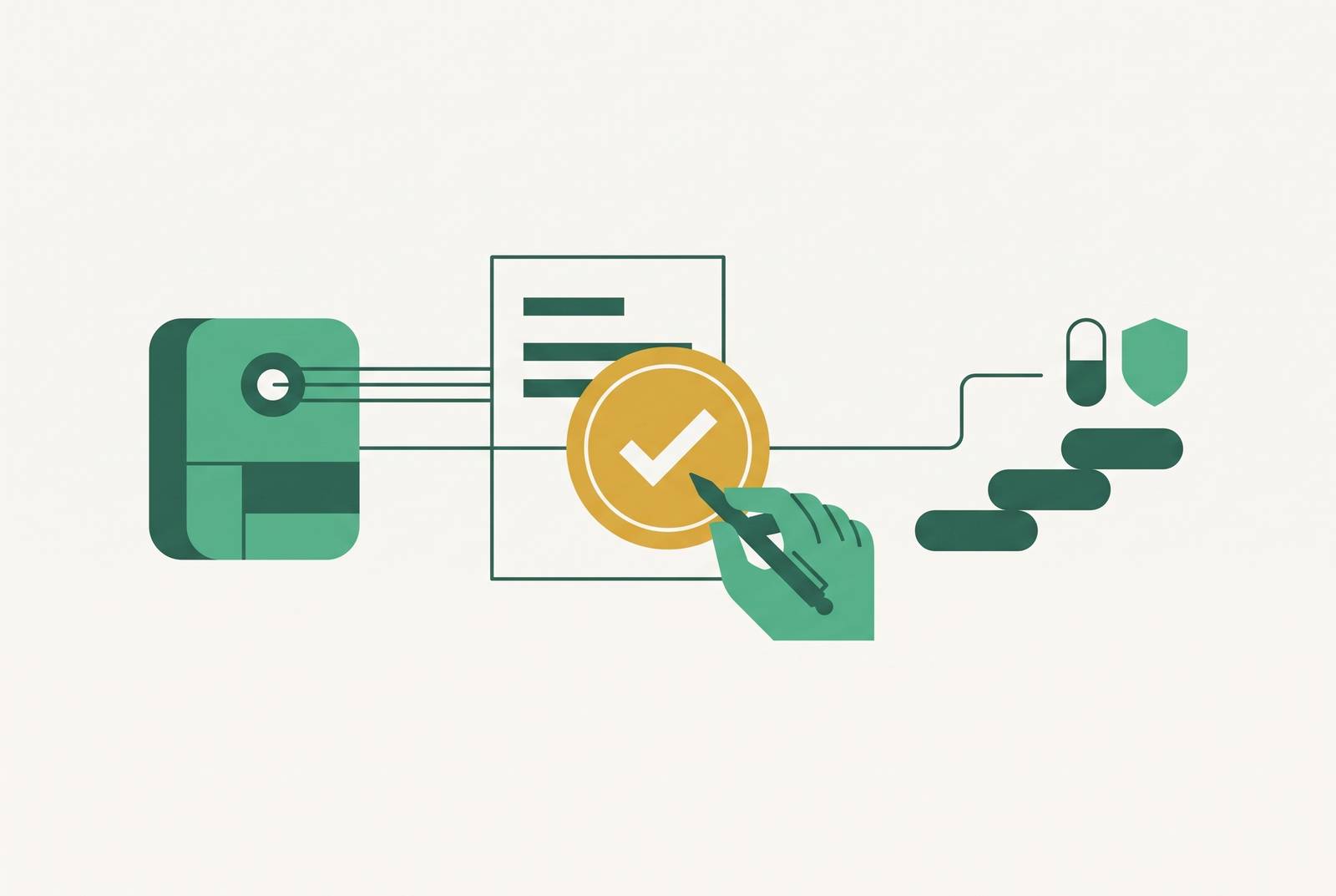
AI-assisted teledermatology with mandatory clinician sign-off means a licensed physician reviews the AI’s findings and approves treatment before any prescription is sent. The safeguard is not simply having a doctor associated with the service, but giving that doctor the authority to change or reject the recommendation. That distinction separates a tool that supports clinical judgment from a platform that exercises prescribing authority itself.
The question patients don't know to ask about AI health tools
A patient uploads a skin photo, answers intake questions, and waits to hear what treatment is recommended. From their side of the screen, the process may look much the same whether software organizes the information for a dermatologist or moves directly toward a prescription. The interface does not reveal who makes the decision. Symptom checkers, intake chatbots, asynchronous care platforms, and automated prescription renewals can all feel like “the app” handling care.
What happens between the upload and the prescription? That is the question that reveals the difference. A fast response says little about whether a physician has independently assessed the patient’s needs. Even a sophisticated preliminary assessment does not show that someone with prescribing authority must check it. The useful distinction is whether clinical action depends on a licensed physician’s judgment or can proceed without it.
What physician sign-off actually does inside a clinical workflow
Physician sign-off means a licensed clinician independently evaluates the AI’s logic, data sources, and recommendation against the individual patient’s circumstances. It is a clinical decision. In asynchronous teledermatology, a dermatologist reviews the AI-structured intake, images, and preliminary assessment before a treatment recommendation is finalized and transmitted to the patient. The physician must be able to change the proposed treatment, reject it, or determine that the available information does not support it.
That authority distinguishes meaningful review from a rubber stamp. A clinician’s name on a platform does not establish that the clinician controls the outcome. Review that comes after treatment has been recommended cannot serve as the same preventive checkpoint. The same holds when the review takes place in a workflow that gives the physician no way to change the recommendation.
A UPMC retrospective teledermatology study found that dermatologists changed or modified treatment in 96.4% of cases. That finding illustrates substantive clinical intervention. Atypical cases may require integrating clinical, anatomopathological, and microbiological data, while structured intake may omit relevant comorbidities. A patient’s contraindications can change which treatment is right for them even when the preliminary diagnosis seems sound.
Why the regulatory line is drawn at the prescribing action, not the AI's accuracy
An accurate recommendation and an authorized prescribing decision are different things. Accuracy describes how well a system performs, while authority determines what it is permitted to do with its output. A tool that helps a clinician assess symptoms has a different role from one that decides on treatment for a patient without a human checking it. That difference becomes especially clear in prescribing, when a recommendation turns into an action that affects care.
The FDA’s 2026 CDS guidance maintains device oversight and enforcement priority where AI outputs guide clinical care without adequate human oversight or validation. Average accuracy does not remove that concern. AI tools that function as medical devices fall under FDA oversight, including tools clinicians depend on to diagnose, treat, prevent, or manage disease. The clinician must be able to independently assess the output.
State rules also address functions and representations. Colorado, Maine, Rhode Island, Tennessee, and Vermont banned or restricted AI therapy chatbots in 2026. California’s AB 489, effective January 1, 2026, bars AI platforms from using titles, icons, or phrases that imply medical licensure, without an exception for platforms claiming human oversight.
Pennsylvania’s State Board of Medicine filed a complaint in May 2026 against Character Technologies Inc., alleging that a chatbot named “Emilie” engaged in unauthorized medical practice. This was the first such enforcement action by a state medical board. The complaint centered on the chatbot’s representations and functions, regardless of the company’s stated intent. That distinction makes the workflow more revealing than a platform’s description of itself.
What happens when prescribing authority moves to the AI before the safety conditions exist
Utah’s prescription-renewal pilot makes the change in authority explicit. The first program of its kind in the U.S. covers 192 drugs and authorizes an autonomous AI agent to process renewals for chronic conditions with little to no human supervision. Its phased rollout requires doctor review of an initial set of renewals per medication category before the AI processes them independently. Pharmacists retain authority to escalate AI-generated renewals to a physician, but no random physician sampling of subsequent interactions is specified.
LaRocco et al. (2026) identify the pilot and H.R. 238, the Healthy Technology Act of 2025, as developments advancing autonomous prescribing ahead of the technical and ethical conditions for safe deployment. That assessment concerns the order of implementation. It asks whether authority is being handed over before the safeguards it needs are in place, without showing that any particular renewal caused harm.
The daGOAT trial offers a revealing contrast. Chen et al. (2025) reported the only published prospective trial of autonomous AI prescribing, in which an algorithm prescribed an immunosuppressant for graft-vs.-host disease using lab data. Yet the design retained a physician veto. Even this advanced example preserved a clinician’s authority to stop the proposed action, limiting what “autonomous” meant in practice.
Separate chatbot litigation shows why escalation design also deserves scrutiny. In January 2026, civil settlements were reached in five lawsuits brought by families alleging that chatbot interactions contributed to teen suicides and severe mental health crises. The filings alleged missing clinical escalation protocols, verified age-gating, and parental notification. These were not trials of dermatology prescribing, and settlements do not establish the allegations as findings. They do place concrete safety design choices at the center of disputes about patient-facing AI.
Why prescribing clinicians themselves reject uncalibrated autonomous prescribing
LaRocco et al. surveyed 136 U.S. prescribing clinicians and found that they would not permit autonomous prescribing without confidence-based escalation. The system needed to abstain or seek human review when its confidence was low. When uncertainty reflected model ignorance, including sparse or biased training data, they preferred abstention. When it reflected genuine clinical ambiguity, they preferred a summary of competing options.
That distinction explains why transparency is more than reassurance. A clinician needs to know whether the model lacks the knowledge the case calls for or whether the case itself allows more than one reasonable reading. Those are different grounds for a decision. The survey found that clinicians were willing to accept personal liability only when the AI’s inferential logic was transparent enough for them to decide under acknowledged uncertainty. Otherwise, they assigned responsibility to the AI company, health system, or regulatory body.
Responsibility followed the ability to exercise judgment. When an autonomous system does not escalate and its reasoning is inaccessible, clinicians do not regard themselves as meaningfully controlling its decisions. The study states that satisfying the minimum safety conditions “collapses much of what 'autonomy' conventionally means.”
The American Medical Association’s guidelines likewise say AI should augment clinical judgment. They connect physician responsibility to judgment physicians can meaningfully exercise. Under that model, sign-off is part of how clinical authority and accountability stay connected.
The strongest case for removing the physician checkpoint, and why it doesn't resolve the problem
The strongest objection to mandatory review is access. In underserved areas, waiting for a physician can prevent care from reaching someone who needs it. Common inflammatory conditions such as acne, eczema, rosacea, and contact dermatitis also seem well suited to AI-assisted telehealth because they can largely be assessed by sight and have well-established treatment protocols. Asynchronous teledermatology reduces time to diagnosis and is associated with high patient satisfaction. The appeal is not merely a faster transaction.
Some researchers and expert panelists acknowledge that oversight for narrow, well-defined clinical tasks could be calibrated to risk. But a case for proportionate supervision is not evidence that AI-only prescribing is safe and effective. Many panelists think it is too soon for that policy, and some worry about misuse and de facto self-prescribing. What protection remains when review disappears is unresolved.
AI diagnostic accuracy varies between lighter and darker skin types, so people facing access barriers may also be among those receiving less accurate assessments without a physician backstop. Treatment introduces a separate source of risk. Spironolactone, used off-label for hormonal acne, requires physician-verified contraception status because of its contraindications during pregnancy. Recognizing acne does not settle whether that medication is appropriate for a particular patient.
Removing review can reduce one source of delay while transferring unresolved risk to the patient. The difficulty of obtaining care remains urgent. It means that faster availability alone cannot establish that an autonomous service has solved it safely.
How can patients tell whether a doctor reviews AI findings before a prescription is sent?
An informed patient asks who must approve treatment before it reaches them. Is there a named, licensed clinician reviewing the assessment, and is that review mandatory? The next question concerns control. Can that clinician change or reject the AI’s recommendation, or can the workflow proceed around the decision? Together, those answers reveal more than a general promise of “physician oversight.”
If prescribing can proceed without review, the service has prioritized completing that transaction over requiring independent clinical judgment. This distinction concerns the service’s design. A physician who is available on request offers less protection than one who must approve treatment before anyone acts on it. A review that comes later also offers less protection for the original decision.
An informed patient also asks what the AI cannot assess. Does the platform explain the limits of visual-only assessment and identify conditions requiring in-person evaluation? Does its language distinguish the software from the licensed professional, rather than implying that the AI itself has medical credentials? California’s restriction on implied licensure addresses that latter distinction directly.
Privacy protection addresses a separate concern. The proposed 2026 HIPAA Security Rule updates include mandatory multi-factor authentication, encryption at rest and in transit, and annual audits, but are not finalized, with a final rule targeted for July 2027. The changes to federal privacy mandates on February 16, 2026 cover Part 2 SUD records and updates to Notices of Privacy Practices. These protections concern how information is handled. They do not establish who decides whether a prescription is clinically appropriate.
Why the human-AI team is the model that evidence actually supports
AI-assisted dermatologists achieve meaningfully higher diagnostic accuracy than dermatologists working without AI support. The benefit comes from combining different strengths. AI contributes pattern recognition, while the clinician interprets those patterns against the patient’s history, circumstances, and atypical features.
The FDA guidance makes room for that relationship. It describes AI providing a single, clinically appropriate recommendation that a clinician can independently review, verify, and act on. Explainability and oversight are built into the model. A platform can therefore use AI to organize intake, find patterns, and narrow down clinical questions while a licensed physician decides what to prescribe.
Mandatory sign-off does not prevent AI from improving care. For a patient comparing AI-assisted teledermatology services, the decisive safeguard is whether treatment must pass through that judgment before a prescription is sent. Faster care becomes trustworthy when the workflow preserves the authority to say that the proposed treatment is wrong for this patient.
Sources
- From Promise to Practice: Harnessing AI’s Power to Transform Medicine
- National Legal Regulatory Analysis: 2026 Artificial Intelligence, Privacy, and Clinical Governance for Medical Practices
- The Clinician's Veto: Navigating Trust, Liability, and Uncertainty in Autonomous AI Prescribing
- Medical Hallucinations in Foundation Models and Their Impact on Healthcare
- Diagnostic performance of artificial intelligence for dermatological conditions: a systematic review focused on low- and middle-income countries to address resource constraints and improve access to specialist care - PMC