How the Size and Source of a Dermatology AI's Training Set Affects Your Diagnosis Options
Darker skin tones get lower accuracy from dermatology AI tools.
AI-assisted teledermatology with mandatory clinician sign-off puts a licensed clinician between an AI finding and the assessment or treatment a patient receives. That safeguard is important, but it does not establish that the AI performs equally well across skin tones. A dermatology AI’s diagnostic reach depends on the size and, especially, the source of its training set, so patients need evidence about both the images behind the tool and the clinician reviewing its findings.
Why a dermatology AI's training data determines what it can and cannot see
A confident-seeming skin assessment can feel like a clear answer, especially when a patient has been waiting to understand a rash or changing spot. Yet confidence is not evidence of familiarity. The tool may have learned from many images without seeing enough examples of that condition on skin like the patient’s.
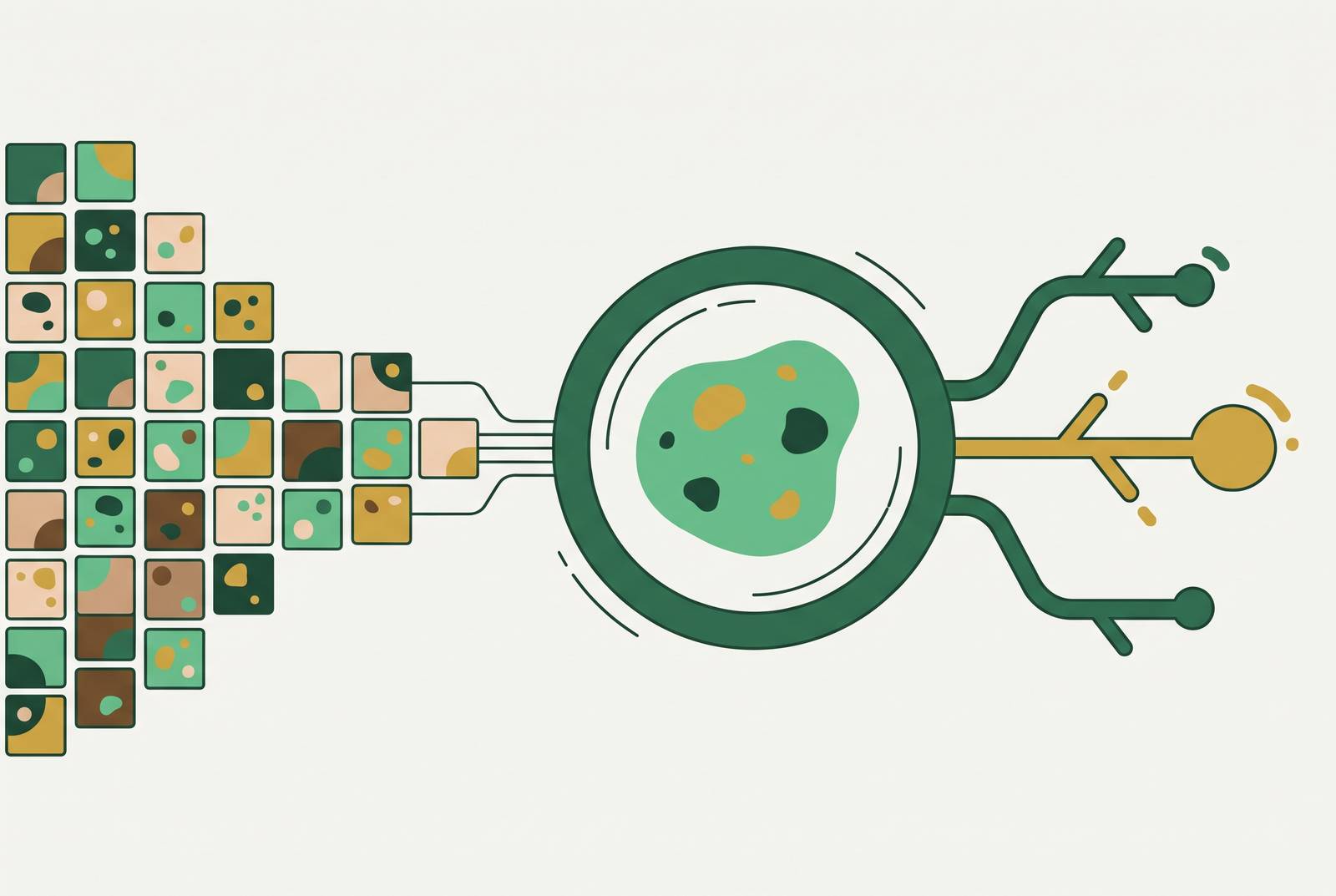
Dermatology AI learns through pattern recognition, using thousands of labeled images to learn what a condition looks like and then applying those patterns to new images. The labels connect an appearance to a diagnosis. But the same condition does not always look the same across skin tones. Erythema, for example, may shift in appearance from red to purple on darker skin. A model that was never taught to recognize that presentation may not identify it reliably.
Changing the model without changing what it learns from leaves the underlying blind spot in place. More images can help only if they supply relevant examples that are underrepresented. As a result, two patients with identical conditions can receive different AI assessments because of their skin tone even with photographs of equal quality.
How skewed the benchmark datasets actually are
Fitzpatrick17k, the most widely used benchmark for training and evaluating fairness in dermatology AI, contains more than three times as many light skin-toned samples as dark ones. The Lesion Image Database is another source that is often used, but only a small share of its images show Black or African American skin. These are not obscure collections at the edges of the field, but sources used to teach and test tools.
Google’s DermAssist illustrates how that imbalance can extend into an industry example. Its foundational dataset included a negligible share of Fitzpatrick type V images and an even smaller fraction of type VI images. Skin tone is also only one dimension of coverage. Training datasets typically concentrate on psoriasis, eczema, and melanoma, while rarer inflammatory conditions, appendageal disorders, and fungal infections remain largely untaught. A large collection can still have substantial gaps.
A 2023 scoping review found that only a small fraction of dermatology AI studies reported skin tone data, and fewer detailed patient ethnicity. Most FDA-approved AI dermatology tools publish little about their dataset demographics. Even when researchers report Fitzpatrick types, the scale may not capture the full range of human skin diversity with enough precision. Patients therefore face two separate uncertainties, namely who appears in the data and how well the categories describe them.
What the accuracy gap looks like in practice, condition by condition
Kadam et al. (2025) evaluated widely cited models using the Diverse Dermatology Images (DDI) dataset and found substantially lower AUC scores for darker skin tones across DeepDerm, ModelDerm, and the HAM10000-trained model. AUC measures how well a model distinguishes between diagnostic groups across different decision thresholds. Stanford’s DeepDerm also showed nearly a three-fold disparity in sensitivity between lighter and darker skin tones in a DDI evaluation. Sensitivity concerns how often a tool detects the condition when it is present. These documented test results are specific to the evaluations described.
GPT-4 likewise provided correct diagnoses more often for lighter skin images than darker ones, with accuracy declining measurably at each step up the Fitzpatrick scale. ChatGPT-4o showed significantly lower sensitivity, specificity, and accuracy for melanoma in people with darker skin. That means the differences were not confined to one measure of performance. The risks are especially serious with melanoma because finding it late can affect what happens next.
Nijjer et al. (2025) examined SkinGPT-4 across common skin diseases, including eczema, allergic-contact dermatitis, and psoriasis. The study found clear differences in demographic parity between the groups with the lightest and darkest skin tones across several measures of how well the tool worked. It also recorded hallucinations involving fabricated anatomical or artifact details. Those invented details introduce a separate concern from uneven recognition, because a diagnostic explanation can include features that are not actually present.
The five-year melanoma survival rate in the United States has been substantially lower for Black patients than for non-Hispanic White patients, and delayed or missed diagnosis deepens that disparity. Human review is necessary, but not automatically corrective. Matthew Groh of Northwestern University’s Kellogg School of Management found that both dermatologists and primary care physicians were less accurate with darker skin images than lighter ones. An AI trained on biased data can therefore reinforce an existing clinical imbalance rather than offset it when a clinician reviews the output.
Why synthetic data augmentation hasn't solved the diversity problem yet
Could developers simply generate more images of darker skin? In theory, synthetic images could help fill in the missing examples. In practice, the evidence shows that generating an image and generating a useful teaching example are different tasks. A 2024 experimental study tested four generative AI models and found that the vast majority of the images they made showed light skin. Dark skin made up only a small fraction.
The study also exposed a diagnostic problem. Two blinded dermatology residents rated only 15% of the generated images as diagnostically accurate. Adding such images could make a dataset larger while linking how a condition looks to the wrong diagnosis. Adobe Firefly was the sole model in the study to produce a skin-tone distribution closer to U.S. census demographics. That exception shows that the distribution can be changed through design.
Existing images need scrutiny too. Fitzpatrick17k has a great deal of disease label noise, and its samples are not biopsied, so adding more images labeled just by looking at them may add to the errors in diagnosis. Stanford’s SkinCon project offers one response by densely re-annotating existing datasets with 48 clinical concepts labeled by dermatologists. That work allows more rigorous analysis of errors, but it is labor-intensive and limited in scale to a subset of images. Synthetic augmentation has not removed the need to control both skin-tone distribution and label quality at the point where data enters training.
What a more representative dataset actually does to model performance
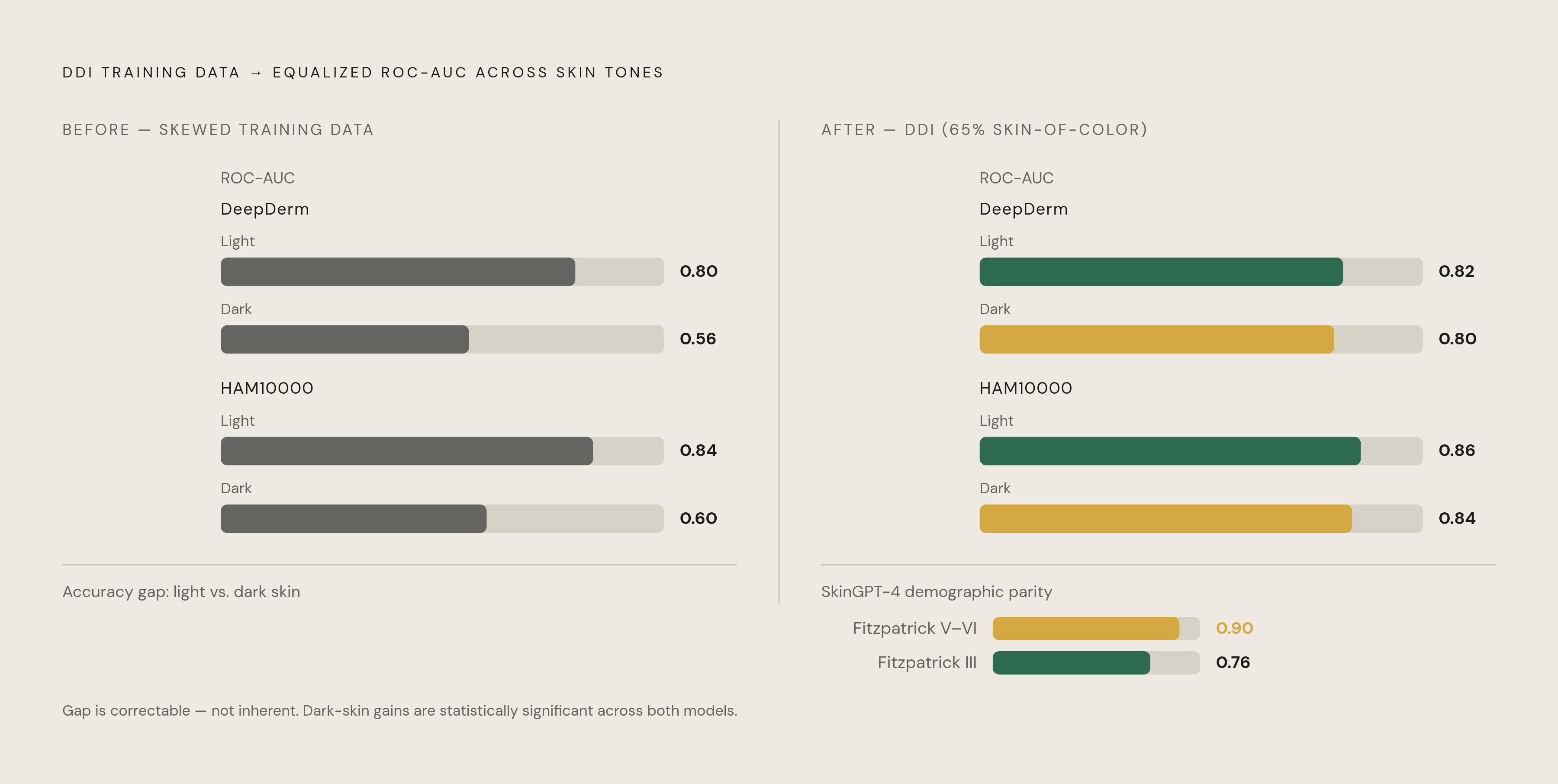
Kadam et al. (2025) found that incorporating DDI into training significantly improved diagnostic accuracy and nearly equalized ROC-AUC values between light and dark skin tones. The dataset comprises 65% skin-of-color images. The gains met the threshold for statistical significance for both DeepDerm and HAM10000. Changing the examples available to the models changed how well they performed across skin tones.
The FEDD framework provides another useful comparison. Trained on small, skin-tone-balanced DDI subsets, it achieved malignancy classification accuracy substantially higher than the prior state of the art on the same dataset. A smaller, deliberately balanced set can supply information that a larger, skewed one lacks, showing why size cannot substitute for coverage.
Nijjer et al. (2025) also improved fairness by fine-tuning models built on the SkinGPT-4 backbone with weighted loss functions that targeted skin-tone disparities. The models achieved substantially improved demographic parity scores across all six Fitzpatrick types. Scores were 0.90 for the darkest tones, Fitzpatrick V–VI, while the score for Fitzpatrick III was lower at 0.76. The scores still differed, so gains should still be checked for each group.
The correction has a straightforward basis. Exposure to a wider range of how conditions appear gives a model a more complete visual vocabulary. These results demonstrate that the gap is correctable. The obstacle is institutional and economic. Collecting, labeling, and verifying diverse clinical images requires deliberate investment that is not standard practice in dataset curation.
How the regulatory environment around dermatology AI leaves patients with limited information
FDA approval or regulatory clearance does not establish that a dermatology AI was trained on diverse data or performs equitably across skin tones. FDA governs AI device safety, CMS controls reimbursement, and HHS sets national standards. Under these frameworks, dermatology AI tools do not currently have to share dataset demographics or publish how well they work for each skin tone. Patients cannot infer that information from a regulatory label.
On January 6, 2026, the FDA announced changes to its guidance that loosened oversight for some AI-enabled digital health products. The change particularly concerned clinical decision support software positioned to assist clinicians, with clinicians retaining the decision-making role. That distinction can ease market entry without adding transparency requirements. A clinician’s place in the workflow and the evidence behind the AI thus remain separate issues. The presence of one does not disclose the other.
Skin Analytics’ DERM system received CE certification for Class III medical devices, the EU’s highest-risk device tier, in February 2025. The British skin cancer detection tool illustrates that regulatory certification is achievable, but certification does not itself answer questions about dataset composition. This leaves patients with limited information at the point of choosing care.
What to ask before relying on any AI-assisted skin assessment
For patients choosing AI-assisted teledermatology, the lesson is to ask about evidence and accountability separately. Does the tool publish how well it works for each Fitzpatrick skin type? If it does not, the research gives reason for caution, though missing data cannot establish the exact size of a particular tool’s gap. What conditions was it trained to assess? A model optimized for melanoma detection may have little meaningful training for rarer inflammatory or fungal conditions that also bring patients to dermatology.
For someone seeking mandatory clinician sign-off, the central question is whether a licensed clinician reviews AI findings before an assessment is returned or any prescription is sent. That should be a documented, accountable step. “AI-assisted” by itself does not establish the requirement. Research on cognitive offloading suggests that a careful review is especially important when an AI output seems confident. The clinician’s role is to validate the patterns the AI surfaces.
The type of appointment also needs to fit the problem. Asynchronous teledermatology involves uploading clear, well-lit photos and a written symptom description for clinician review within 24 to 48 hours. Evidence supports this approach for common conditions including acne, rosacea, eczema, and psoriasis. It is not a substitute for in-person evaluation of suspicious lesions or complex chronic presentations.
No named-platform evidence here establishes which service requires physician approval before every prescription, so it does not support a vendor ranking. The useful comparison is instead whether a service can explain its training coverage, show skin-tone-specific performance, and document clinician review. A platform combining AI triage with licensed review provides a safeguard, but it does not erase the biases documented in either models or clinicians. Skin health is medical health, and the standard should be the evidence and oversight expected of any clinical tool. If a service cannot answer basic questions about its data or review process, that absence is itself useful information.
Sources
- SkinCon: A skin disease dataset densely annotated by domain experts for fine-grained model debugging and analysis
- FEDD -- Fair, Efficient, and Diverse Diffusion-based Lesion Segmentation and Malignancy Classification
- LB1196 Evaluating the diagnostic accuracy of AI models in dermatology: Addressing skin tone bias to improve outcomes for ethnic skin types - Journal of Investigative Dermatology
- Adapting Large Language Models to Mitigate Skin Tone Biases in Clinical Dermatology Tasks: A Mixed-Methods Study
- Exploring the Diagnostic Capability of Artificial Intelligence in Dermatology for Darker Skin Tones: A Narrative Review
- Mitigating Individual Skin Tone Bias in Skin Lesion Classification through Distribution-Aware Reweighting